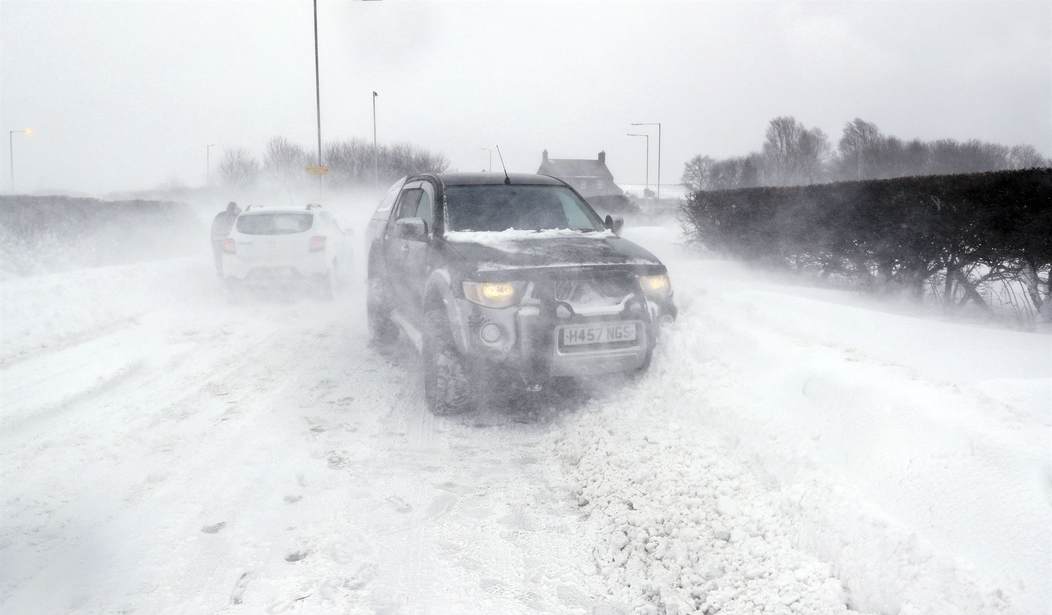

There's good reason the weather is of concern to people, especially when it's projected to be cold. A quick look at humans compared to critters who live in the far north indicates very clearly that we're not cold-adapted critters; we rely on our technology and our wits to stay warm. Without that, well, we have no thick, multi-layered pelts, no layers of blubber (well, most of us don't), and no other typical cold-weather adaptations you see in critters like caribou, muskoxen, and polar bears. We are a warm-weather species, and biologically will remain so. In fact, right here in Alaska, you can see people who are, to some degree, more cold-adapted than most of us: The various tribes of the Inuit, who tend to be shorter, stockier, and shorter in arms and legs. These are cold adaptations, but most of us aren't so fortunate in cold climates, and even the Inuit survive in their Arctic homes because of fire and warm clothing. Clothing doesn't get any warmer than winter caribou or seal furs, and these folks are well-versed in taking advantage of that. That's how human brains work.
So, hot weather isn't the problem for humans that cold weather is, and the numbers prove that out. Climate scolds, though, are fond of spreading panic over heat waves, even though the cost in human injury and human lives is higher from cold than heat. A new report from the UK, a notoriously damp, chilly place, proves that out. Paul Homewood, writing at his climate blog Not A Lot Of People Know That, brings the numbers.
It was only two weeks ago that I wrote about the official cover up of excess deaths in winter. It did not take long for my suspicions to be confirmed.
Last week the Telegraph reported:
Three times more people die during cold snaps than when the weather is very hot, official data show.
Figures from the Office for National Statistics (ONS) show that from 1988 to 2025, about 42,000 people died on the hottest days. On the coldest days almost 150,000 died, in the same period.
However, data suggest the difference between the numbers of deaths because of cold and heat is shrinking.
Note that the time period is 37 years.
The number of heat-related deaths itself is absurdly meaningless – 42,000 sounds a lot, but over 38 years it is barely a thousand a year. Compared to annual deaths of over 600,000, that is microscopically tiny. These deaths are supposedly excess deaths over and above what might have been expected.
But the numbers are not even calculated from actual data, which should be a simple enough task; instead, they are “modelled estimates”, as the ONS describe:.
“We used a statistical model to estimate the relationship between temperature and mortality, while accounting for other factors that may influence mortality risk, for example, air pollution.”
Clearly the Government’s Net Zero agenda is badly compromised by the fact that excess deaths in winter number in the tens of thousands every year; by contrast, deaths in summer are always the lowest of any season. Last year was no exception:
Here's the chart:
— Ward Clark (@TheGreatLander) September 10, 2026
The numbers here in the United States are a little more scattered, which is hardly surprising, since we are a much larger country with a much wider range of environments than the UK; while here in Alaska, deaths from heat are essentially zero, and cold is a very real concern, people in Arizona face just the opposite issue. But even so, human injury and death from cold weather still outstrip injury and death from heat. In 2022, the last year for which solid numbers have been compiled, the number of heat-related deaths was between 1,719 and 1,722, while cold-related deaths were around 3,500 to 3,571, depending on how you crunch the numbers; mind you, 2022 was a year with a number of severe winter storms and the notorious Arctic Vortex in play, dropping temperatures across much of the continental United States into ranges that we take for granted here in Alaska, but for which a lot of people simply weren't prepared.
Facts are stubborn things. And the facts remain that humans handle hot weather better than cold weather. That's how we are built; we have been and remain the product of a part of the world known for a warm, dry climate. And yet, the climate scolds are still using the threat of warm weather to push for sweeping changes in how we live, how we conduct business; everything, in fact.
The climate in the Northern Hemisphere is indeed warming, gradually. That's what happens when the climate is recovering from a major glaciation, as ours has been for about 11,000 years. That's not bad for humans, although it's making people in places like Phoenix less comfortable. In fact, some warming may be good for Britain, as it was in the Roman Warm Period, 250 BC to 400 AD, when people could and did grow wine grapes in Britain, something one can't really do today outside a greenhouse. And I can tell you this, even the most hardened Alaskan sometimes looks at the outside temps in January and silently wishes for a little climate change for the warmer.
But this isn't where we should surrender our modern, high-tech lifestyles. If our climate is warming, then it's technology that will make us more, not less, comfortable.
And, as for the scolds in Europe who are complaining about the hot weather, they may want to consider a piece of late-19th-century technology that's in wide use here in the United States: Air conditioning.