
Life is amazingly resilient. So are the ecosystems that life makes up. And, yes, even in the face of changing climate conditions, as the old saying goes, life finds a way. If it wasn't able to do this, there probably wouldn't be any life on Earth today, given some of the catastrophic events in the past - asteroid strikes, massive volcanism, and so forth.
Right now, the global climate is, yes, warming somewhat. That's not, or at least, it shouldn't be, a subject of great concern. Yes, it's leading to some warmer summers, which can cause problems in places that haven't adopted a basic 20th-century technology called "air conditioning." And, yes, it's natural; some dips and spikes notwithstanding, the planet has been warming gradually since the end of the last major glaciation. Throughout the Earth's history, it's mostly been warmer than it is now; sometimes, much warmer.
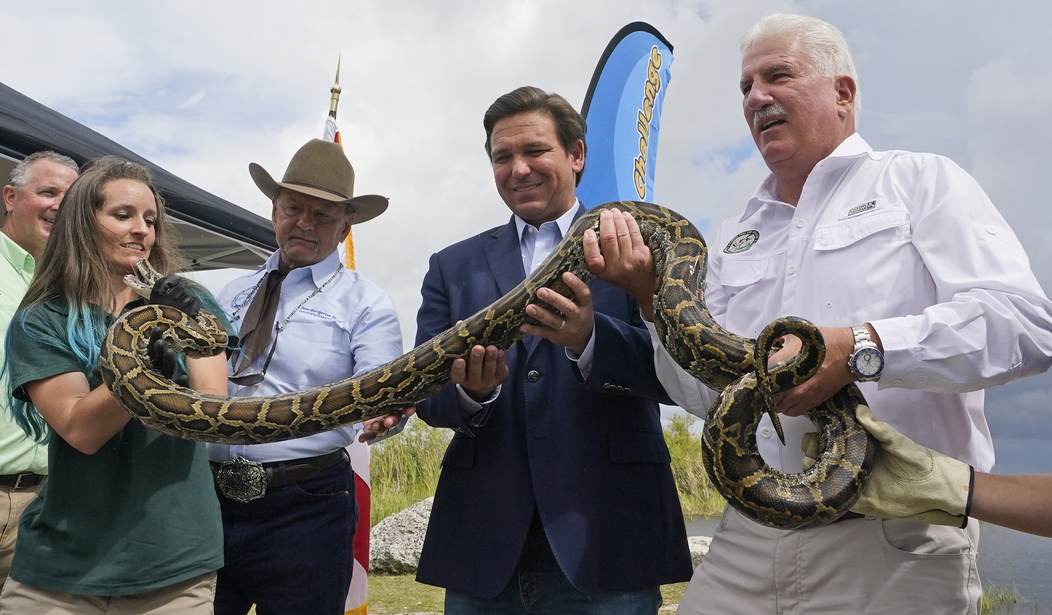
Life just presses on. And not just through climate issues, but through all kinds of things. Now, in Florida, wildlife in places like the Everglades are dealing with an invasive apex predator, Burmese pythons. But these big snakes aren't the only predators around, and as any biologist would expect, in Florida, life finds a way.
Irresponsible “exotic pet” traders brought Burmese pythons to Florida in the 1970s. Irresponsible “pet” owners “introduced” them into the state’s hospitable wetlands environment not long after, when they discovered how “challenging” it was to care for critters that grew from 20 inches at birth to six feet or more two years later – and might happily consume dogs, cats and even children. True apex predators.
The largest python ever recorded in Florida was 19 feet long; the heaviest, 215 pounds. Goats, pigs, deer and anything smaller are all at risk. The gigantic snakes have even eaten alligators.
With females laying 12-100 eggs each year, the invasive “nuisance” quickly became a crisis across the Big Cypress Swamp, Everglades National Park and beyond.
Bobcat, deer, opossum, racoon, rabbit and fox populations plummeted by 87-99 percent. Birds provided handy snacks. Localized extinction loomed.
The first apex predator to respond was humans. That's not a surprise; when this first surfaced, many of us said, "Put a bounty on pythons, put the word out that they are good to eat, and the local rednecks will clean them out."
But humans aren't the only predators in Florida. And those others are increasingly turning the tables on pythons.
Alligators are the other apex predators in Florida's wetlands. Not only is a mature adult a tough nut for even a big python to crack, but alligators have now learned to ambush pythons on dry land, in dry times when the snakes are looking for water. Florida panthers, that state's version of the mountain lion have learned to bite through a big snake's spine, paralyzing it and converting it into several meals. That's not surprising if you know that these big cats normally kill prey by biting at the base of the skull, and they are perfectly capable of making kills on big critters; I've seen sites in Colorado where a 400+ pound cow elk was killed by a mountain lion, a big example of which may be 180 pounds.
Coyotes are one of the most adaptable critters of all: Clever, curious, and able to find a meal almost anywhere. They are adopting the panther's technique: One bite at the base of a python's skull kills the big snake. And, of course, you knew raccoons, the one critter maybe even more clever, curious and adaptable than coyotes, are now learning that a nest of python eggs results in several fine meals. River otters have made the same discovery, as have black vultures.
So why does this matter in the climate change debate?
Read More: The Laughable New Notion of Ecocide
FCC Greenlights New Orbiting Mirrors That Could Disrupt Night Skies
Well, here's why, and I'm going to tell you: Because the climate scolds are making a big deal on how the climate will supposedly result in mass extinctions of critters unable to adapt to a change in global temperatures of a couple of degrees.
Nature and climate alarmists thrive on farfetched tales, faulty data, wild theories and GIGO models about greedy people and corporations laying waste to Planet Earth and sending it into a climate death spiral. They show little concern for people whose living standards they throttle back – or who are never permitted to achieve modern living standards and life spans in the first place.
Nor do these self-laudatory, self-serving alarmists show any concern for the habitats and wildlife sacrificed in the name of their fanciful quest for “clean, renewable, sustainable” energy.
If wildlife can adapt and turn the tables on pythons, they can certainly adapt to slight temperature increases. What they may be less able to overcome are habitat losses and rampant devastation inflicted by wind, solar, battery and transmission line installations … and mining the planet to build them.
Florida's wildlife is a great example of just this. They have improvised, adapted, and overcome. And we haven't even discussed how prey species are adapting, but we know they are.
Once again, we see the problems with climate scolds and environmentalist nuts who rarely, if ever, enter the environment, or as we call it hereabouts, "out in the woods." It's not that the rest of us don't care about the environment, mind you; I do, because I live out in it. But the panic-mongers, in raising hooraw about a possible mass extinction, have no idea how bad previous mass extinctions were, and have no idea to what degree many animals, many ecosystems, can self-correct.
Florida has now given us just such an example.