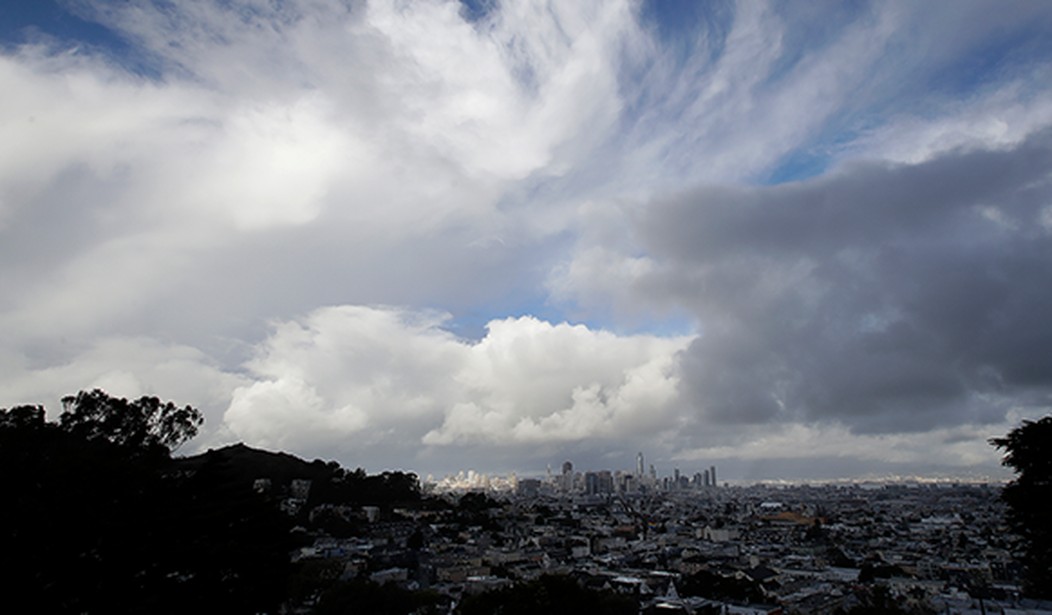

Back in my corporate days, when I was lecturing on cause analysis and the importance of attention to detail and making sure not to overlook the obvious, there was a question I used to pose to my audiences, who were mostly engineers of one sort or another: "How can you suspend 500 pounds of water in mid-air with no visible means of support?" That was something of a poser to engineers who tend to lean into technical solutions. Once in a while, though, someone got the obvious answer: "Make a cloud."
We have a lot of cloudy days in our corner of south-central Alaska. We're all familiar with cloudy days, and we all understand the one thing about them: They tend to be cooler than sunny days. Mankind has known about this, well, forever. Now a new research project has quantified the effect cloud cover has on climate, how it changes the albedo of the atmosphere, and how that change in albedo is likely greater than the greenhouse gas effect from water vapor in the atmosphere.
We still have a lot to learn about the planet's climate and all its influences, but now new research, titled "Earth’s Dimming Mirror: Cloud Contraction and the Rise of Albedo Governance," from European climate researchers Gianni Bellocchi, Vinay Kumar Fredrik Charpentier Ljungqvist and Nazzareno Diodato, originally published in Environmental Research Letters in July, presents one more piece of the puzzle. From the abstract:
Earth has reflected progressively less solar radiation since the start of the satellite era (1979), amplifying the planetary energy imbalance. Satellite analyses attribute the trend primarily to circulation-driven contraction of reflective cloud regimes, whereas process-based studies emphasize changes in surface reflectivity. We argue that these perspectives are dynamically linked: as cloud cover contracts, diminishing atmospheric masking elevates the realized climatic leverage of surface albedo. This coupling makes surface reflectivity an increasingly important and manageable regulator of solar absorption under clearer-sky conditions. We propose an integrated governance framework that explicitly incorporates albedo management alongside carbon management.
That's a lot of scientific language, but it can be boiled down to "increases in cloud cover means that the atmosphere reflects more solar radiation, whereas decreases in cloud cover means more solar radiation makes it to the surface." Anyone who has been for a walk outside when a cloud passes in front of the sun knows this intuitively, but this study looks at a much larger scale.
It's all about albedo, which is the fraction of solar radiation reflected by the planet's atmosphere and the surface.
Read More: Watch Out: Now the Climate Scolds Are Pushing 'Central Control'
How Earth’s Wonderful, Self-Correcting Climate System Defies Alarmism
Over at the No Tricks Zone, author Kenneth Richard had this to say about the new study:
A July 2026 Environmental Research Letters paper authored by Bellocchi et al. attributes ~80% of the rise in Earth’s absorbed solar radiation since 2000 to declining high-reflectivity cloud cover, primarily from circulation-driven contraction of storm-cloud zones.
The study highlights the climate’s “albedo governance,” suggesting a 1% shift in Earth’s albedo corresponds to a 1°C surface temperature change.
With more cloud cover, more solar radiation is reflected and the surface cools. With declining cloud albedo, which has been observed since 1980, less solar radiation is reflected and the surface warms.
Cloud cover changes are driven by natural atmospheric circulation modes and internal variability. This is supported by reconstruction data showing cloud cover decline has for centuries occurred independently from “greenhouse-gas forcing.”
As I've written many times, the global climate has been trending towards warmer temps (and, it seems, clearer skies) for the last 11,000 years or so, since the end of the last major glaciation. Now we see that the albedo provided by cloud cover is yet another of the countless influences on local weather and local climate. Water vapor, of which clouds are made, is in fact a more potent greenhouse gas than carbon dioxide, and of course, water vapor consists only of hydrogen and oxygen; no carbon included.
But now we see evidence that the reduction in albedo has an even greater effect. What's more, the study referenced and linked above points out as well that the systems of cloud cover and albedo are broadly connected and, to a degree, self-resolving.
The contraction of cloud regimes, the long-term decline of Mediterranean cloudiness, and widespread shifts in surface albedo are not isolated phenomena.
Rather, they are interconnected components of a broader transition in the Earth’s energy balance: a rapidly dimming planetary mirror. As skies clear, a larger fraction of incoming shortwave radiation reaches the surface, increasing the climatic influence of land and ocean reflectivity. Rather than representing competing explanations, cloud contraction and surface albedo act as dynamically coupled controls, with changes in cloud cover determining the extent to which surface reflectivity influences the planetary radiation budget.
That's, again, a lot of typically tentative (as science reporting should be) and, frankly, rather prolix language for "the planet's average cloud cover is slowly decreasing, reducing the planet's overall albedo and contributing to warming temperatures."
Now, on to the political aspect: The effect cloud cover and albedo has on climate isn't something you'll ever hear the climate scolds talk about. Why not? Because there is no political gain, no agenda served, in talking about water vapor in the atmosphere. It's not something we can do anything about. Instead, the scolds will continue to cry about our carbon footprints, which is something they can use, something they can blame on humans, something they can use to justify legislating away much of our modern, energy-hungry lifestyles.
We still have a lot to learn about the massive, chaotic systems that drive the Earth's global climate. But learning is key; and it's something the climate scolds, still fixated on CO2, seem incapable of doing.
Editor's Note: This article was edited for clarity post-publication.