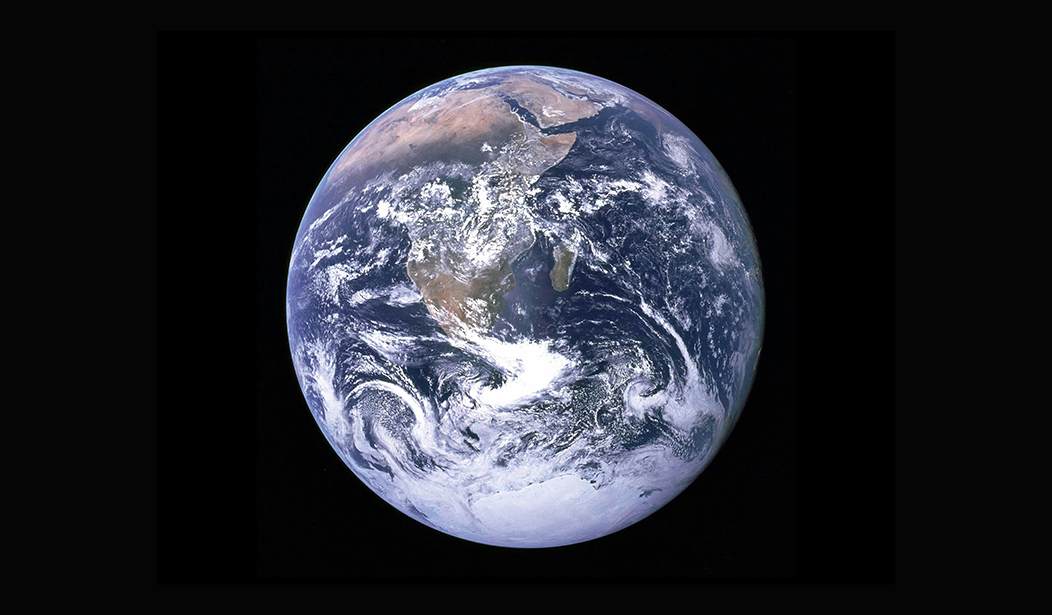

Even after decades of space travel, only a comparative handful of humans have seen Earth from space. A common comment from those folks is one of wonder: How that shining, blue-white pearl hanging in space is home to every human being who has ever lived. From space, set against the vastness of the cosmos, it seems small - an unremarkable planet orbiting an unremarkable star, one of billions in our galaxy, which is one of billions of galaxies in the universe. But it's our home, unique (as far as we know) in bearing not only life but intelligent life - us.
On the human scale, though, our efforts seem likewise remarkably small, tiny even, next to the Earth's overall history, and the vast cycles and rhythms which it harbors, on which its global climate operates. We are trying to learn to understand all that, and we have a long, long way to go. But we do know some things, some recent (on the geological scale) trends, and it's interesting to set them alongside the claims of the people who would have us surrender parts of our modern, technological lifestyles to try to prevent a degree or two of warming over the next few decades.
On that, CFact's Joe Bastardi has some interesting notions.
I got this idea from Bill Gray. Now, do not blame Dr. Gray for it, but he was the one who first got me thinking about this. I was watching a talk he gave, and he explained how all inputs go into such a chaotic pattern that you can’t tell what is dominant and what to believe. So I came up with this idea: The Sun, the oceans, stochastic events, and the system’s very design far outweigh what man can do to it. It involves humbling oneself enough to understand that even if we did things to end life on Earth (I am talking about things like blowing ourselves up), the system would always overcome and adjust to the state it was meant to be in, and then continue on its natural cycle to wherever it was supposed to go. And there would be no more arguing over saving the planet, since the people arguing would not be here (nor would anyone else). The planet would, though, and would adjust based on the parameters it has always adjusted to.
Suppose there are an unknown number of cycles, ranging from multi-seasonal to multi-century, at work here. And suppose that, for a time, there is a crucial intersection of those cycles — or at least that they come close enough to each other — to tip the balance of the climate one way or the other for a time. How could you tell, since those cycles may be like a tidal wave, masked in the ocean until they actually show up approaching land — in this case, the intersection of another large cycle, which may have other smaller cycles also playing a role? Everything (or enough of it) comes together to produce a result, which then will naturally be forced to reverse, but in its own time.
It would explain the variances we have seen in climate through the known geological timescale.
Here, from Mr. Bastardi's article, is a great visual of the effects of those cycles, just since the last major glaciation ended.
— Ward Clark (@TheGreatLander) August 10, 2026
Note the two major spikes, around 8-6,000 years ago, and again around 5-4,000 years ago. These are the Holocene Climate Optimums. Smaller warm spells happened later, during the Roman Climate Optimum and the Medieval Warm Period, and we haven't yet reached the thermal optimums of those times. You can also see the Little Ice Age, which was marked by privation and crop failures. All of these events happened before the Industrial Revolution really got going; before humans were making use of fossil fuels, before air conditioning, before cars, trucks, and aircraft, before natural gas furnaces, before our modern lifestyles.
Read More: How and Why the Left Has Weaponized Climate Science
Are Democrats Now Caught Between a Socialism Rock and a Climate Change Hard Place?
Mr. Bastardi continues:
But until we can explain why this happened before in a precise manner, there is plenty of room for conjecture. They have man-made emissions; I have cyclical intersections (such as the sun, the oceans, stochastic events, and the design of the system, which, due to the way it was created, can never find a balance that it can hit and hold, but must instead move toward greater chaos to a point, then return).
You are in a great forest here, and all you can truly see are the trees. Saying that one tree alone, while excluding all the others that make up the forest, is nonsense. But all the trees together do make it up. And that’s the secret: They are all together. And so, cycles that are known and unknown may be coming together in such a way that they are producing what we see now. When you only focus on what you believe, you are incapable of seeing anything different.
This is where the claims of the climate scolds crash and burn. To expand on Mr. Bastardi's metaphor, the scolds are looking at fragments of bark on a few widely-separated trees, and missing the huge, hemisphere-spanning taiga that lies before them. Even the most dedicated and adventurous woodsman doesn't know what all is in that vast forest, nor what all has transpired in those deep, dark woods in all the millennia they have stood.
The climate scolds and Democrats (but I repeat myself) would have us surrender much of our modern lifestyle to address a slight warming of the climate, which has happened before - look at the chart above - and which will happen again, no matter what we do about it. And, again, there's just no reason. Yes, the global mean temperatures are currently trending upward, just as they have before. Better the people of the developed world focus their attention on what they can do, like outfit European households with the early 20th-century miracle of air conditioning, and building more nuclear reactors for electrical generation. The climate will look after itself. The Earth will look after itself. It always has. It always will.