



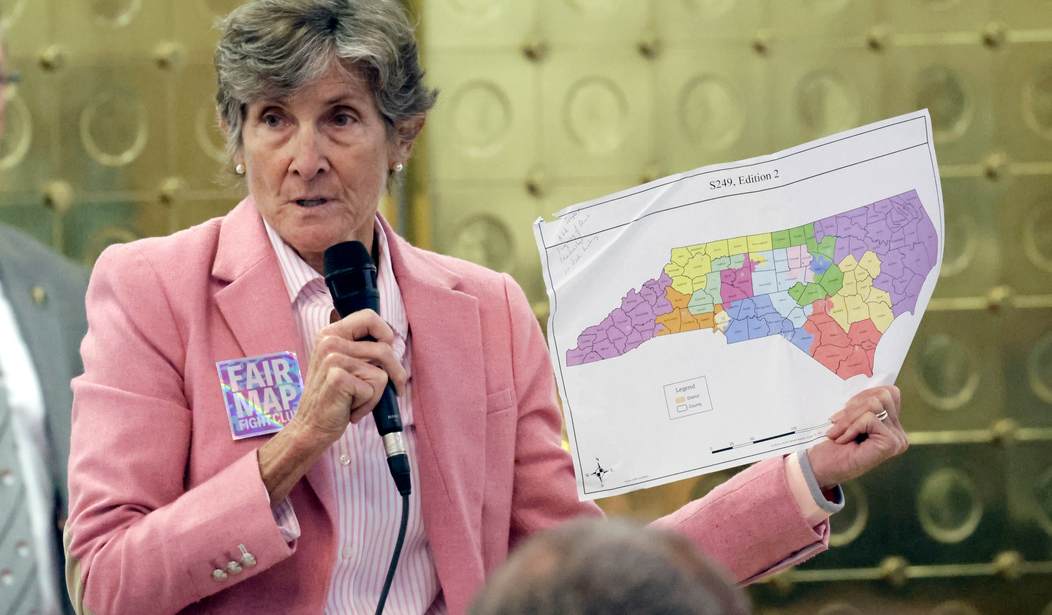
If the current unofficial results in North Carolina hold, we're going to be seeing a reversal in the political makeup of our congressional delegation on the House side in the next Congress.
We went into Election Day with a 10R-4D advantage. Barring any changes that come from recounts that may be done in the closer races (including Rep. Virginia Foxx's race in NC-05, where she's down by just a few hundred votes), we're going to be looking at 11D-3R.
Naturally, we're seeing a lot of crowing on social media from the Usual Suspects about what happened (which also included flipping the state house), and one word that is getting a lot of play amid their celebrations is "dummymander," which, loosely translated, means a gerrymander that has backfired. It used to mean "backfired over time," but in more modern times it just means with the next election cycle - or so I've been reliably informed.
One of the more noteworthy mentions of this term came from Democrat Rep. Deborah Ross (NC-02), who posted this tweet of a Wikipedia entry that was likely done/updated by a leftist of the 2024 before-and-2026 after congressional maps. Incidentally, she called it an "encyclopedia" entry even though Wikipedia is nowhere near close to being encyclopedia-level quality and accuracy:
Congrats to @NCGOP on becoming the encyclopedia example of a dummymander. I hope this will motivate you to spend less time suppressing voters and more time delivering for them! https://t.co/VuFNx3MaYJ
— Congresswoman Deborah Ross (@RepDeborahRoss) November 11, 2026
Not surprisingly, Ross - who herself is in a district gerrymandered for Democrat representation - succeeded in dumbing down the debate with the deliberately deceptive tweet, implying that the map change done in the fall of 2025 (seen in the photo at the top of this piece) caused all those flips in 2026.
This tweet was typical of the hot takes coming from the press side of things:
This is the definition of a DUMMYMANDER -- in North Carolina: "Democrats were virtually assured of controlling a majority of the delegation and came within several thousand votes of sweeping all 14 districts." Unbelievable. https://t.co/RcTqH6ZnnP
— Josh Kraushaar (@JoshKraushaar) November 5, 2026
Here's the problem with these arguments.
Only two districts were redrawn in October 2025: NC-01 and NC-03. The 1st Congressional District, which is represented by Democrat Rep. Don Davis, was considered more competitive and possibly advantageous to redraw for possible Republican benefit in 2026. To redraw it, they shifted some counties around and, in essence, somewhat diluted the 3rd Congressional District, which is represented by GOP Rep. Greg Murphy. There was concern at the time that this could end up hurting Murphy in a wave election cycle, but they took the risk.
It ended up not paying off. Murphy conceded his race on Wednesday, losing by just under 300 votes. Don Davis won reelection, but the numbers show that the map redraw cut into his Democrat vote share by a significant amount. In other words, in a normal midterm wave year, his Republican opponent, Laurie Buckhout, probably would have won and would have flipped the seat in the process:
Gerrymander of #nc1 was incredibly effective in cutting into the Democratic vote share. It only “failed” bc of the 100 year flood electoral environment. 2028 likely won’t look like this . #ncpol https://t.co/JixZS1KADn
— Chris Cooper (@chriscooperwcu) November 6, 2026
Murphy likely would have kept his seat as well had his old district lines been in place and had this been a typical midterm swing and not a tsunami. Even under the newer map, he likely would have won had it not been for the "100-year flood electoral environment" Professor Cooper mentions above.
Bottom line is that, at best, this was a one-district "dummymander" if at all, not a statewide one.
I'm going insane having to keep pointing this out. A MAP CRACKING UNDER A 15 POINT DEFICIT DOES NOT MAKE IT A "DUMMYMANDER"! House gerrymanders are to maximize chances of having the majority in a close election. If you lose by 15 points, you're already not getting the majority!
— Bernard Stanford ✡︎ (@stanfordNYC) November 12, 2026
I think people are getting way ahead of themselves here. How is this dummymander if it takes a D+13 year to break it? Any other cycle in recent history Republicans would win more seats than their popular vote % would suggest.
— Aseemru (@Aseemru) November 11, 2026
And as Prof. Cooper wrote roughly a week before Election Day, it's not really a "dummymander" if it works to the advantage of the party that drew it in election cycles where there are no midterm political tsunamis:
2028 will be a different year and the electoral environment is likely to be better for Republicans and worse for Democrats it is in 2026. Democrats who win unlikely districts in 2026 may therefore face a rude awakening in 2028. If that happens, the districts that looked like poorly designed dummymanders in 2026 may look like strategic and well-drawn gerrymanders in 2028.
Sometimes a failed gerrymander isn't a dummymander; it's just a gerrymander in a bad year.
As I previously noted, since the state house flipped, talk has already turned here to the possibility of an "independent redistricting commission," with the incoming House Speaker-elect Robert Reives (D-Chatham) saying that would be his idea of a "permanent solution" while seeming to operate on the assumption that Republicans will win back many of the seats they lost Tuesday and perhaps could take control of the state house again.
Unofficial election results show Republicans holding on to the NC Senate, where it will be 26R-24D going into the next session, barring anything unforeseen with any possible recounts in the close state senate races.
Absent an outright gerrymander attempt ahead of 2028, which would be likely to fail in part because of a Senate block and in part because it would be hard to justify to voters why you want to redraw maps you won off of, NC Democrats are trying to work now to make it difficult for maps to be redrawn by the party in power come census time in 2030, and their attempted workaround is to push for that commission.
The onus is going to be on Republican state senators to hold the line (with their constituents making their voices known as well) to make sure that doesn't happen, because we know in the end the likelihood of the commission being truly independent would be slim to none.
Last but not least, an inconvenient reminder for Democrats that they are the original kings of actual dummymanders here in North Carolina, which were done when Democrat Roy Cooper, our Senator-elect (who, of course, participated in gerrymandering as a state lawmaker but who opposed them as governor), was serving in the state legislature:
While everyone is throwing around the dummymander label, remember that the chapter that coined the term included a prominent example drawn by NC Democrats--calling it a "textbook dummymander". #ncpol https://t.co/V3t7zazoYj
— Chris Cooper (@chriscooperwcu) November 12, 2026
This is the evolution of NC-12 when Democrats controlled redestricting. It was known as America’s most gerrymandered district, running right down an interstate for the most part. https://t.co/pvIv3mhlZZ
— Oilfield Rando (@Oilfield_Rando) September 23, 2021
Never forget.
Editor's Note: The Democrat Party has been infected by socialism, and it's spreading FAST. Democrats are claiming there's nothing to worry about, but we know the truth.
Help us continue to shine a light on the socialist takeover by joining RedState VIP. Use promo code FIGHT to get 60% off your VIP membership.


Join the Conversation
VIP members get the ability to comment on articles.