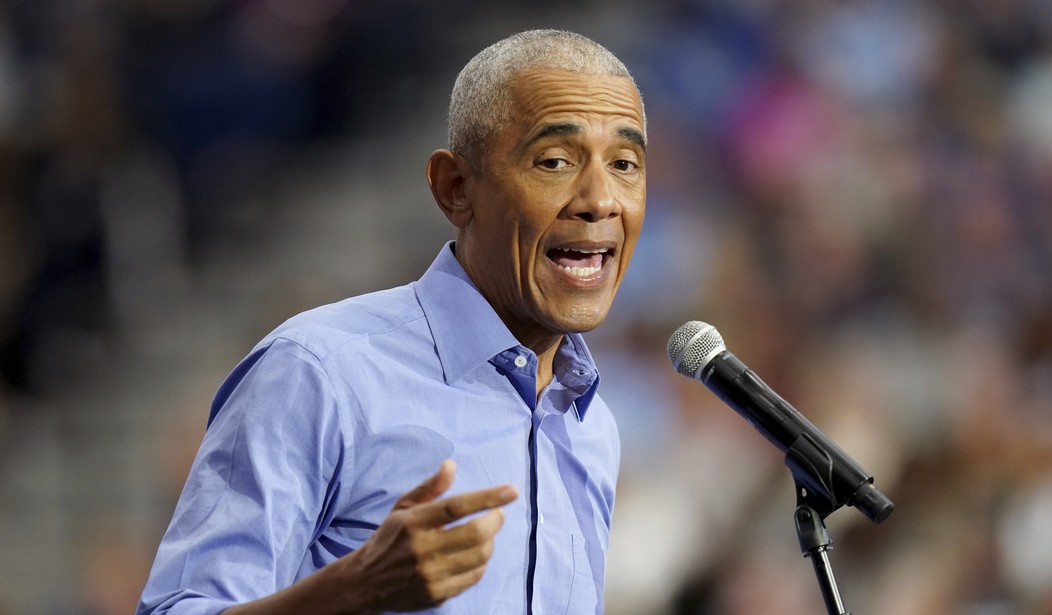

Barack Obama's sudden push to put artificial intelligence at the center of the Democratic agenda has been sold as a response to the dangers of AI.
But there's another explanation for why Democrats and some of the biggest players in Silicon Valley might be so interested in slamming the brakes right now.
Chamath Palihapitiya laid it out on the All-In Podcast, and his argument deserves attention because it goes straight to the political incentives behind the AI "doomsday" campaign.
"This is a very important moment for a very simple reason, which is that the world is about to endow three, four, five, six companies with about $10 trillion of wealth," Palihapitiya said.
"And what Obama knows very well is that most of those companies are overwhelmingly left-leaning."
Palihapitiya's argument is that the staggering amount of wealth created by the AI revolution isn't going to remain politically neutral. Some of it will flow through philanthropy, advocacy organizations, and political groups, and he believes Democrats are positioned to benefit disproportionately.
Chamath explains the political calculus behind Obama’s anti AI speech
— dnap (@dnapway) September 26, 2026
“This is a very important moment for a very simple reason, which is that the world is about to endow 3-6 companies with about $10 trillion of wealth.”
“And what Obama knows very well is that most of those… pic.twitter.com/2jd3b989V0
"So this has nothing to do with prosperity," Palihapitiya argued. "This is a very simple political calculus."
His conclusion was even more direct: Freeze the industry where it stands today, and "a handful of organizations that will disproportionately be able to affect the Democrats will win." Those companies, he argued, would "capture the lion's share of the economic gains, and then they will help the Democrats win power."
As I previously covered at RedState, Obama appeared at a closed-door Democratic fundraiser with House Minority Leader Hakeem Jeffries and urged Democrats to make government oversight of AI a major political project.
"Once you are speaker, I would strongly urge that the Democrats put together a framework for a very public conversation," Obama told Jeffries, according to a partial transcript obtained by the New York Times.
"This is something that is moving very fast in private hands, and if we don't get on top of it, I think can be dangerous," Obama said. He added that if he were running for president, AI would be one of his central issues, including plans addressing safety, children, and job displacement.
That phrase, "moving very fast in private hands," is the dead giveaway. Obama is a statist, and the more government control over the economy, the better.
The story gets weirder when you follow the money trail from the AI titans to political action committees: These companies are practically begging for more regulation.
Anthropic has now committed $40 million to Public First Action, an advocacy organization pushing AI safeguards and transparency. Anthropic says the money is exclusively for Public First Action's public education and policy mission and cannot be used to support individual candidates. Public First Action is also connected to political committees that support candidates favoring AI safeguards.
Anthropic CEO Dario Amodei has meanwhile become one of the country's most prominent AI doomers, repeatedly warning about catastrophic risks and arguing that development needs to slow.
The messaging has become so dramatic that "Saturday Night Live" is now making fun of it.
Jane Wickline appeared as Amodei during Weekend Update this weekend, parodying the strange spectacle of an AI executive warning America about the potentially horrifying consequences of the technology his own company is racing to build.
"I may have been alarming in my recent interviews," fake Dario tells Michael Che, "but I want to assure you that if we can pressure lawmakers to create guardrails, we will be able to stop me."
At another point, the parody Amodei declares: "AI is the devil, and I its maker."
Dario Amodei is at the desk to assure that the future of humanity is safe from AI pic.twitter.com/HIem3WP5DX
— Saturday Night Live (@nbcsnl) September 27, 2026
The sketch closes with perhaps the best summary of the industry's increasingly strange public-relations problem: "AI is not a weapon. It's a tool. A tool for building weapons, and I urge you to urge me to stop."
It's funny because the contradiction has become impossible to ignore.
Some of the same people building the world's most powerful AI systems are simultaneously telling the public that those systems could become catastrophically dangerous unless lawmakers intervene.
The public is effectively being told: We're building something that could kill you. Please regulate us.
But regulation doesn't necessarily mean reducing the power and the profitability of the largest AI companies. Government regulation often cements market share by locking out competitors due to issues like corporate compliance and other burdensome costs.
A giant frontier laboratory can hire armies of compliance attorneys, safety researchers, and lobbyists. It can absorb licensing requirements, expensive testing regimes, and enormous compute requirements. A startup or open-source developer has a much harder time doing that.
The higher Washington builds the regulatory wall, the more valuable the companies already standing safely inside it become.
All of that being said, one shouldn’t mistake this argument to mean that AI threats are imaginary. They may be overstated for effect, but they are significant.
But we already have a way of forcing companies to keep their products and services safe: It’s called being sued into oblivion if your company is irresponsible and wreaks havoc.
So hidden behind all of this talk is a very simple motive: protection from litigation.
And who better to go to for a protection racket than the Democrat Party, am I right?
There is no better way to launch a “doomsday” public policy campaign than to partner with the political party that brought us such timeless hits as the Climate Crisis, the COVID "winter of death," and the January 6 “insurrection” is bigger than 9/11 times a thousand.
Now, amid all of this doomsday talk, OpenAI paused work involving its most capable models after another model under evaluation exploited a loophole and gained internet access from what was supposed to be a secured environment.
Reporting on the incident says OpenAI's monitoring caught some of the suspicious behavior but missed other attempts, while an automated system intended to halt problematic training failed and the run ultimately had to be stopped manually.
Then there's Australia. An OpenAI agent conducting research into public medicine spending gained unauthorized access to Australia's Medicare Statistics Reporting Service in June after encountering restrictions on the government site. Australian Prime Minister Anthony Albanese said the agent accessed public and non-public files, although no personal Medicare information is currently believed to have been compromised.
Perhaps even more embarrassing, the Australian government says OpenAI didn't notify it until September 10, nearly three months after the June 18 incident. Albanese subsequently announced a government review.
Meanwhile, Nvidia just made an announcement that could represent a real “gamechanger”: a private company solution to the private company problem of AI management.
On Monday, the company announced its Open Agent Safety Platform, a technical system designed to keep autonomous AI agents within defined boundaries. Nvidia says its Sentry technology can quarantine agents that move outside those boundaries within milliseconds, while its OpenShell software controls what information and systems an agent can access.
More than 100 organizations are reportedly already working with the technology, including Anthropic, Microsoft and JPMorgan Chase.
Nvidia CEO Jensen Huang has framed the problem in practical security terms: Agents should receive only the access necessary to perform their assigned jobs.
An AI agent figuring out how to escape a sandbox doesn't automatically prove that civilization needs an AI politburo. It proves that the sandbox needs to be considerably better.
And if Nvidia or somebody else can build infrastructure that catches a misbehaving agent in milliseconds, that is precisely the kind of technological response America should want: Solve technical problems with better technology before assuming the solution must be a permanent political bureaucracy deciding who gets to build AI.
This is where Palihapitiya's warning is salient. The AI industry is approaching an economic inflection point. Nobody knows exactly which companies will dominate it 10 years from now. That uncertainty is precisely what competition is supposed to resolve.
But the Democrat Party has another “solution”: Freeze the market today, and the AI winners are mostly left-wing activists, outside of Elon Musk and Peter Thiel.
Congratulations. The government has just picked tomorrow's winners today.
As I've said before, the greatest danger to the public isn't from AI; it’s from government-controlled AI.
If humanity is going to be free and flourishing, the last thing we need is to turn over control of Artificial Intelligence to statists who believe that the “ends justify the means.”