




We're still sorting out all of the implications of the 2026 midterm elections. There's a lot to sort out there, of course, and it won't all happen quickly; much will depend on to what extent congressional and state-level Democrats will listen to the wackadoodle caucus in their own party, and to what extent the remaining moderates, like Sen. John Fetterman (D-PA), are able to keep hold of the reins.
My money's on the wackadoodles, from what we've seen so far. But there's a silver lining there; these are the very same people who are liable to overstep, and that could hurt them in 2028. That, however, is a speculation for another time.
What is interesting is how this election may have made more plausible something the Democrats have been kicking around for years, a workaround to sideline the Constitution's electoral system for choosing the president, colloquially known as the Electoral College. The workaround is called the National Popular Vote Interstate Compact, or NPVIC, and as my colleague Rusty Weiss pointed out earlier, the Democrats now control the legislatures of enough states to make this a possibility. Rusty writes:
Democrats didn’t just pick up a few statehouses following Tuesday's midterm elections — they may have just won the power to sideline the Electoral College by 2028. If they follow through, the next president could be chosen by a nationwide popular vote instead of the system the Constitution very clearly laid out.
Remember when we talked about Elon Musk warning that the 2026 elections could lead to a cataclysmic chain of events that leads to permanent one-party rule down the line? Yeah, this is the kind of thing we were referring to.
Axios is reporting that “sweeping statehouse gains” have “opened a path to effectively replacing the Electoral College with a national popular vote in time for the 2028 presidential election."
This is what all the State Legislatures are looking like. Dems now have the power to pass the National Voter Compact to effectively abolish the Electoral College. https://t.co/cDAIeGqRZS
— Saikat Chakrabarti (@saikatc) November 4, 2026
There are, however, some serious constitutional objections to this.
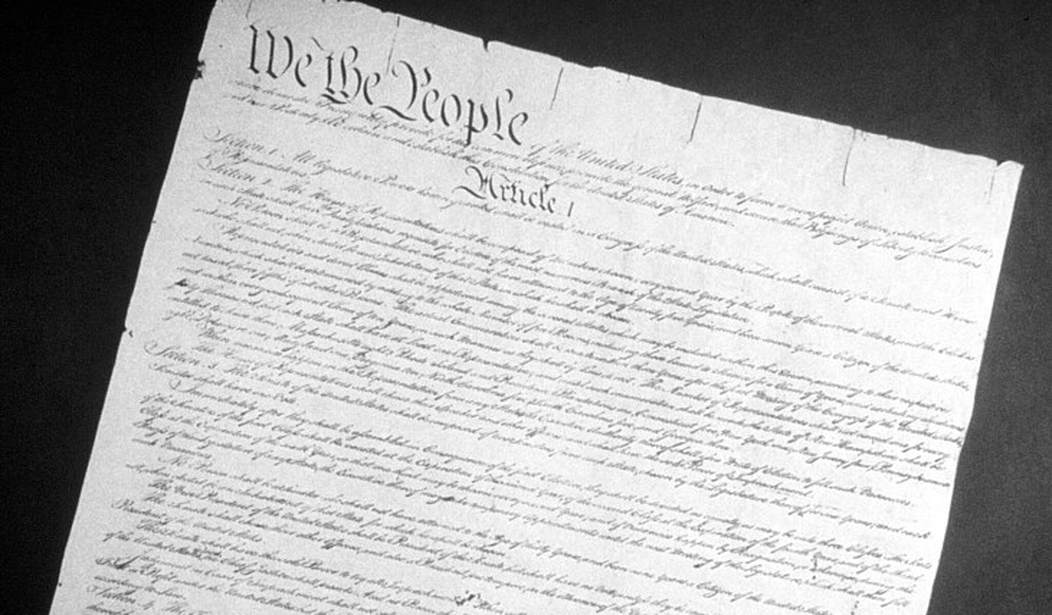
First, this plan is a political compact between states that arguably amounts to a de facto constitutional amendment, bypassing the amendment process. That raises a serious question under the Compact Clause of Article 1, Section 10, which states in its third clause:
No State shall, without the Consent of Congress, lay any Duty of Tonnage, keep Troops, or Ships of War in time of Peace, enter into any Agreement or Compact with another State, or with a foreign Power, or engage in War, unless actually invaded, or in such imminent Danger as will not admit of delay.
Now, supporters of the NPVIC claim that congressional consent for compacts of this type is only necessary when an agreement enhances state power in defiance of the Constitution (which this would seem to do) or encroaches on federal authority. The Constitution does give the states broad powers in the choosing of electors, but the process can't be just negated wholesale. But to a layman, an agreement among states to effectively change how presidential elections are decided would seem to raise precisely the sort of constitutional concerns the Compact Clause was intended to address.
There's also an argument to be made, as I mention above, that this seeks to effectively change the constitutional system for electing the president without going through the Article V amendment process. That raises a separate question about whether the states can accomplish through an interstate agreement what would otherwise require a constitutional amendment. Of course, when the 120th Congress is seated, the Democrats will have control of Congress.
Supporters of the compact, however, point to Article II, which gives state legislatures broad authority to determine how their presidential electors are chosen. They argue that the compact simply exercises that existing authority rather than amending the Constitution. Whether that authority extends to coordinating the selection of electors across enough states to determine the national outcome is a question the courts have yet to resolve.
Another argument may be that even Congress lacks the power to directly approve this measure. Congress, on its own, has no authority to redraw how presidential elections are held, save through the amendment process, and in today's political climate, the chance of any constitutional amendment being ratified is essentially zero.
Article II of the Constitution gives the states a lot of wiggle room in the selection of presidential electors. But the NPVIC has a number of constitutional issues; furthermore, the compact could end up compelling a state's electors to vote in defiance of the wishes of the people in that state, in accordance with a possibly unconstitutional interstate compact. And that, in fact, may be one of the stronger political arguments against this dumb idea.
The Democrats, as Rusty points out, now have the numbers to attempt this. But there are serious constitutional issues to be decided before this could even be implemented; if the requisite number of states do, eventually, sign on to the NPVIC, and attempt to enforce it, it will be challenged immediately, and will without doubt end up with the Supreme Court. And, after that, it's anyone's guess. If the Democrats win the presidency in 2028 and manage to bring in a number of "progressive" justices, or even replace two or more aging constitutionalists (like Justice Thomas) with more in the mold of Justice Jackson, the Democrats may yet get their way on this. But for now, in this, the Democrats would seem to have a long and bitter fight ahead, if they choose to try this.