







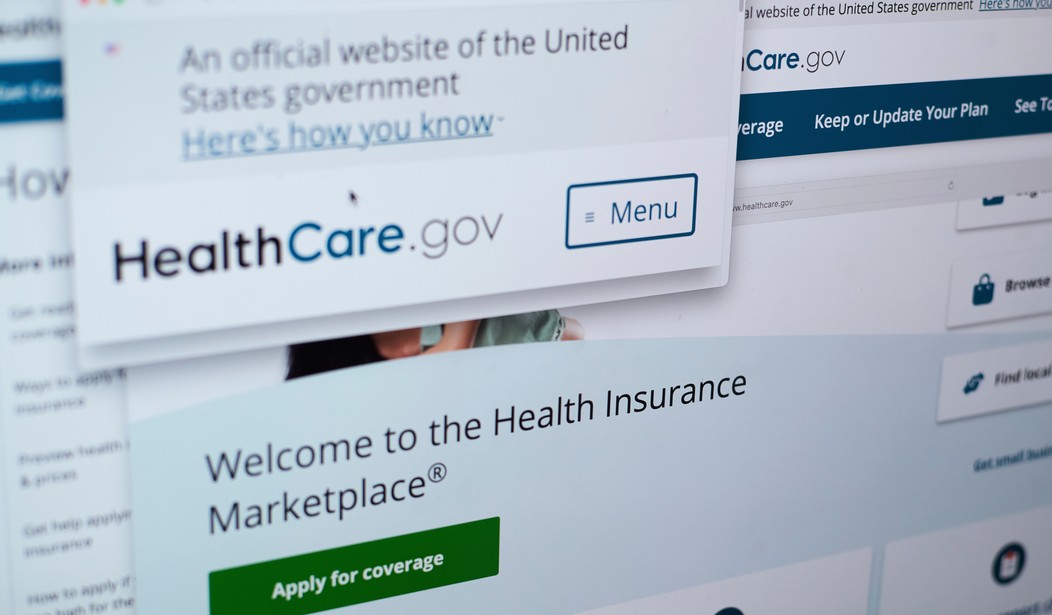

Remember when the Affordable Care Act was supposed to make healthcare... affordable?
Well, here we are, more than 16 years after President Barack Obama signed his signature legislative achievement into law, and Americans are wondering what exactly they're paying for when they purchase health insurance.
The subject came up in an interesting exchange on X over the weekend that caught my attention because it illustrated something that millions of Americans have probably experienced themselves.
One social media user vented his frustration over the seemingly absurd economics of his health insurance plan.
“CAN SOMEONE EXPLAIN HEALTH INSURANCE LIKE I’M FIVE?” he asked.
“I pay $580 every month for health insurance. Then I get sick, visit the doctor, and receive a $1,400 bill because I haven’t met my $6,500 deductible.”
Do the math on that one. He's paying $6,960 a year for the insurance itself, and then potentially another $6,500 in deductible expenses for applicable medical services before his insurer begins picking up its share of those bills.
That's nearly $13,500. A spine surgeon named Dr. Hooman Melamed responded with an excellent explanation of some of the economic forces that have produced this situation.
I'm a spine surgeon. You asked a fair question, so here's the plain-English answer. Before 2012 you could buy an individual plan online for about $200 a month, pick from six or seven insurers, and choose your own deductible: $500 if you wanted to pay more up front, $5,000 if you didn't. If you were healthy, that is. If you were sick, they could turn you down, and that part was real and had to be fixed. Obamacare fixed it by requiring every plan to cover everyone for everything. Good. But that made the real price of a plan jump, and the only way to keep the monthly number from looking insane was to push the cost onto the back end. That's your $6,500 deductible. You're paying comprehensive prices for catastrophic coverage. Then the quiet part. The law caps what insurers can keep at 20% of premiums. So the only way an insurer makes more money is if the total bill gets bigger. 20% of $10,000 beats 20% of $5,000. They have no reason to fight the hospital's price. They pass it through, take their cut, and send you the premium. And the hospital's price went up. Hospitals bought the independent doctors, and the same visit & surgery under the hospital's name now costs 3-10 times more. Hospital prices are up 281% since 2000. The number of insurers you can choose from fell to one in half the counties in America by 2018. Meanwhile, six in ten adults now have a chronic disease, so the pool is sicker. So: sicker patients, pricier hospitals, an insurer that profits from a bigger bill, and a law that moved the cost to your deductible. That's what you're paying for. Nobody in that chain gets paid more if you get better. That's the part to fix.
— Hooman M. Melamed MD FAAOS (@DrHMelamed) November 22, 2026
“Before 2012 you could buy an individual plan online for about $200 a month, pick from six or seven insurers, and choose your own deductible: $500 if you wanted to pay more up front, $5,000 if you didn't,” he wrote.
“If you were healthy, that is. If you were sick, they could turn you down, and that part was real and had to be fixed.”
Melamed explained how the Affordable Care Act's expansion of mandatory insurance coverage affected the price of individual health insurance, and how higher deductibles became part of the equation.
“You're paying comprehensive prices for catastrophic coverage,” he wrote.
I wanted to dig into some of the numbers behind Melamed's explanation because, frankly, they are fascinating. And much of what he says is borne out by government data and academic research.
In 2017, the Department of Health and Human Services published an analysis comparing average individual health insurance premiums in the 39 states using the federal marketplace.
In 2013, before Obamacare's major insurance reforms took effect, the average monthly premium was $232. By 2017, it was $476. That's an increase of 105 percent in just four years.
The insurance products and the populations being insured had changed considerably. Among other things, insurers were now required to cover people with preexisting medical conditions. But the increase in the sticker price of individual insurance was substantial.
And then there are those deductibles. According to health policy research organization KFF, the average deductible for a Bronze marketplace insurance plan was $5,113 in 2014. By 2023, it had reached $7,481. In 2025, it stood at $7,186.
But perhaps the most interesting part of Melamed's explanation concerns a little-discussed provision of Obamacare known as the medical loss ratio.
“Then the quiet part,” the surgeon wrote. “The law caps what insurers can keep at 20% of premiums. So the only way an insurer makes more money is if the total bill gets bigger. 20% of $10,000 beats 20% of $5,000.”
Here's how that works. Under the Affordable Care Act, insurance companies operating in the individual and small-group markets are generally required to spend at least 80 percent of premium revenues on medical claims and efforts to improve the quality of care. For large-group insurance, it's 85 percent.
The remainder covers administrative expenses, marketing, and profits. The idea was to prevent insurance companies from pocketing too much of the money Americans were paying in premiums.
But consider the economic incentives involved. If your allowable markup is expressed as a percentage of medical expenditures, higher expenditures allow for a larger markup in absolute dollars.
If this smacks of a scam to you, then read on. Economists Steve Cicala, Ethan Lieber, and Victoria Marone examined the provision in a 2019 academic paper entitled “Regulating Markups in US Health Insurance.”
“While intended to reduce premiums, we show this rule creates incentives to increase costs,” the economists concluded.
Their research found that affected insurers responded to the regulation by increasing medical claims expenditures. How does this make healthcare more affordable? It doesn't.
In other words, the architects of a law ostensibly intended to make health insurance more "affordable" introduced a regulatory mechanism that could actually weaken insurers' incentives to contain medical costs.
Now consider what's happening on the other side of that transaction: the price of hospital services.
“Hospitals bought the independent doctors,” Melamed explained, pointing out that medical services can become significantly more expensive once they are billed through hospital systems.
According to a new analysis of Bureau of Labor Statistics data published this month by the Peterson-KFF Health System Tracker, hospital services prices have increased by a staggering 314 percent since January 2000.
Overall consumer prices increased by 100 percent during that same period. That would be double.
Want to know what makes that figure really interesting? Prices for physicians' services increased by just 84 percent.
So, while the price of hospital services has more than quadrupled since the turn of the century, the price of physicians' services hasn't even doubled.
There is a considerable body of research documenting how hospital consolidation has affected medical prices. A 2018 study published in the Journal of Health Economics found that prices for physicians' services increased by an average of 14.1 percent after hospitals acquired their practices.
A 2025 Government Accountability Office report also examined how hospitals' acquisitions of physician practices have led to higher spending, including through facility fees that can be charged for services delivered in hospital-owned outpatient practices.
But surely, Americans are getting healthier? Wrong. A 2025 CDC study found that more than three-quarters of American adults reported having at least one of a dozen chronic conditions in 2023.
Put all of these factors together, and you begin to understand why Americans are getting squeezed so badly. Obamacare expanded insurance coverage, but expanding insurance coverage and making medical care less expensive are two very different things.
And now, with Democrats returning to power in Congress, the conversation is shifting back toward Medicare for All. The more things change, the more they stay the same. It's like a merry-go-round and every time we make the circle we've got someone picking our pockets.
As my RedState colleague Nick Arama reported Sunday, Michigan Senator-elect Abdul El-Sayed has been pitching President Donald Trump on a plan to guarantee healthcare to Americans from “cradle to grave.”
Sen. John Kennedy (R-LA) had a pointed observation about the economics of such a proposal.
“The numbers don't work,” Kennedy said.
In fact, the Congressional Budget Office has examined several different permutations of a single-payer healthcare system. Its 2020 analysis estimated that federal healthcare subsidies in 2030 would increase by between $1.5 trillion and $3 trillion in a single year under the options it studied.
Much of that spending would replace expenditures currently made through private insurance and directly by households. But financing such an enormous expansion of federal obligations would require some combination of new taxes, spending reductions elsewhere, or additional borrowing.
And the underlying medical services would still have to be provided. This brings us back to the difference between health insurance and healthcare.
Americans have good reason to be fed up with their insurance companies.
But there is a government-rigged economic system behind the prices they're being charged, including hospital systems, government reimbursement policies, regulations affecting insurance markets, and the deteriorating health of the American population.
None of this will be solved by "single-payer" health care, because that simply means that all of us "pay" for it. Whether that be with money out of our pocket or with declining quality of care, we will still pay.
That's the tragedy of collectivism. When the government takes over for the market, the "solution" is for people to take whatever they get and like it.
There is no track record to back up the belief that government intervention in anything leads to better outcomes. It's a myth that people simply have to stop believing.
As one commenter put it, "Every time government subsidizes something, the costs skyrocket. Every. Single. Time."
@jasonfx Every time government subsidizes something, the costs skyrocket. Every. Single. Time. https://t.co/Fs2d9cHVKn
— Rhetoric Facer 🇺🇸 (@John_Monahan) November 22, 2026
It's not any more difficult to understand than that.