








When World War II ended in Europe, the shape of the Western World was shaken up pretty good. The Allies, primarily the United States, France, the United Kingdom and the Soviet Union, proceeded to carve Europe up into occupation zones. Germany was cut in half. The U.S. and the U.K., and to a lesser extent France, set about bringing back some semblance of a normal economy and governments in their sectors, while the Soviet Union simply gobbled up the small, battered nations of Eastern Europe. The Iron Curtain went down, the Berlin Wall went up, and a nasty situation was created that would last for almost half a century.
History doesn't always repeat, but it often rhymes. In 2014, Ukraine, a former Soviet "republic," was attacked by Russia. Vladimir Putin's forces seized Crimea in, then in 2022, Russia launched a full-scale invasion of Ukraine — and got stopped in Eastern Ukraine. That's where things still stand now, after almost five years of fighting.
The seeds of the past give rise to the flowers — or in Putin's case, the weeds — of the future. It's interesting to look at the Soviet Union's annexation and occupation of Eastern Europe in light of what's happening now.
The Soviet Union had already annexed several territories in 1939 and 1940, then reasserted its control over much of the region as the Red Army advanced westward in 1944 and 1945. Much of this territory had already been assigned to the Soviet sphere of influence under the Molotov-Ribbentrop Pact, so from Moscow's point of view, they were reclaiming Soviet territory. The people in those areas don't appear to have been consulted. Those nations were the Baltic states of Estonia, Latvia, and Lithuania; eastern Poland was broken up and added to the Ukrainian and Byelorussian Soviet Socialist Republics (SSR). Bessarabia and Northern Bukovina became the Moldavian SSR. After the war, parts of Romania were absorbed, as was Northern East Prussia.
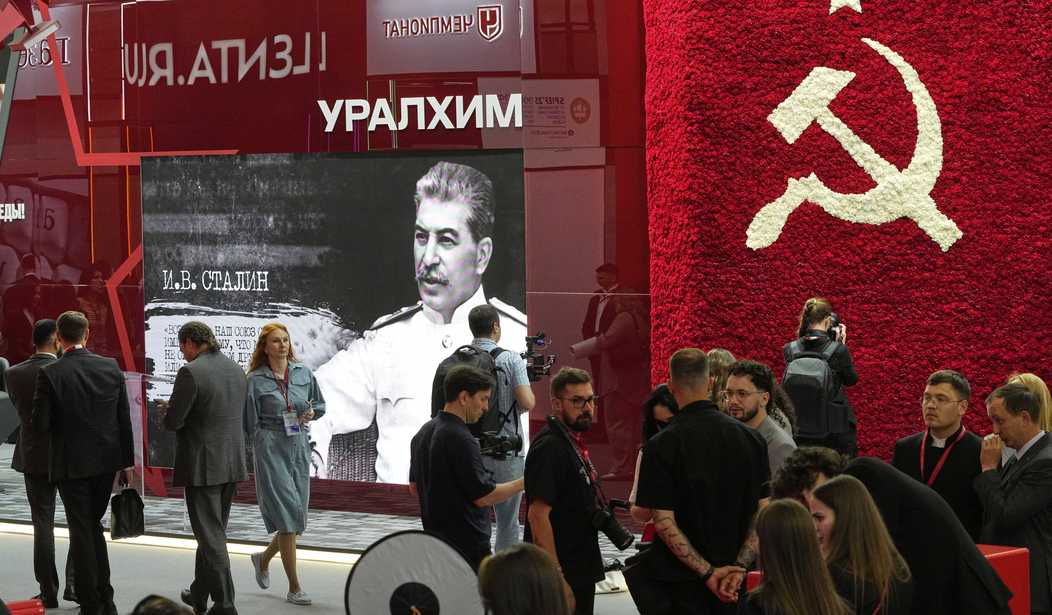
The "satellite states" weren't absorbed as SSRs, but remained client states of the USSR, including Romania, Bulgaria, East Germany, Poland, Hungary, and Czechoslovakia. These states found themselves in the post-war era behind the Iron Curtain — and under Stalin's boot.
This was the high point of the Soviet Union. This is the country that Vladimir Putin grew up in. This is the nation that he served as a Lieutenant Colonel in the Komitet Gosudarstvennoy Bezopasnosti — the Committee for State Security, or KGB. This is the nation that he seems to be trying to rebuild. However, Putin doesn't seem to be too interested in a resurgence of the Soviet Union as a Communist state, although he is a Russian nationalist; he has, on numerous occasions, demonstrated an encyclopedic knowledge of Russian history, far, far beyond World War II. In a 2005 State of the Nation address to the Duma (the Russian Parliament), he described the loss of the Soviet Union as the "greatest geopolitical catastrophe of the century."
One threat assessment done on Putin in 2025 supports the view of him as a Russian nationalist rather than a Soviet revanchist.
Putinʼs foreign policy goals will almost certainly remain unchanged for the foreseeable future because they are rooted in his conception of how Russia should project power. As Putin determines whether to take high-risk actions (including kinetic military operations in western Ukraine or NATO territory) in service to those goals, he is likely to weigh several factors, including his assessment of Russiaʼs own military capabilities and NATOʼs ability and willingness to respond forcefully. Putin is highly unlikely to launch such operations in the short- or medium-term, probably because he judges that Russiaʼs military capabilities are currently insufficient to make them successful. However, Putin very likely desires further territorial conquest, and his decision whether to act on that desire in the long term will almost certainly hinge on his assessment of NATOʼs resolve, Russiaʼs military capabilities, and whether he has exhausted his non-military options.
I wrote earlier today, discussing the ongoing tensions between Russia and Estonia, that Putin was unlikely to take action against Estonia — at least, not military action. And, as noted by the threat assessment, that's likely because he doesn't think he can pull it off.
But here's the thing: Putin's territorial ambitions are implacable, and he sees much of the territory as historically Russian. And, in some cases, he's not necessarily wrong, from an historical standpoint. Estonia and Ukraine, for example, both have substantial ethnic Russian minorities.
So, it would seem that it's not a new Soviet Union that Putin is trying to build, but rather a new Russian Empire. The problems he faces likely won't allow that. Russia is in the process of falling off a demographic cliff. The unexpectedly stubborn Ukrainians are giving him much more of a fight than he (and most of the rest of us) expected. And he's just plain running out of resources — and time. He won't live forever.
Putin may well be trying to set himself up as Tsar Vladimir I over an expanded Russia. But time and logistics are not on his side.