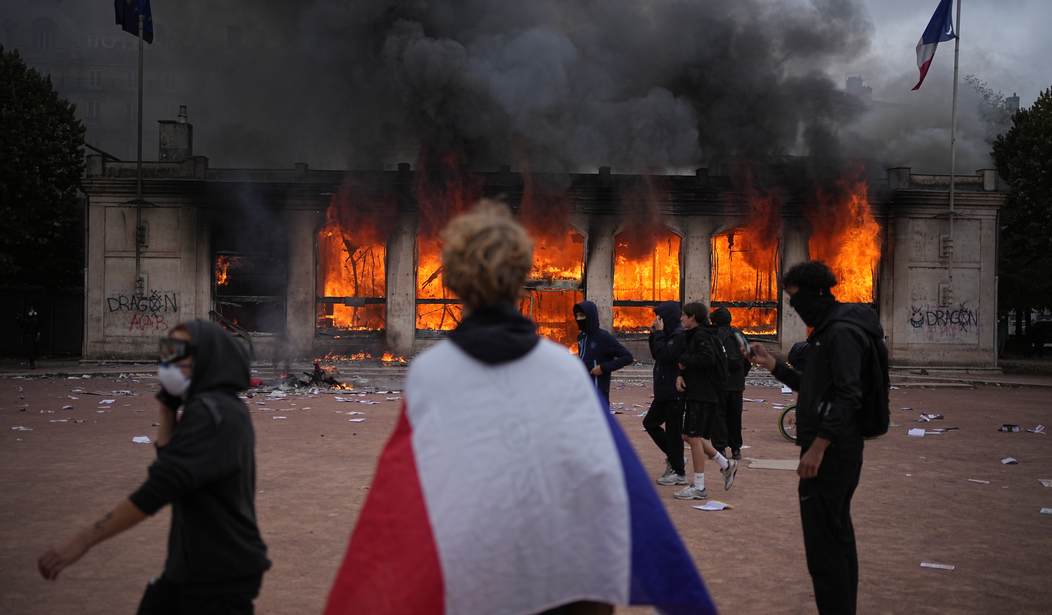

Much of the history of the world, even the developed Western world, with its centuries of progress, is a history of violence. That violence hasn't always been open warfare, with nations contending against nations. Sometimes it has been in the form of civil war, with two factions fighting for control of one country, or at least a part of a country. Sometimes it's been civil unrest, in the form of riots, looting and general mayhem.
France has had several such episodes in its history. Once a great power, France has been torn apart time and again, with major conflicts like the Franco-Prussian War, the Napoleonic Wars, the Great War, and World War II. There have been revolutions, most notably the French Revolution of 1787 to 1799, following close on the heels of our own revolution; but whereas our revolution gave rise to a free republic, the greatest nation in human history, the French Revolution resulted in a descent into tyranny. As revolutions go, that's far more often the case.
Now, France is suffering again, with rounds of riots and looting, and it's not at all clear how this all is going to end. The Mises Institute recently provided an interesting synopsis:
The root cause of the crisis in France is similar to the one in many other European countries, but more serious. Long-term economic stagnation has left the French facing a rising cost of living. For young people, particularly those from immigrant backgrounds and with few qualifications, the problems are more acute. They are facing poor educational conditions as students, and high youth unemployment upon graduation. Their already-limited prospects will soon be further disrupted by the rapid adoption of AI.
This could apply to much of Europe, as it happens. The Mediterranean and smaller Atlantic nations, most notably Portugal, Italy and Greece, the PIGS nations, have been struggling under mounting fiscal instability. The Euro forced most of the nations of Europe, with varying government policies, cultures, and laws, into one common currency; this was never going to end well, and one of the few smart things the United Kingdom has done in recent decades is to stay on the pound — and the other was Brexit.
There's one other key problem in France:
The social fracture between this bleak reality and the older, affluent urban “bobos” (“bourgeois-bohèmes”) is increasingly palpable. The latter form President Macron’s dwindling base of support, yet inhabit a world far removed from both the immigrant-heavy Parisian suburbs such as Seine-Saint-Denis and the modest, sometimes struggling, “France périphérique,” where surging fuel and electricity costs directly erode disposable income.
The organizers and supporters of these protests-turned-riots would love to sell this as a tax revolt. It's not. It may be in part a benefits revolt, in which leftist French "students" are demanding more and more free stuff, and if that has a familiar ring to us Americans, it's with good reason.
There is, though, one other thing, and the Mises people seem to touch it with a needle.
All this forms a fertile breeding ground for social unrest and popular uprising, in a country with a long tradition of this kind. The dire reality slowly becoming apparent across French society is that the bloated French state’s “modèle républicain” is failing. Its promise of “Liberté, Égalité, Fraternité” contains tensions that become increasingly difficult to reconcile as the state expands: coercive attempts to impose ever greater material equality inevitably come at the expense of individual liberty. The inevitable and predicted social decay from such an inefficient system is becoming increasingly visible, as the French joke sardonically that the one part of the public administration that never seems to fail is the tax collector.
The elephant in the room is this: France, like many of the nations of Europe, these nations that gave us Western civilization, have been freely admitting millions from North Africa and the Middle East, people who seek to impose their values on Europe rather than accepting European values as their own; look at any photo or video of the rioting in France, and you'll see a healthy leavening of people who have a distinctly non-French look to them.
And, no, it's not racist to acknowledge an obvious and undeniable truth.
France, right now, is at the forefront. The country is ablaze. Ancient buildings, ancient monuments, are being torn down or burned. Europe, a generation from now, will not be the Europe we know today. It will sure not be the Europe our fathers and grandfathers fought to liberate from Nazi Germany. What happens in France will be repeated: In Germany, in Greece, in the United Kingdom, and elsewhere. If France falls - and President Macron seems unable to prevent it — then it will be only the first of many dominoes.
And, one more thing: Right here, right now, in these United States, we should harbor no illusions that we are immune to this sort of thing. We're not, and we had better be prepared to deal with just this kind of unrest, because we've already seen it happen, right here, and that's a natural-born fact.