


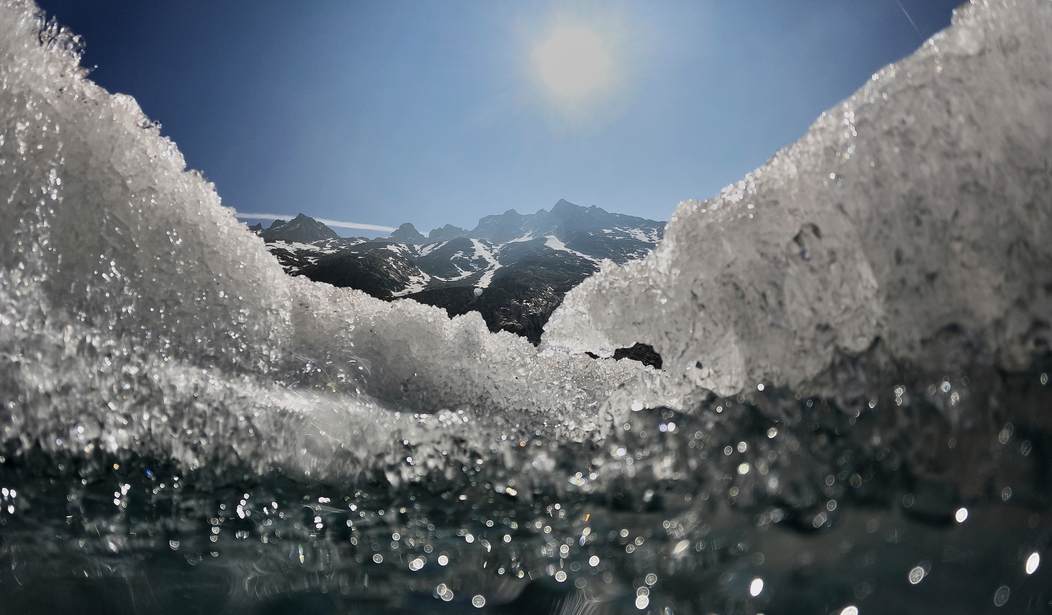

For about the last half a million years, mile-thick glaciers have been going up and down the Northern Hemisphere, as measured in geologic time, like window shades. In that time, we are in what is thought to be the fifth interglacial warm period, a warm time between major glaciations. That's the primary reason that our climate has been slowly warming, for about the last 13,000 years.
This isn't just an issue for science. It's become a political issue. Yes, it's ridiculous, but there it is; there are people who think they know the planet's correct temperature and that they can somehow set the planet's thermostat. Furthermore, they think that human contributions to that warming are enough to jeopardize our existence, and we must immediately give up much of our modern lifestyle to deal with it.
Now, a new study referenced in the journal Science says that this small human contribution may have actually forestalled the next major glaciation. I'm not so sure, but let's look at their reasoning.
Has anthropogenic warming prevented the next glacial cycle? Young et al. showed that it may have done just that (see the Perspective by Marcott). They looked at the evolution of the Barnes Ice Cap on Baffin Island, Canada, the last remaining piece of the Laurentide Ice Sheet (LIS), which once covered much of North America and was the largest of the Pleistocene ice sheets. After shrinking throughout much of the early- and mid-Holocene, the LIS began to grow again around 2000 years ago but then began shrinking once more around 1960. The authors attribute this reversal to anthropogenic greenhouse forcing, evidence that humans caused the termination of the next glaciation.
A house editorial in one of my favorite online journals, Issues & Insights, has some ideas about all this.
The fact that a new glacial period had begun should not be a surprise to anyone who knows anything about the history of ice ages.
The climate record shows that ice ages are a recurring phenomenon that last far longer than “interglacial” periods like the one we are in right now (80,000 years vs. 10,000 years, roughly). And global temperatures during previous interglacials were far higher than today’s “hottest year on record.” The chart below shows this in dramatic fashion.
Here's that chart:
https://t.co/KzmG5F9sPm
— Ward Clark (@TheGreatLander) October 30, 2026
There are a couple of interesting things to note here.
First, look at the interglacial periods and the mean temperatures. As I'm continually pointing out, through most of Earth's history it's been warmer than it is now. These interglacial periods support that assertion. In the very last interglacial prior to the one we're in now, temperatures reflected in this Antarctic ice-core reconstruction were around 10 degrees higher than now, at their peak. That was between 100,000 and 150,000 years ago. There were people around then; they were hunter-gatherers, but there were people, and they would seem to survive, and as evidence of their survival, well, look in a mirror.
Note also that during the last major glaciation, temps bottomed out at about 20 degrees colder than the current average. We lived through that, too. But we're a warm-adapted species, and we and our food crops and animals do better in a warmer climate.
But it's the time scale here that I find interesting. The study reported on in Science only notes that the remnants of the Laurentide glaciers began to retreat in 1960. That's 65 years ago; an eyeblink in geological time. Do they really propose we draw a trendline of 60 years on a climate issue that has been cycling for half a million years? And that, by implication, we should make public policy decisions based on that?
Another major glaciation would be difficult, at best. Our food crops would suffer; at a new glacial maximum, much of our current farm and grazing land would be under ice. The planet would be colder, but it would also be drier, with much of the planet's fresh water locked up in ice. Just as in the last major glaciation, deserts would expand, environments would change.
So, if we have, through our carbon and other emissions, staved off another major glaciation, isn't that a good thing?
Honestly, there's no reason for anyone on either side of this issue to get too worked up. Human influence on these vast cycles is minimal at best. One day, yes, there may well be another major glaciation. We may yet see mile-thick glaciers over where Winnipeg and Calgary stand now.
Here's an interesting tidbit from the paper referenced by Science:
As atmospheric CO concentrations continue to increase, a return to glacial conditions is extremely unlikely but our new paleo-LIS dataset informs ongoing discussion as to when, and how, a glacial inception would have occurred in a preindustrial climate state. Previous modeling work suggests that the next glacial inception would not have occurred for several thousand to tens of thousands of years.
Now, this work isn't full of climate scold dogma. It's actually a pretty even-handed look at things, but the scolds are too fond of pointing out work like this to proclaim that our works are so great that they are literally changing a climate cycle that has been going on for half a million years. They are also too fond of pointing out that we must change our lifestyles to try to alleviate these claims. But note the time scales involved: The next glacial inception, that is to say, the start of another major glaciation, would be thousands of years; and that it is "extremely unlikely" that we would have seen a return to glacial conditions.
In short, we cannot and should not try to base public policy on things that may happen a thousand or ten thousand years from now.