
Facts matter. In issues of politics, of policy, and most especially of science, facts matter. In the matter of climate change, which is supposed to be an area of scientific inquiry but which has become a matter of partisan activism, facts matter. And the facts are these: The earth's climate has always changed, and always will. Humans have some impact on those changes, the extent of which pales before the planet's vast cycles, cycles of winds, ocean currents and temperatures, and even cycles in axial tilt, rotation and orbit. We are currently in an interglacial warming period, and have been since the end of the last major glaciation about 13,000 years ago. And, finally, through much of earth's history, it has been warmer than it is now. Sometimes much warmer.
These are facts.
So, let's take a look at three periods in Earth's history, and compare some numbers. Mind you today's numbers come from direct measurements and so are tighter than the historical evidence, which are not snapshots but trends over thousands and millions of years, but the trends are plain, and much of the evidence, like the remains of tropical forests in Germany and ancient forests in Antarctica, is pretty reliable.
First, as a baseline, let's look at the state of affairs today. As mentioned, we are currently in the Holocene Epoch, in a warming cycle that began with the end of the last major glaciation, about 13,000 years ago. That glaciation, the most recent of several, began about 115,000 years ago, with the glacial maximum about 21,000 years ago; global mean temps were about 6 C colder than now, and mile-thick ice sheets covered much of the Northern Hemisphere. The end of that major glaciation ushered us into the Holocene, the most recent geological epoch, in which we remain today. Right now, in the middle of this warming period, global mean temperatures are about 15 C, with atmospheric CO2 levels at about 426 parts per million (ppm). That's a pretty comfortable baseline for us humans, and a quick look at our comparatively brief history reveals that we do much better in warm spells like the Roman Warm Period than in cold snaps like the Little Ice Age.
That's where we stand. But 55 million years ago, in the early Eocene, long before there were any humans driving SUVs or building factories, things were very different; this was the time of the Eocene Thermal Maximum, and it lives up to its name. In this near-record warm spell, the global mean temperatures were around 23 to 27 C, compared to today's 15C. Atmospheric CO2 levels carried from around 600 to 1,000 ppm throughout this time, compared to today's 426. In this period, there were tropical rain forests in Germany, with all of the fossils of plants and animals we'd expect to find in that kind of environment. The Arctic was free of ice. There were palm trees in what is now Alaska and redwoods on Ellesmere Island. And remember: No humans.
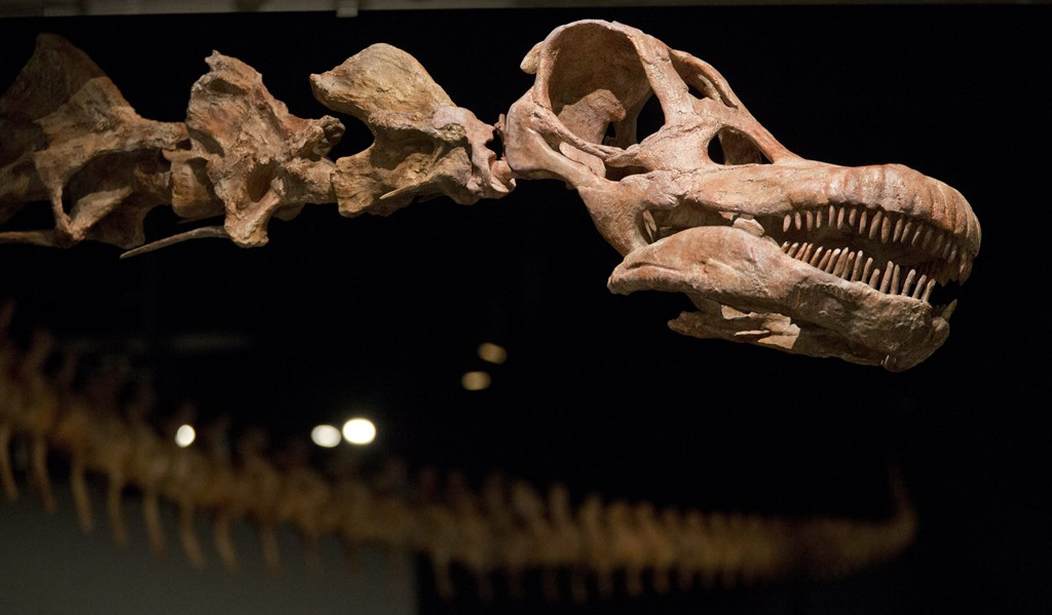
For another example, let's go back further, in fact back to around 200 million years ago, to the early Jurassic, when the dinosaurs were starting to thrive. In this long-lost time, global mean temperatures were estimated to have been around 20-25 C, compared to today's 15C; atmospheric CO2 levels were about 1,600 to 2,000ppm. Vegetation was lush, resulting also in higher O2 levels than today. These warm temps and high O2 levels made possible the rise of some of the largest creatures to ever walk the planet.
That's the evidence.
There are, of course, cold snaps in Earth's history too, including the aforementioned most recent major glaciation and the more recent Little Ice Age which lasted up into the early years of the Industrial Revolution, and if the rise of factories had something to do with the end of a period marked by crop failures and disease, all I can say is, hooray for factories! Throughout this time there were also major changes in ocean currents, including the equator-spanning Tethys seaway, which carried warm water around the planet, and in the Jurassic, the mega-continent Pangea, with all of its varied environments.
So, why does this matter in the climate change argument? Here's why and I'm going to tell you. It is as simple as this: To anyone with an understanding of this planet's history, the vastness of the scale, the duration of the cycles, the chaotic nature of this planet's climate, which operates literally on a planetary scale, there's just no good argument to be made for somehow being able to predict humanity's relatively puny effect a hundred or a thousand years from now.
Yes, the climate changes. Yes, through much of Earth's history it has been warmer than now, and it is during those warm spells that life thrives. Yes, humans have an effect on the climate, but it's not enough to surrender our comfortable modern lifestyles, as the climate scolds would have us to; in fact, our influence may be making things on this whirling globe a little more tolerable, after all is said and done. And that, dear readers, is a good thing.