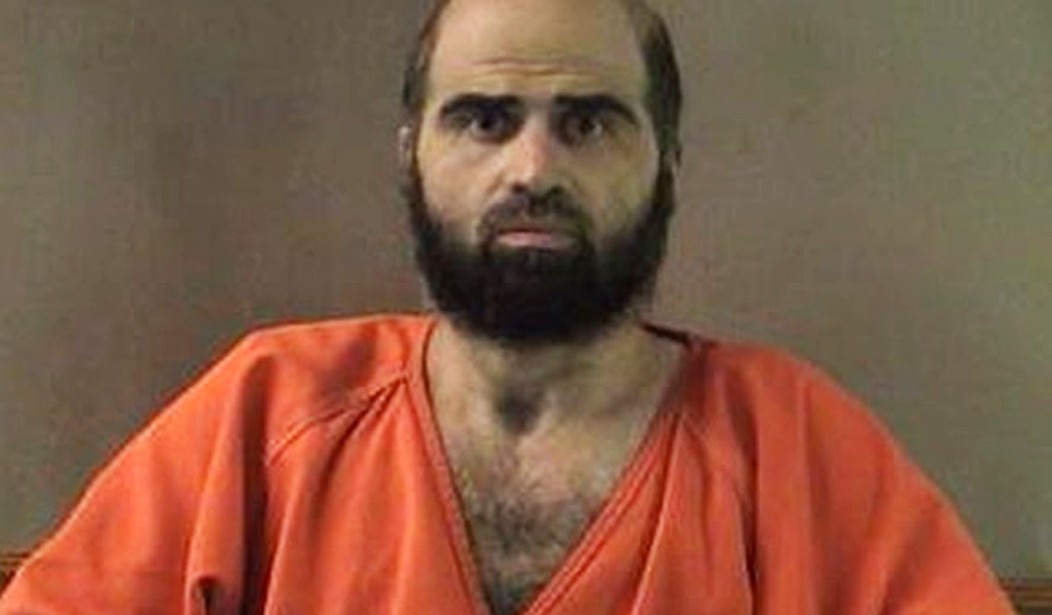

On December 3, the former U.S. Army officer Nidal Hasan, convicted by a military court-martial of a shooting spree in which he killed 13 of his fellow soldiers and wounded 32 others, will be executed by firing squad. His execution, according to the Pentagon, will be live-streamed. The last public execution in the United States was the death by hanging of Roscoe Jackson on May 21, 1937. The last execution carried out by the U.S. Army was in April of 1961, when Private John Bennett was hanged at Fort Leavenworth, Kansas.
That's the history. Now, the Army is about to make some new history. This event has stirred up a lot of discussion, as death penalty cases often do, and in this case you can add a particular betrayal and, of course, a dash of jihadism into the mix.
Like a lot of people, I have some thoughts on this execution and the live-streaming thereof, and it's this: I'm in favor of both. Here's why, and I'm going to tell you.
First, the death penalty. I've never been opposed to the death penalty. In some cases, it might make logistical sense to just confine a particular goblin to prison for life with no hope of parole, rather than putting the victims and the victims' families through endless appeal after appeal before the job is finally done, not to mention putting the taxpayers through a soaking for the goblin's legal defense. But in this case? No. Nidal Hasan was placed in a position of great trust, not just as an American but as an officer in the United States Army. He took an oath as an Army officer, the same oath I took, to "...support and defend the Constitution of the United States against all enemies, foreign and domestic; that I will bear true faith and allegiance to the same; that I take this obligation freely, without any mental reservation or purpose of evasion; and that I will well and faithfully discharge the duties of the office on which I am about to enter." Nidal Hasan betrayed that oath. He defiled the Constitution. He proved himself to be an enemy of the United States. He did not bear true faith; he did not take that obligation freely and without purpose of evasion. And worst of all, he defiled his oath and his position in a jihadi attack, in which he murdered 13 soldiers and wounded 32 others. One of the soldiers he murdered was pregnant, and reports indicate her last words were to beg, not for her life, but for her baby. Hasan killed them both.
There is a role for retribution in this case: Simply put, revenge, revenge for the dead and wounded, retribution visited on Nidal Hasan for his act of evil. Nothing short of death is appropriate.
Detractors point out that Hasan is now in a wheelchair, as though that somehow expunges him for paying for his crimes. Horse squeeze. He is in a wheelchair because it took four shots from responders to stop him from murdering more people.
Detractors claim that there are constitutional problems with the death penalty. There are not. The Fifth Amendment specifically allows for the death penalty, stating in part that no person shall be "...be deprived of life, liberty, or property, without due process of law", meaning, plainly, that with due process of law, a person may be deprived of life. Hasan faced his due process in the form of a military court-martial carried out under the Uniform Code of Military Justice.
Detractors claim there are humanitarian issues. Nonsense. Properly equipped and drilled, a firing squad can and will provide a quick, clean death free of suffering. Given some recent bungled attempts using lethal injections, it seems rather that the civil corrections departments should look into this method of execution.
But in this particular case, I'm all down with the revenge angle. Nidal Hasan could very well have killed someone I served with. If you're a veteran, he could very well have killed someone you served with. His act was a heinous betrayal, an act of utter treachery, betraying the trust of the American people and the service members he attacked.
And, yes, I think that livestreaming the event is perfectly justified. Nobody will be forced to watch it, after all. But some of Hasan's fellow jihadis will, and while some may be outraged, some others may stop and think for a moment; the message they should take away is, "the United States isn't playing around any more."
And, finally, some people arguing against this execution will make the argument that by killing Nidal Hasan, we, the United States, are making him a martyr for his jihadi cause. Fine, fine. You know what all martyrs have in common?
They're dead.
On December 3, Nidal Hasan will learn his ultimate fate, and it's a sure thing that 72 virgins aren't going to be involved. I'll watch the livestream, and I'll watch it with a sense of grim satisfaction, and on that occasion, I will remember my mother's statement that, when someone dies, you should find something good to say about them. In the case of Nidal Hasan, I will simply say this:
"He's dead. Good."