
There's an old saying in geopolitics that nations are less likely to go to war with other nations they are doing business with. There's a level of truth to that; if people on both sides are making money, the incentive is to keep that train a-rolling. But that doesn't apply in every case; in 1940, the United States traded with Japan, and yet Pearl Harbor happened.
Japan, interestingly enough, is now probably the best ally the United States has in the North Pacific. China, with whom we were allied in World War II, is now America's primary geopolitical rival. Yes, we do a lot of business with China. But recent events, from China's ramping up its military production to illegal Chinese-owned biological laboratories in the USA to Chinese nationals buying up American farmland near our military installations, tell us that China may not be content to be peaceful trade partners forever.
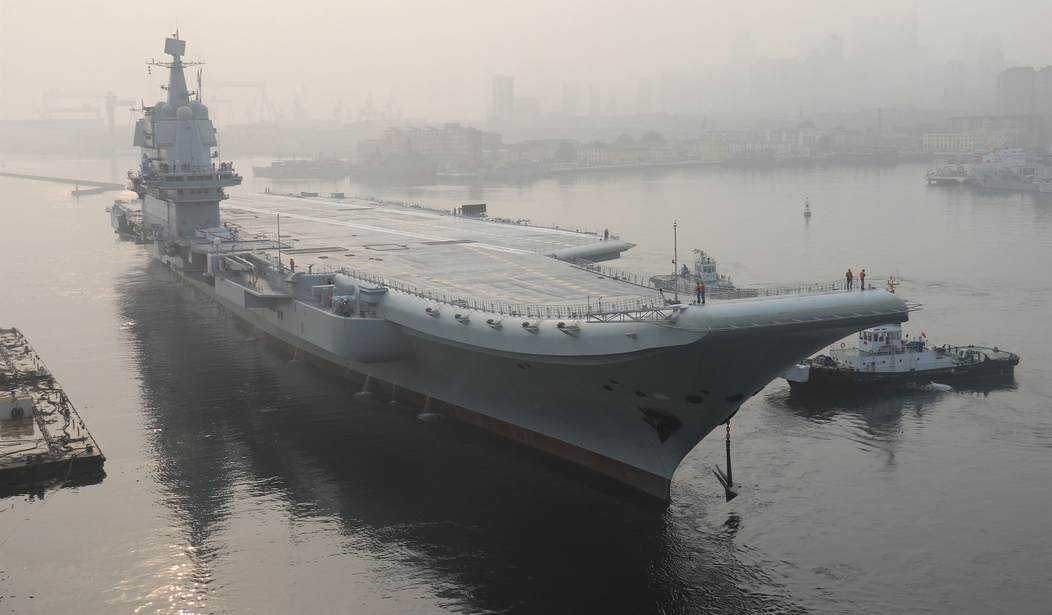
Another indicator is the fact that China is trying to build a blue-water navy, including modern aircraft carriers. America's vaunted supercarriers are formidable, but they can also have some key vulnerabilities; they are the best-protected ships in the fleet, but that's because they are primary targets for any adversary in a conflict.
Defense News' Michael Peck has some thoughts on how the United States Navy might best counter this possible Chinese threat, and he's relying on the old argument: A good offense is the best defense.
China is devoting enormous efforts — from submarines to ballistic missiles — to destroy America’s aircraft carriers.
The strategy prompted a U.S. think tank to ask why America couldn’t do the same and sink China’s growing fleet of carriers.
The think tank, the Center for Strategic and International Studies, devised a plan to target Chinese carriers by using many of the same tactics that China would use against American flattops.
“China’s expanding carrier force presents a strategic vulnerability that the United States and its allies can exploit, rather than merely a challenge to U.S. dominance,” argues a CSIS report, titled “Flip the Script.”
“Instead of treating U.S. carriers as hunted platforms, focusing on how to defend U.S. assets, this report argues that the United States and allied Pacific powers can — and should — go on the offense, becoming the hunters instead of the hunted in this near-peer competition,” it continues.
This seems an obvious solution; there's an old saying in war that battles are often won by those who "get there the firstest with the mostest." Of course, while tactics win battles, it's logistics that wins wars, and while China is building carriers, it's at-sea replenishment still lags behind that of the United States.
But there may well be a reason for that, and it has to do with China's motivations in this buildup.
Just as losing a Ford-class carrier would deeply humiliate Washington, sinking a Fujian-class carrier would be devastating for Beijing. Just as U.S. planners must be cautious about committing carriers in waters exposed to submarine attack, so, too, might Chinese admirals.
“These platforms are both prestige projects and critical enablers of future Chinese sea control and expeditionary operations,” CSIS said. “Moreover, just like their U.S. counterparts, the Chinese carriers are high‑value, hard‑to‑replace assets vulnerable to long‑range strike.”
China currently has three operational aircraft carriers, and a 2025 Pentagon study estimated that the People’s Liberation Army Navy will build six more by 2035. Yet, Beijing’s quest to build a carrier fleet may be driven less by military considerations than by prestige, just as Britain and Germany raced to build dreadnoughts before the First World War.
So, in 2035, only nine years from now, China will have nine operational aircraft carriers. As of this writing, the United States Navy has 11, with two more Ford-class carriers in construction, expected to be finished by 2035, giving us a total of 13. What's more, our carriers are nuclear-powered; China's existing carriers are conventionally powered, complicating their logistics problems, especially in at-sea replenishment. (China is thought to be working on a design for a nuclear-powered carrier.)
The primary offensive weapon against carriers, though, is likely to be submarines. There the United States has a significant advantage, at least for now; the United States Navy at present has 53 nuclear-powered attack submarines, to China's 6 nuclear-powered boats and 46 diesel-electric boats.
The plan mentioned above, put forth by the Center for Strategic and International Studies, takes an aggressive tone: If it comes to it, the United States should hit hard and fast.
The tactics advocated by CSIS may seem eerily familiar to U.S. Navy strategists contemplating American carriers sailing within harm’s way to save Taiwan from invasion. For example, CSIS envisions deploying manned and unmanned submarines that could ambush Chinese flattops. This would include U.S. nuclear subs and quiet diesel-electric boats from allies such as Australia, Japan and South Korea.
“The key is to turn the undersea domain into a continuous threat envelope that forces Beijing to invest heavily in escorts, ASW aviation, and fixed sensors simply to move carriers out of its home waters,” the report said.
In other words, again, get there the firstest with the mostest. America's ships being nuclear-powered solves one major logistical problem: Fuel. And the United States Navy has decades of experience in blue-water operations, whereas China is still figuring that out. The advantage, right now, is with the United States.
America hasn't fought a near-peer conflict since 1945. That's an unprecedented time without our nation being in a major war. But China is looking at our naval supremacy with envy, and we should be planning and building accordingly. I will remind you of George Santayana's caution: Only the dead have seen the end of war.