
As I'm fond of pointing out, we solve today's problems with tomorrow's technology. That's always been the case, from the time one tribe countered another tribe's atlatls by inventing the bow and arrow. Right now, in the energy sector, voices are claiming that the answer for today's energy issues is "renewables," such as wind and solar, but that's a canard. You can't replace a high-energy-density source with a low-energy-density source, and that's what the proponents of wind and solar propose to do. Every major advance in human technology has been made possible by an increase, not a decrease, in energy density of primary fuel sources.
Right now, the answer to all this, the answer to the energy needs of the developed world, is nuclear power. It is the highest energy-density source of electrical generation we have available to us now and for the foreseeable future. Nuclear power, furthermore, is everything the green energy activists and climate scolds claim to want: Clean, minimal emissions, and reliable and consistent to boot.
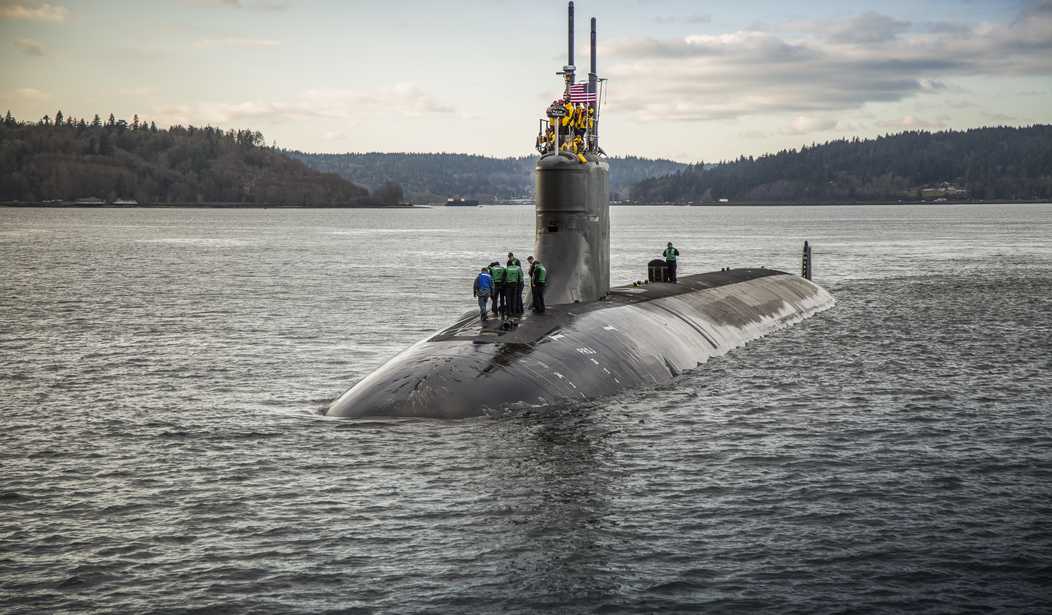
The United States Navy has used nuclear power for three quarters of a century now, in vessels ranging from submarines to aircraft carriers. A recent article by a U.S. Navy nuclear submarine officer, Josh Kaplowitz, brings us some fascinating insights on what life is like - eating, sleeping, carrying on with one's duties - within a few long strides of a nuclear reactor.
I've spent years operating nuclear power plants and living alongside them. At sea, my life and the lives of 155 other souls depends on a nuclear reactor operating safely in one of the most unforgiving environments on Earth.
A Navy nuke sub crew may be submerged for days, weeks at a time, prowling the deeps like a great pelagic shark, all the while its crew is sealing in that steel tube - with a nuclear reactor.
During deployment out to sea, I would wake up and start my day with a workout on a treadmill we had by the missile tubes. After my workout, I would shower, brush my teeth and grab some breakfast before my work day started. Before going to work I would head back to the engine room to do some studying and work on my nuclear qualifications. Then came the main part of my work day: standing watch and supporting my crew.
Nothing crazy in this story right? But, this was all happening while we were deep in the ocean, cruising fast and quiet, powered by a nuclear reactor. All the shower water, system pumps, lights, treadmills, stoves, communications, safety… relied on that nuclear reactor splitting uranium atoms and releasing neutrons for power.
The reactor was not this scary, evil thing but our day-to-day life source. It produced the power we needed to carry out our missions.
Fission reactors aren't a new technology. The very first "atomic piles" were assembled and operating in the United States in 1941, four years before nuclear power was weaponized. Now, nuclear power is the clear answer to the developed and the developing world's electrical generation needs. And that industry would do well to look to the United States Navy as an example of how to handle modern reactors. The Navy has a stellar record of safety with its nuclear reactors, in submarines and surface ships both.
No civilian or military personnel in the Naval Nuclear Propulsion Program have ever exceeded the federal lifetime radiation exposure limit or the federal annual limit in effect at the time. Since 1968, no personnel have exceeded 5 rem per year, which was the Program’s self-imposed limit until it became the federal limit in 1994. In recent years, the average annual radiation exposure for operators has dropped to about one-tenth of the average annual exposure a member of the American public receives from natural background radiation and medical sources.
Modern reactors, from industrial-scale pebble bed reactors to small modular reactors to now, even portable reactors, have the potential to change the way we think about energy.
Want to decentralize the electrical grid? Small modular reactors could provide electricity for small rural communities and even some suburbs of major cities, allowing them to be unhooked from miles and miles of transmission lines from centralized power plants.
Want to help with the development of the Third World? It's impossible without reliable, constant electricity. Electrification would do more to lift the Third World out of poverty than all the truckloads of rice, beans, and old t-shirts ever assembled. It would literally be world-changing for much of sub-Saharan Africa and parts of Asia.
Worried about the energy costs of the new data centers that seem to be popping up everywhere like spring wildflowers? Equip each one with a small modular reactor. Tie them in so any excess power they produce is returned to the local grid.
The United States Navy has shown us how it can be done, and they have been doing it for many decades, safely and reliably. This is everything that green energy advocates, climate scolds, and environmentalists claim to want. We, as a nation, should be building nuclear power plants like mad people.
We solve today's problems with tomorrow's technology. In the case of nuclear power, that tomorrow is now. People like Josh Kaplowitz are living that future, and when they describe it, we should listen to them.
Now, fusion power? That could be the next big game changer. That is, in another 30, 40, or 50 years - just as it has been for several decades now.