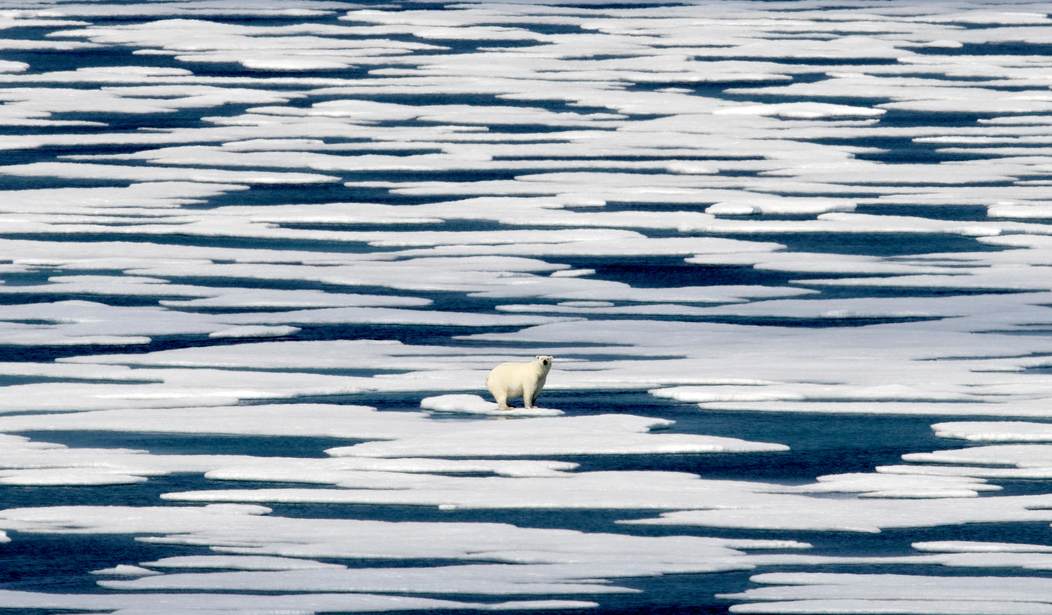

There's an old saying that predictions are hard to make, especially about the future. It's especially apt in natural processes, which are frequently chaotic and sometimes on a scale that we have a hard time understanding. The global climate is a stunning example of just this. It exists on scales of size and time that are hard for us to imagine; it is literally planetary in size, and it has existed with variations major and minor for billions of years. Even the cycles that affect the global climate exist on staggering schedules, with oceanic, geologic and orbital cycles ranging from hundreds to thousands to millions of years.
It's hard to make any predictions about a system this vast, this ancient, and this chaotic. And yet, that's what the climate scolds and the supposed experts working this agenda are trying to do.
Watts Up With That's Mike Jonas has been playing with some AI modeling for climate, and he has some interesting observations. First, on Chaos Theory, Mr. Jonas gives us a primer:
First, let’s be clear about what we are looking at. Chaos Theory says that Earth’s weather and climate are very sensitive to local conditions: a tiny variation grows exponentially into a large difference. We know that weather and climate show natural variations on many physical scales and many time scales – there is turbulence in both the atmosphere and the ocean. We know that turbulence can be very difficult to predict, and we know that differential equations such as Navier-Stokes can be useful for understanding it. We don’t know that a tiny variation will grow exponentially. My suspicion is that the exponential growth described by Chaos Theory is an artefact of the models, not a natural phenomenon, and that it is being confused with natural variation. Further, that if we ditched Chaos Theory we might end up with a better understanding of our world.
That's as I've been saying and writing for years. It's nearly impossible, at least with current techniques and technologies, to understand global climate enough to accurately predict trends over a few days or weeks ahead of time; when people try, they generally fail.
So I did an extensive search of the literature, using Grok of course because it is amongst other things a powerful search engine. Amongst all the attempts to demonstrate Chaos Theory using models, there were some that tried to do it using atmospheric analogues: they look for pairs of very similar situations in historical records to see whether they then diverge rapidly as per Chaos Theory. The concept is that the difference between the two situations is a proxy for Chaos Theory’s variation in initial conditions. Unsurprisingly, they found divergence (otherwise weather forecasting would be easy), but equally unsurprisingly the situations were never close enough to be a proper test – Chaos Theory is based on infinitesimal differences.
And then Grok served up a bombshell. Some of its AI mates have got into climate modelling, and when some of their model runs showed the rapid divergence expected from Chaos Theory their handlers did a very interesting test: they repeated the exact same model runs on a more accurate computer. The divergence was eliminated or severely reduced. The divergence, in their words, “is caused by numerical noise, which is an artifact of the computation rather than a real atmospheric process“. If chaos can be created by using a less accurate computer, imagine how much chaos can be created by the crude iterations of a GCM. (GCMs are General Circulation Models, which have been the mainstream climate models for many years).
Global Circulation Models (GCMs) are what much of the climate scold movement depends on to claim they are predicting the climate future. Now this is a data point indicating that they are even less useful than we thought; their output is statistical noise.
I'm not exactly an expert on chaos theory; my background in mathematics peaked with Biostatistics when I was in college. But I've read enough to know the basics, that being that chaos theory is the study of how complex systems can demonstrate complex and sometimes random and erratic behavior. Small inputs can, but do not necessarily, lead to large consequences; this is what is meant by the "butterfly effect."
The global climate is one of these systems, ruled by the laws of physics, yet still complex and unpredictable. The problem here, in the application of GCMs, is that it may well be impossible to tell when the inputs and predicted effects are real, or whether they are introduced by the program.
Now, this whole thing is nearly as hard to wrap one's mind around as the climate itself. But as far as policy goes, this just goes to reinforce the best arguments against the climate scolds: that we simply don't understand the global climate well enough to make any accurate long-term predictions about it, much less to go mucking about with it. Furthermore, it's not worth deleting much of our modern, comfortable, energy-hungry lifestyle to arrest a problem we aren't sure is even happening.
The climate has changed. It's changing now. It always has, and it always will. Humans are adaptable. We'll get by. And more and more, the models that the climate scolds use to argue for boxing us into 15-minute cities and take electric driverless pods everywhere are increasingly proven to be inaccurate at best, and deceptive, at worst.