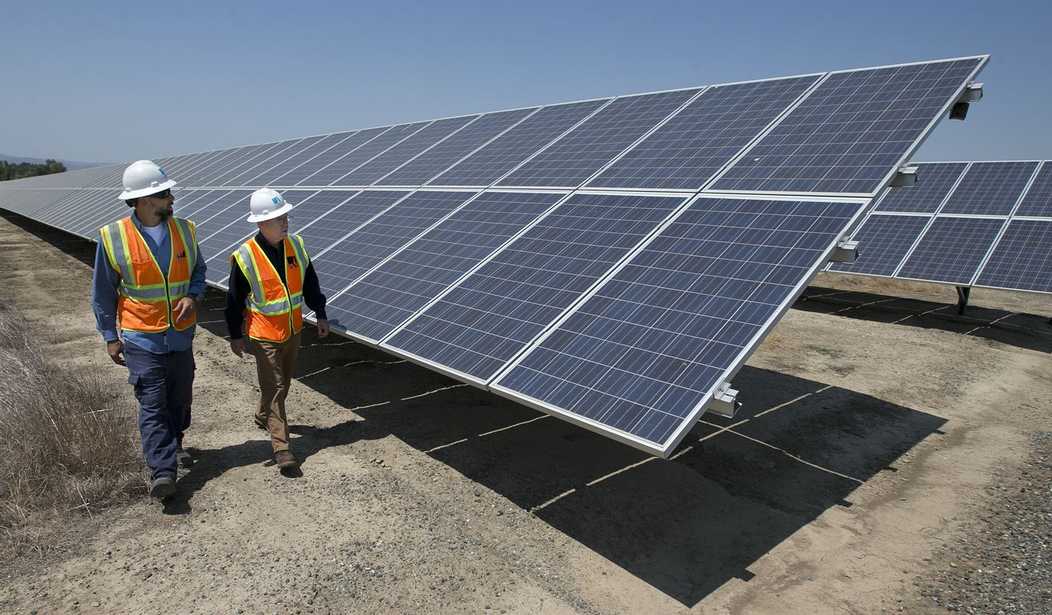

This hits against "green" energy schemes just keep piling up. The numbers simply don't add up. You can't replace a high-energy-density source with a low-energy-density source. Every major advance in human technology has been enabled by the corresponding increase in energy density of a society's primary energy source, from biomass (wood and dung) to charcoal, to coal, to oil and natural gas, and now to nuclear power.
I've said, and written, this for years. The problem is not just that the various "green" energy sources, primarily solar and wind, aren't economically viable; it's that they aren't nearly as "clean" as advocates claim. And they won't be sufficient to meet our growing energy needs.
But a recent report from the Massachusetts Institute of Technology (MIT) is still making the case for green energy.
While climate activists bewail the Trump administration’s embrace of fossil fuels and its corresponding disdain for solar panels and wind turbines, a new report released by the Massachusetts Institute of Technology’s Center for Energy and Environmental Research says greener days may yet be in our future.
The report, “Glass Half-Full: Building a Decarbonized U.S. Power Sector,” sees a green light at the end of Trump’s dark tunnel of dismantling Biden-era climate policies. Focusing exclusively on electricity generation over the next decade, the report uses a mathematical model to compare how much “clean power” will survive the Trump administration’s phase-out of wind and solar subsidies and its scuttling of other green-energy initiatives with what would have been produced under Biden-era climate policies.
But the United States has been backing away from renewables under the Trump administration. A deal of development funds originally intended for solar and wind power projects is now being focused instead on gas and oil development. And there is a lot of interesting work going on in nuclear fission energy, which is the real answer: A reliable, clear, high-density energy source that actually works.
Read More: The Next Big Thing: Deployable Nuclear Reactors
Renewables’ Dirty Truth: Biggest Garbage Heaps Ever Created
Advocates of "green" energy and the climate scolds (that's a Venn diagram that's essentially one big circle) are quick to point to Europe as an example of decarbonization, but in this as in many things, Europe isn't exactly the best role model. In this long, hot summer, Europeans are suffering from the heat in no small part because air-conditioning, a late 19th-century technology, is uncommon there. So, Europe's per capita energy use may be lower, but that doesn't mean that this comes without cost.
“From 2015-2025, the first decade of the Paris Agreement on climate change, global energy consumption rose by more than 14%, with sharply contrasting dynamics,” notes Samuel Furfari, professor of energy geopolitics at the Université Libre de Bruxelles. “Europe’s decrease in energy use is no triumph of ecological heroics but rather the outcome of the assault of the EU Green Deal on competitiveness and its predictable deindustrialization and economic decline.”
The cost, in other words, for these "renewable" energy sources is the sacrifice of key aspects of our modern lifestyle.
Europe, mind you, has bigger problems than just this, not least of which is the apparent suicide-by-apathy of ethnic Europeans. But here in the United States, our energy needs are only going to increase. The advent of artificial intelligence, or AI, and the hundreds of energy-hungry data centers that it requires, will only push our energy needs higher and higher.
And, again, every major advance in human technology has come with a corresponding increase in the energy density of that society's primary energy source. For the United States and much of the rest of the developed world, that means (for now) natural gas, oil, and most especially nuclear power.
Japan knows the deal. They have done the cost analysis and are covering their needs with traditional sources.
Japan, the world’s fourth-largest economy and once a champion of decarbonization, has responded to the recent Middle East energy bottlenecks by reducing its liquefied natural gas (LNG) imports from that troubled region (while increasing LNG imports from the U.S.), ramping up coal-fired generation, and restarting nuclear power plants. Wind and solar power, along with battery storage, are being pushed aside.
But the worst part of this whole equation is that clean energy, as the advocates for these boondoggles term it, isn't clean at all. Solar panels and windmill blades wear out. They can't just be chucked in a landfill, either. Worse, some estimates based on current usage alone predict as much as 133 million tons of windmill blades alone will have to be buried or otherwise disposed of by 2050.
There is going to be a major energy transition in the next few decades; very likely in the next few years. Natural gas, oil, and even coal will remain mainstays for electrical generation, heating, and motor fuel for now. But the electrical generation of the future belongs to nuclear power, no matter what featherheaded climate scolds and "green" energy advocates have to say about it. That's just reality. Our energy needs in the next few years are going to skyrocket in this Western world, and nuclear power is the best way to meet those needs. Nuclear power already is clean, and it's reliable, safe (with the new reactors), and high-density to boot. These are facts.
We solve today's problems with tomorrow's technology. Our current problems with energy needs won't be resolved with windmills and solar panels. Oil and gas will work for now, but in the end, it is nuclear power that will pave the way forward and provide reliable, clean, high-density energy to meet our increasing technology needs.