
Here in our small Susitna Valley community, we have some issues with our electricity supply that we share with a lot of small, rural communities. A few years back, I had a conversation with a guy from our electricity supplier, the Matanuska Electric Association, about the need for robust surge protection on the computers my wife and I rely on in our work; as he described it, our electricity, carried from as far as Anchorage on above-ground lines, is "dirty," prone to spikes and dips. And the above-ground lines are prone to their own issues; a windstorm can knock out a significant number of households by dropping tree branches on the lines. A couple of years back, we were without electricity for over 24 hours.
That's OK. We knew this would be the case when we moved into our rural home; I grew up with similar issues. And, I will say, it's totally worth it. But it begs the question: Could there be a better way to deliver clean, reliable energy - locally? There may be, if we can resolve the regulatory burden: Small modular reactors.
There are three reasons that these new reactor designs could solve a lot of our country's issues with electricity and our aging grid: Energy density and the versatility it offers, decentralization of the power grid, and the possibility of decoupling from and dispersing that grid. A recent CFact piece has more.
First, energy density:
As much as the science and engineering of solar panels and wind turbines have undoubtedly advanced over recent years, so has the technology of nuclear reactors. A modern nuclear reactor is very far advanced, in comparison to the scary images created in the public mind of a Chernobyl or Fukushima.
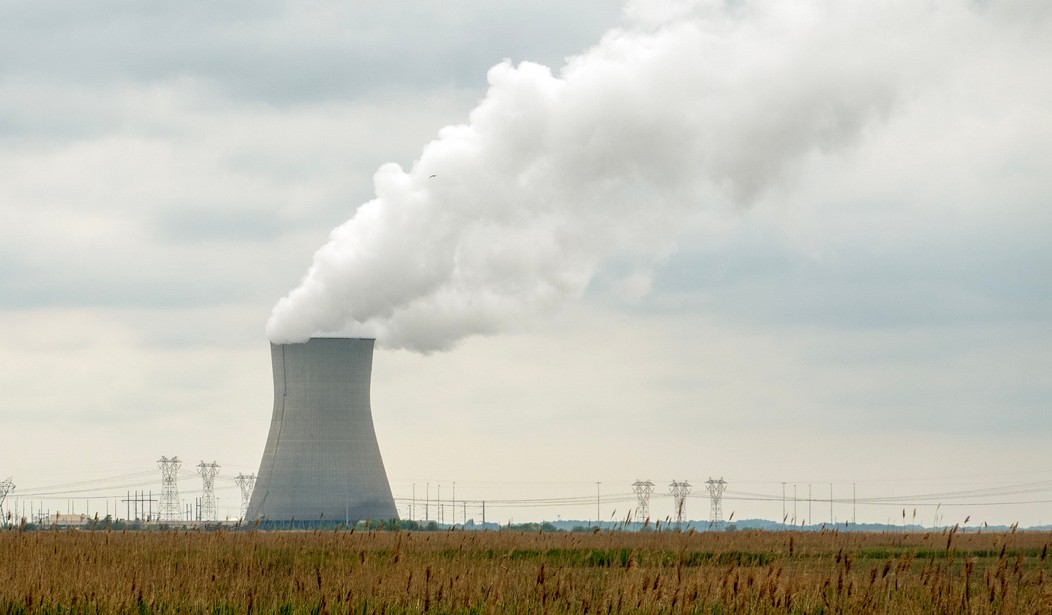
However, we are also finding that the philosophy of nuclear power is altering the concept of electricity generation. A coal-fired power station has to be built near where the coal is for economic reasons. In the case of oil and gas, long pipelines have to be built to carry the fuels from delivery points to points of use. In contrast, a large nuclear power station can have its entire annual supply of nuclear fuel delivered in one truck, once. So, in principle, you can put a nuclear power station wherever you like. It does not have to be near the fuel supply point. Generally, however, there has been one significant limitation for new large nuclear power stations, and that is water for cooling. Large nuclear power stations have tended to be built on a coastline, or on the banks of very large lakes.
Those, mind, are the big, grid-scale reactors. Energy density still makes them a viable option; as I have said, and written, for years, every major advance in human technology has been accompanied by - indeed, made possible by - an increase in the energy density of that society's primary fuel. Nuclear power is the advancement that will power advances like artificial intelligence (AI). And small modular reactors come with advantages of their own.
That brings us to decentralization.
A modern large reactor is typically around 1200 MW in size, or larger.
An SMR is defined as being less than 300 MW in size, with some being as small as 10 or 20 MW. So, it is possible to imagine a factory, mine, or town, owning its own nuclear reactor. In fact, a facility such as one of these can even have its own electricity grid, which is not connected into a national grid, and need only be half a dozen kilometers in diameter…or smaller.
The ‘modular’ in the name implies the goal of building most of the nuclear reactor indoors, like motor cars are made on a production line. Then one merely transports the SMR in easily transportable subassemblies to the site, where they are essentially bolted altogether, thereby getting rid of many difficult processes such as cutting and welding outdoors on site.
Consider the possibilities here. These systems would not only be clean and reliable, but also a versatile means of delivering electricity. For our community, one SMR could power most, if not all, of our little rural community, and the same could apply to thousands of like communities around the fruited plain. We would no longer be dependent on the extended grid bringing power from far-away generation plants, although maintaining a connection as a backup would seem a good idea. And these small modular reactors are everything that "alternative" sources are not: High energy density, constant, reliable, and, if we can apply the economies of scale, cheap.
Read More: Will New Nuclear Fusion Designs Disrupt SMRs Before They Launch?
The Physics Rule Renewables Can Never Escape: Energy Density
Then, finally, decoupling and decentralizing the grid.
SMR’s can be owned by private companies at their respective points of consumption. Clearly, one would expect them to proliferate across the country, so it would be logical to ask, “How will we control them from technical and legal perspectives?” In parallel, we are seeing an explosion of internet use, linked to the incredible prospects for Artificial Intelligence, universally now just called AI. So, we link numbers of SMR’s together, and to a monitoring station, using the internet. Reactors can be in different states or even different countries. In the monitoring stations. technicians would watch pressures, temperatures, flow rates, and much more. Any minor deviation in any reactor would cause a warning to signal in the monitoring station. Operators would then direct various responses. The station would also monitor stores of spare parts and where they are located, so that each reactor does not have to hold its own stock.
That would yield not only practical but also strategic advantages. Set aside industry for a moment; imagine installations like major military bases, no longer dependent on commercial energy production, but decoupled, powered by an on-base small modular reactor. Imagine an electrical grid that is decentralized, dispersed, with electricity generated near the point of use, without the requirement of a few big generating plants, but rather many smaller, dispersed sources. Add this to new methods of enriching uranium that may well be orders of magnitude more efficient, and you've got the energy picture of the future.
The energy future, without a doubt, is nuclear. Of course, the usual suspects will oppose anything nuclear: The environmental movement, the climate scolds, all the people who claim to want what nuclear power delivers: Clean, reliable, affordable electricity. But they seem to be losing ground. Facts are stubborn things, and the facts around nuclear power are becoming too plain and too well-known to hold back any longer.