



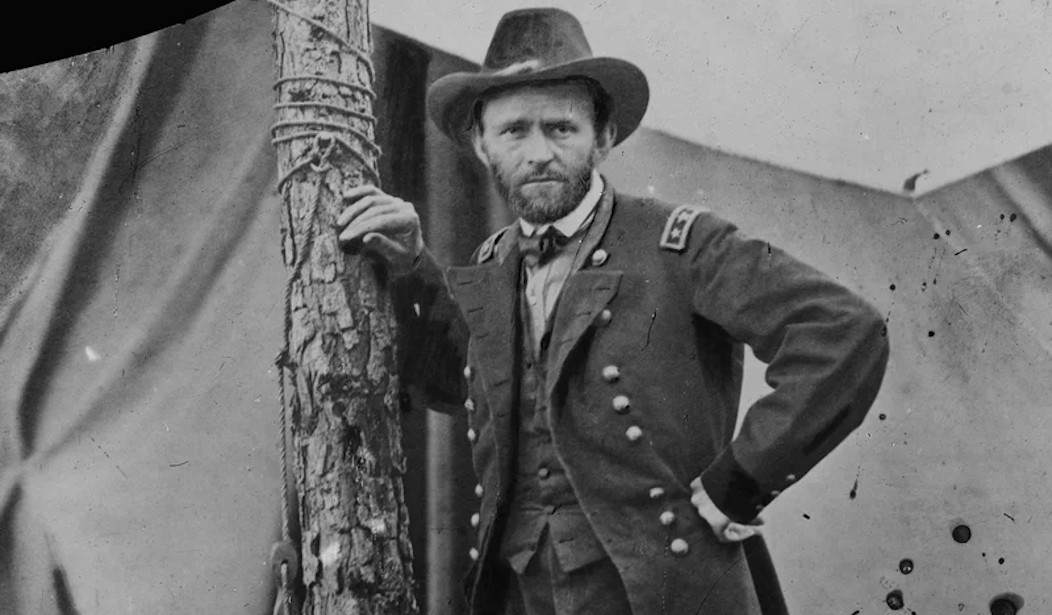
As a Southerner, I was raised on the heroics of Virginia's version of the trinity — Robert E. Lee, Thomas J. "Stonewall" Jackson, and J.E.B. Stuart — who turned the ragged lines of men in butternut and gray into a whirlwind that broke Union lines on battlefields where a dispassionate evaluation of numbers and equipment would have convinced the casual observer that they couldn't prevail. Grant was a butcher who bludgeoned his way to victories his skill could not have produced. Sherman was the personification of evil. Let's not even talk about Phil Sheridan's pillage of the Shenandoah Valley. With age and study, though, Grant and Sherman have become two of my favorite characters. They understood the nature of war in a way that few before them did. A couple of vignettes from Grant's Civil War years endear the man to me, and one holds a valuable lesson for the GOP today as we view and contemplate the carnage of November 3. see Morning Minute: Well, Hell... – RedState.
It is March 1862. The federal Army of the Tennessee was coming off two signal victories at Forts Henry and Donelson and was resting at a sleepy Tennessee riverboat whistle-stop called Pittsburgh Landing. Grant was the commander. He had about 48,000 men and was waiting for reinforcements from General Don Carlos Buell's Army of the Ohio. Once Buell arrived, the plan was to advance on Corinth, Mississippi, sever two major rail trunks, and cut off Lee's Army of Northern Virginia from supplies and reinforcements from the Confederacy's southwest. There was some skirmishing, but Grant had no inkling of a major attack. He'd been warned that the Confederates might attack General W. H. L. Wallace's Second Division, but he dismissed the concern, writing "I have scarcely the faintest idea of an attack, (general one), being made upon us but will be prepared should such a thing take place." His de facto deputy commander, General William Tecumseh Sherman, echoed his skepticism. Sherman was short on combat experience, but he was the only West Point graduate among Grant's division commanders and, as such, was Grant's confidant. Sherman wrote to Grant, "I have no doubt that nothing will occur today more than some picket firing."
His opponent, the dashing Confederate general Albert Sidney Johnston, had other ideas. He knew Grant's approximate strength and that he had numerical parity with Grant on April 6. He also knew Buell was advancing to join Grant and that by the evening of April 8 he would probably be outnumbered 2-1. If he were going to act, the time was now.
Before dawn, around what we infantry guys call BMNT, or Beginning Morning Nautical Twilight, when the unaided eye can begin to discern faint shapes, Johnson's Army of Mississippi blasted through Grant's thin picket line and hit an army that was largely asleep.
Under inspired leadership at the company and regimental level, Grant's army pulled itself together and began to hold ground. Fierce fighting developed across the battlefield, especially at the area later known as the Hornet's Nest, where Union troops under Generals Benjamin Prentiss and W.H.L. Wallace held off repeated Confederate assaults for hours. The stubborn defense delayed the Confederate advance and bought Grant valuable time.
Despite the Confederate success, they failed to destroy Grant's army. By late afternoon, the Union forces had been compressed into a strong final defensive line near Pittsburg Landing on the Tennessee River, supported by Union artillery and gunboats USS Tyler and USS Lexington. During the fighting, Johnston was mortally wounded, and command passed to P.G.T. Beauregard. As darkness fell, Beauregard prudently halted the attack, believing Grant's army was beaten and unable to escape. Very little positive happens when you throw dog-tired troops into an attack at night, in the rain, over unreconnoitered terrain.
As darkness fell, a torrential thunderstorm hit the battlefield, and the rapidly dropping temperature brought hypothermia that mercifully finished off many of the wounded who lay unattended. Grant, himself, was in incredible pain from his horse falling on him as he rode the picket lines the night before the battle and could only move with great effort. That he could cover the battlefield all day in that condition shows his mental and physical toughness.
This is how Ron Chernow, in his epic work, "Grant," describes what happened next.
Wrapped in his greatcoat, Grant returned to the haven of the nearby oak tree with its spreading canopy of branches. Sherman found him standing there, streaming with rain, hat pulled low over his face, collar upturned, holding a lantern and chewing a cigar. "Well, Grant, we've had the devil's own day, haven't we?" Sherman remarked. "Yes," replied Grant with a drag on his cigar. "Lick 'em tomorrow though."
"Lick 'em tomorrow though."
Grant had just finished the first day of the bloodiest battle in American history (Shiloh would hold that dubious honor for another eight months until the Battle of Stones River would take the lead). He's not panicked. He's not casting blame. He's not looking for scapegoats.
"Lick 'em tomorrow though."
I don't pretend to have the answer as to what happened during the midterms. All I can say is that the facile blame-shifting by Vice President JD Vance is probably not accurate; see Vance's Explanation for the GOP's Midterm Disaster Is a Little Too Neat and Tidy – RedState. What I do know is nothing in politics is forever. In 2002, Democrat apparatchiks John Judis and Ruy Teixeira wrote a book, "The Emerging Democratic Majority," which proclaimed the end of politics in the same way Francis Fukuyama's "The End of History and the Last Man" assured us that totalitarianism had been vanquished and something like an EU-style liberal democracy was inevitable everywhere.
If House elections had followed 2024 voting patterns, the GOP would have at least 230 seats. In 2028, if we have strong candidates and an articulable vision for the future from whoever is at the top of the ticket, there is no reason we can't retain the White House and have a solid working majority in the House.
The Senate may be unwinnable because the seats are mostly in safe Blue states. That said, until November 3, sane people would have considered Texas and Mississippi to be safe Red seats.
None of this is to say we don't face huge difficulties. Senate incumbents are difficult to displace, even when they are barely sentient. Donor money follows incumbents, not ideas, because a bought incumbent can give you your policy preferences.
We have had the "devil's own day."
Lick 'em tomorrow though.
Editor's Note: President Trump is leading America into the "Golden Age" as Democrats desperately try to stop it.
Help us continue to report on President Trump's successes and combat Democrats' lies. Join RedState VIP and use promo code FIGHT to receive 60% off your membership.

Join the Conversation
VIP members get the ability to comment on articles.