








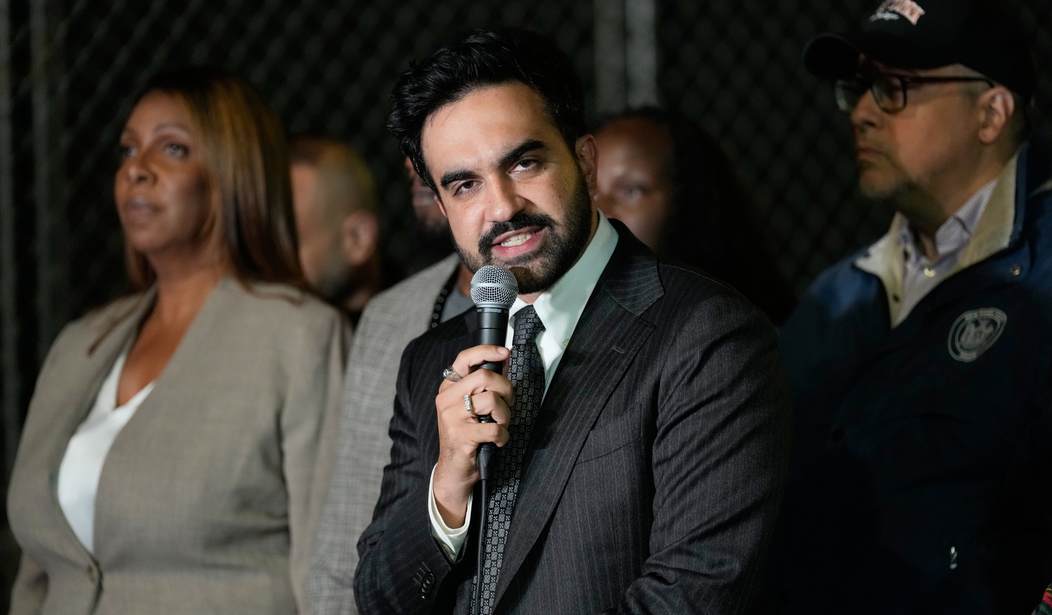

If you’re wondering about Mayor Mamdani’s dubious cancellation of the Thanksgiving Day parade, you won’t find any smoking musket.
There was a bad weather forecast, but Macy's Thanksgiving Day parades have been held in worse. You pull in the Garfield balloon and you carry on. That's the American way.
But it turns out that the apple pie doesn't fall far from the dessert tray. Because Mamdani's dad may be even more openly anti-American than his politician son.
The Columbia University professor has devoted a good portion of his academic career to examining the supposed evils of the modern nation-state, and the United States figures rather prominently in his work.
What better way to justify destroying America than to criticize that its founding was evil, and therefore, its system of government is illegitimate and should be “fundamentally transformed”?
We are talking about narcissists who can criticize a nation that became a world power due to free market capitalism and its constitutional system of government, but cannot for one moment ever look in the mirror.
Well, we’re going to hold up a mirror to Mamdani’s anti-Americanism, and we’re going to glean if he might have something against the holiday.
So, if you ever run out of things to feel ungrateful for over Thanksgiving, might I suggest spending an afternoon watching lectures by New York City Mayor Zohran Mamdani's father?
That is a snoozefest that hits harder than tryptophan, let me assure you. But let me save you the spoiler alert: It is deeply anti-American.
As one X commenter put it, “Probably nothing.”
Mamdani's Father: American settler colonialism is the root of all evil. Mayor Mamdani: Let's postpone Thanksgiving. Probably nothing. https://t.co/yoaoiOTqby
— MAZE (@mazemoore) November 26, 2026
What got me interested in revisiting the elder Mamdani's scholarship was the bizarre turn of events surrounding Thanksgiving in New York City.
As I reported earlier, the mayor got quite a roasting on social media after announcing the postponement of the 100th annual Macy's Thanksgiving Day Parade.
The decision, made in conjunction with Macy's and other city officials, was attributed to public safety. Yet the parade had never before been postponed due to weather. In 1971, when conditions were too dangerous to fly the giant balloons, the organizers simply held the parade without them.
Mamdani will also be missing Saturday's rescheduled parade because he is undergoing surgery on his Achilles tendon.
Then there was this lovely Thanksgiving message from New York City Public Advocate Jumaane Williams, with Mamdani and New York Attorney General Letitia James looking on at an event in Harlem.
Williams described Thanksgiving as the “commemoration of a horrible time” for some Americans.
NOW - Public Advocate of New York City, Jumaane Williams, says that Thanksgiving for some is a "commemoration of a horrible time in history," and that the current "pretty bad" administration "likes to erase history and what happened." https://t.co/F5UoGAtyqT
— Disclose.tv (@disclosetv) November 26, 2026
What a delightful way to celebrate Thanksgiving.
Spend a little time searching YouTube for lectures by the mayor's father, Mahmood Mamdani, and you'll get a sense of the intellectual framework behind much of the contemporary political discourse surrounding colonialism.
The elder Mamdani published a book in 2020 entitled Neither Settler nor Native: The Making and Unmaking of Permanent Minorities.
The United States occupies a central place in his historical analysis. He essentially treats the European settlement of North America as a template for political arrangements that would subsequently emerge in Nazi Germany, apartheid South Africa, and Israel.
In 2024, he gave an interview to The Nation that ran under the headline, “The Idea of the Nation-State Is Synonymous With Genocide.”
Nationalism and colonialism, according to Mamdani, are “twins joined at the hip.”
So, how far did the apple fall from the tree?
The younger Mamdani certainly shares some of his father's preoccupations when it comes to Israel. Earlier this week, the mayor expressed support for congressional Democrats pursuing sanctions involving Israeli settlements, referring to the “settler enterprise” and encouraging further action.
But there's something about this intellectual obsession with Western colonialism that has always bothered me, particularly when it comes from people who profess to be concerned about universal human rights.
How universally are those principles actually applied?
There is no shortage of historical scholarship documenting the mistreatment of Native Americans by European settlers. But the notion that Europeans introduced conquest, slavery, and territorial disputes to the Americas is historically illiterate.
That’s putting it politely. Another way to put it is that it deliberately distorts the settlement of America for propaganda reasons.
The Aztecs built an empire by conquering neighboring peoples and exacting tribute from them. Historian Pekka Hämäläinen's The Comanche Empire documents how the Comanches established their own sphere of imperial dominance across much of the American Southwest and northern Mexico.
Native Americans were human beings with political ambitions of their own. They traded, fought wars, took slaves, formed alliances, and acquired territory.
And, given the Mamdanis' interest in colonialism, there is another rather substantial chapter of world history worth revisiting.
The Arab-Islamic military conquests of the seventh and eighth centuries extended from the Iberian Peninsula to the Indian subcontinent. The Ottoman Empire conquered Constantinople in 1453 and ruled over considerable portions of southeastern Europe for centuries.
How much of the modern Islamic world's geographical footprint is itself the product of conquest?
Did the peoples of North Africa collectively wake up one morning speaking Arabic?
If the circumstances under which a civilization acquired its territory determine its present-day legitimacy, then we could all have dinner table conversations about our national origins more uncomfortable than the one we just had with our drunk uncle that voted for Obama.
The elder Mamdani does examine Sudan in his scholarship, including the historical relationship between Arab and non-Arab populations. But I would be considerably more interested in seeing the contemporary political implications of Islamic imperial history subjected to the same degree of scrutiny that American history receives.
And why stop at history? Let's talk about what's happening right now.
In March, Mayor Mamdani was quick to condemn American and Israeli military action against Iran. He subsequently acknowledged, when pressed on the subject, that Iran had a “brutal government.”
In January, the mayor had also drawn criticism for his initial silence regarding the Iranian government's deadly crackdown on its own citizens before eventually condemning it.
Obviously, it was also “probably nothing” that his office was caught in a scandal for trying to discuss political matters with the Iranian regime in a time of war.
It’s not an accident that the Mamdanis have a “blind spot” for Muslim majority nations bigger than Stevie Wonder trying to drive a car.
According to Freedom House's 2026 assessment, the United States scores 81 out of 100 on its index of political rights and civil liberties. Saudi Arabia scores nine.
Saudi Arabia is an immensely wealthy country. What's its excuse for maintaining an absolute monarchy that affords its citizens so few political rights?
In Iran, women have faced arrest and violence at the hands of the state over how they dress. Political dissidents have been imprisoned, and religious minorities face extensive restrictions.
In Afghanistan, more than 2.6 million girls have been denied a secondary education since the Taliban returned to power, according to UNICEF.
That's not something that happened 400 years ago. It's happening in 2026.
And if we're going to discuss the plight of Indigenous peoples, religious minorities, and women, why should these contemporary injustices command any less of our attention than the historical injustices committed by Europeans?
America is not unique in that the history of the nation is devoid of bloodshed.
But America abolished slavery, extended constitutional protections to formerly enslaved people, enfranchised women, and expanded the civil rights of its citizens.
That is a heck of a lot more than can be said for Muslim-majority nations that have failed to do any of that to this day.
This is what frustrates me about the selective use of history as a justification for the fundamental transformation of American society.
What exactly are we transforming it into? And what is the historical record of the people who have attempted such transformations elsewhere?
Where is the evidence that socialist or Islamist systems of government can deliver the combination of religious tolerance, individual liberty, material prosperity, and political freedom that Americans have come to expect?
It's easy enough to find fault with what human beings did centuries ago. It's harder and more exceptional to build institutions that enable millions of people of different backgrounds to live together and prosper.
We cannot all go back to living in some idyllic tribal existence that never existed in the first place. The entire history of human civilization has been one of migration, competition, conflict, and, gradually, the development of institutions that allow us to coexist.
America's accomplishments deserve to be evaluated just as seriously as its failures. And when it comes to the accomplishments of the socialist and Islamist regimes, it’s no contest.
So, instead of making a day devoted to being thankful for the great things we have in America about the “dark days” of 17th century history, why not just grab a family member and a turkey leg and say grace? Oh, and pass the glazed ham.