


It was a blue tsunami that looked something out of The Impossible.
That is an aptly named reference for some of the seismic shifts in the electorate, particularly among Latinos in border states and young people across the nation.
We are talking up to 70 points shifting away from Republicans toward Democrats in some election races. These are results that beggar belief.
So, did these voters really put their stamp of approval on the Democrat Party because it had any solutions to high grocery bills, elevated gas prices, and student loan debt? Was it an expression of outrage at the Republican Party for abandoning its base on dinner table issues, such as affordability and job creation for American citizens and young males?
Or did Democrats have a "secret weapon"? Because if we are to believe this "impossible" narrative, the Democrats were able to use persuasion to rip away Trump's 2024 coalition.
It looks like the Democrats were half a marathon ahead of the Republicans in the Texas races when it comes to the use of advanced analytics.
The Federalist recently published a story that gives us further insight into what went terribly, horribly wrong in the Texas elections.
The architect of this Texas effort was one of the most eloquent voices in the new data world of Democratic politics: David Shor, the founder of Blue Rose Research. While many Democrats dreamed of turning Texas blue, Shor had the exact team to do it using new testing skills that Democrats have honed over 20 years. He likely knew that Texas could not turn blue simply on the strength of midterm headwinds against Trump and the GOP. [...]
In recent years, Shor and other Democrats had expressed concern over — and an understanding of — the massive success Trump achieved among working-class voters, especially Hispanic working-class voters in Texas... As I wrote in The Federalist last week, this new methodology leads to a precisely targeted campaign — invisible to the rest of the electorate — where one bloc of voters, or even several different blocs, receives distinct ads that prior testing has shown to be highly persuasive to each particular group. The ads used in such targeted campaigns often differ sharply from those broadcast broadly, because scientists have found they can be blunter and bolder when other voters are not listening. The more aggressive ads are “hidden” from a majority of voters.
So, we are talking about micro-targeting and message-testing. Not the first campaign in the world to think of such tactics. The Federalist story by Joe Arlinghaus gave more insight:
This may be where Shor got luckiest. The Abbott campaign had always raised money with ease and had a strategist at its helm, David Carney, who had run seven straight winning campaigns for statewide office in Texas going back to 1998. Carney had never experienced a loss in Texas, running the gubernatorial campaigns of both Abbott and his predecessor, Rick Perry. In 2012, Carney and his team were profiled in a Democratic book called The Victory Lab for their innovative use of early experimentation borrowed from the left. Even in recent years, through a Republican data effort called Cygnal, Carney claimed to understand big data better than most campaigns.
With Carney at the helm, Abbott should have recognized that he was the only standard-bearer on the right in Texas capable of stopping the Democrats. Instead, the Abbott campaign was simply ineffective at countering Talarico’s messaging.
It remains to be seen exactly what Abbott did wrong, but my own analysis and that of my data scientists lead us to believe that the Abbott team’s two greatest mistakes were:
- Failing to understand that the race was really against Talarico rather than Abbott’s own underfunded opponent, Gina Hinojosa, and
- Failing to understand how important the Hispanic vote was or how to appeal to those voters.
As a voter who lived in Texas throughout this campaign debacle, the Republican response to the Talarico campaign appeared to be disjointed, and poorly coordinated.
However, there is more to the story here: The Democrat Party in many urban areas has capitalized on extensive opportunities to scout the political terrain and map out areas where they can "turn out" the vote — by any means possible. The COVID pandemic, for example, was one such opportunity for left-wing operatives to go door-to-door and to gather data on prospective voters.
In 2021, Harris County (under County Judge Lina Hidalgo) awarded an approximately $11 million contract to Elevate Strategies, a firm run by Democratic consultant Felicity Pereyra (who had prior ties to Democratic campaigns, including Adrian Garcia’s and Hillary Clinton’s). The contract was for a COVID-19 vaccine awareness and outreach campaign focused on low-vaccination areas. It included plans to hire canvassers (reports referenced roughly 50) for door-to-door-style work.
Invoices showed payments to firms such as Civis Analytics (a progressive data/analytics company with roots in Obama-era campaign work and voter-turnout modeling) and NGP VAN (a major Democrat voter-file and canvassing platform). Critics, including local analysts and former officials, described this as effectively using public funds to acquire and deploy voter-targeting and get-out-the-vote infrastructure rather than pure public-health messaging. The Texas Organizing Project was also listed as a subcontractor.
Hidalgo canceled the contract in September 2021, saying it had become too politicized. Only a fraction of the roughly $1.4 million already paid was later recovered. The episode triggered a criminal investigation by the Texas Rangers. Several of Hidalgo’s staffers were later indicted on charges related to the process.
The Democrats are more ruthless when it comes to their ground game and their data-gathering. The Republicans are more likely to play by the rules.
Texas stands out for another reason. Data analyst Lenny Bronner, who previously worked for The Washington Post, examined precinct results across 13 states to determine how much of the Democrats' midterm gains resulted from higher relative turnout and how much came from voters switching parties.
Nationally, in the states examined, roughly 75 percent of the Democratic gains came from turnout differences. About 20 percent came from persuasion, meaning voters who had previously supported Republicans crossing over to Democrat candidates. But the Lone Star State was alone when it comes to the purported impact of persuasion on the election.
According to Bronner's Texas-specific analysis, approximately 45 percent of the Democrats' net gains came from voters switching away from Republicans. The remaining gains were largely attributable to turnout differences, with some residual effects in the model.
"So far, Texas is the only state where our model indicates that persuasion explains more of Democrats net gain than turnout does!" Bronner wrote.
This persuasion effect was reportedly impactful in Hispanic communities. Bronner estimated that persuasion accounted for approximately 81 percent of the Democratic improvement in Hidalgo County, in the Rio Grande Valley. Even in predominantly white areas, Texas exhibited more evidence of vote switching than many other states.
As Stateline reported, the preliminary numbers suggest Republicans experienced a serious persuasion problem in Texas, alongside the broader nationwide turnout disadvantage.
The results also exposed how quickly Trump's advances among younger voters evaporated. A November 19 analysis highlighted by Derek Thompson showed enormous Democratic swings among men ages 18 to 29, particularly those without college degrees. The estimates indicated a mind-blowing 67-point Democrat improvement among young men in the Texas Senate race, increasing to approximately 73 points among young men without college degrees.
Similar shifts appeared in South Carolina, Mississippi and Indiana, with some estimates exceeding 70 points toward Democrats. These are changes in partisan margins between elections, not claims that 70 percent of individual voters switched parties.
Young men without a college degree in Texas, South Carolina, and Mississippi swung 20-30 points toward Trump in 2024 and then between 64 and 77 points against Trump in 2026. A demo that's totally up for grabs. https://t.co/TUXgpqLbs4
— Derek Thompson (@DKThomp) November 19, 2026
The reversal is particularly brutal because Trump made substantial gains among young men in 2024. In several Southern states, non-college young men moved sharply toward Trump during the presidential election, only to move dramatically toward Democrats two years later.
The broader trend was confirmed by the Associated Press's post-election voter survey. Roughly seven in ten voters under 30 nationally supported Democratic House candidates in 2026, compared with an electorate that had been nearly evenly divided between Trump and Harris two years earlier.
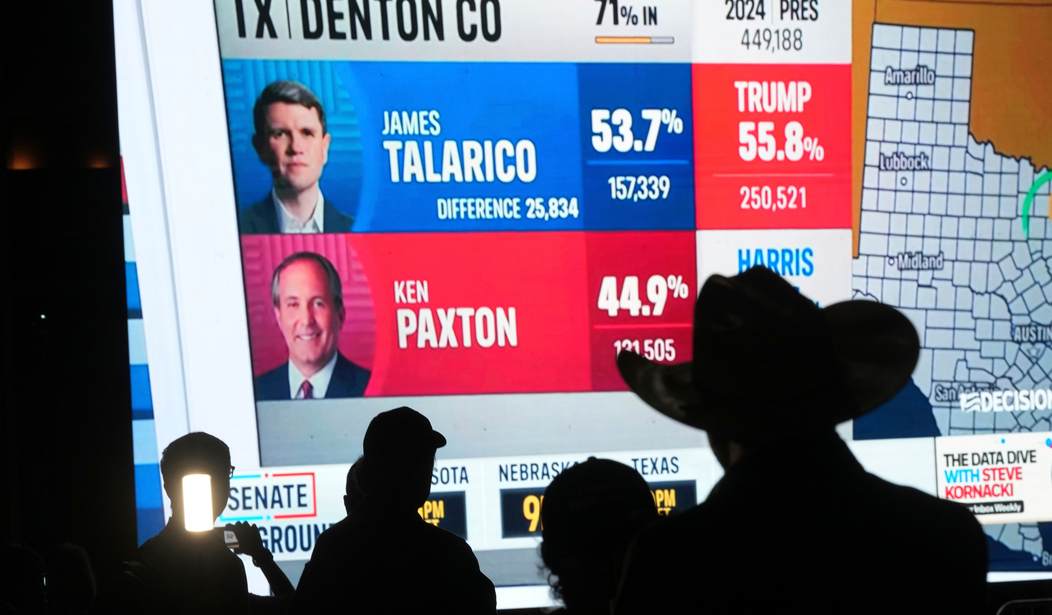
Republicans also lost ground among Hispanic voters, particularly in Texas, where Talarico won approximately six in ten Hispanic voters in the Senate race, according to the AP survey. The same demographic had been much more competitive for Trump in 2024.
There were serious turnout problems as well. The Texas Tribune documented strong participation in urban and border counties that helped produce the Democratic victory. Independent voters also moved toward Democrats, compounding the Republican losses among younger and Hispanic constituencies.
Dallas County was also particularly damaging for Republicans' statewide election hopes. As the Dallas Express reported:
Republican Thomas Smith led Democrat Okey Anyiam by 45,988 votes across the 253 Texas counties outside Dallas County in the November 3 race for the Texas Court of Criminal Appeals, Place 3, according to election returns Smith cited. But Dallas County delivered Anyiam a 283,819-vote advantage, more than enough to overcome Smith’s lead elsewhere.
“The GOP cannot survive without being competitive in urban counties, in Texas or anywhere else. It’s unsustainable. This is not a criticism of the current local party leadership. They’re working hard and trying. But this has to improve,” Smith wrote in his November 17 post.
He also wrote, “I remember when Dallas County was red. The city and the county were better. The quality of life, safety and the spirit was demonstrably better.” Smith added.
“The Left competes everywhere. Why do we not do the same?” he asked.
The results suggest the GOP's understanding of its own coalition was seriously outdated. Campaign strategies built around the assumption that Trump's gains among Hispanic voters and young men represented a durable political realignment did not anticipate the scale of the reversal.
Let's also touch on another political reality: The disproportionate gains made under Trump 2.0 for various segments of the economy.
The job market under Trump's second term has delivered uneven results, particularly for American-born men. By August 2026, women had reportedly accounted for nearly 90 percent of net payroll job gains since Trump's reelection.
Meanwhile, Reuters reported that foreign-born workers accounted for all net employment gains between July and October, while employment among native-born Americans declined. In fact, American-born workers lost 900,000 jobs in the last three months, while foreign-born workers gained 1.6 million jobs.
Brutal.
This is how the Democrat Party was able to persuade working class and young people that Trump and the GOP had abandoned them. If you want to look at the economic gains, that feeling appears to be justified.
And that leaves Republicans confronting a disturbing reality about the 2026 election. The party didn't simply suffer from a smaller electorate or a more motivated Democrat opposition. In Texas, a significant share of its previous support had changed sides.
The Republican Party had a chance to make life better for all voters while it had control of the House, Senate, and Presidency and simply failed to deliver on its promises.
That isn't to say that America doesn't have serious election integrity issues. It certainly does and we should do everything in our power to fix them.
But we have to deal with what is known in the Texas election. And what is known is the GOP mainly lost because it failed to persuade Texas voters the current state of affairs is an acceptable one.