
The Democrat Party has developed a peculiar understanding of American democracy: When voters elect a president Democrats find unacceptable, impeachment becomes the preferred method of overturning the will of the people.
And if at first they don't succeed at impeaching and removing the president? Apparently, the answer is to try and try again.
Now, with Democrats preparing to take control of the House of Representatives in January, the prospect of impeaching President Donald Trump for a third time is already being openly discussed.
The disgraceful thing is that Democrats have so thoroughly normalized impeachment within their party that they view it now as a routine tool of American politics.
Impeachment was never intended to be routine. It was designed as an extraordinary constitutional remedy for serious abuses of public trust, not a congressional vote of no confidence in a president whose policies the opposition dislikes.
But Democrats have increasingly treated impeachment as a means of establishing a political narrative: The president is unacceptable, his administration is illegitimate, and therefore his continued exercise of executive power must be resisted.
Whether the Senate actually removes him from office has become almost secondary to the political spectacle itself.
There is one rather significant hurdle for these socialist revolutionaries: The Founding Fathers anticipated precisely this kind of partisan abuse when they wrote the Constitution.
According to a November 16 Politico report, House Democrats are divided over whether to launch another impeachment effort against Trump when the new Congress convenes. Some Democrats argue the president has already committed impeachable offenses, but their listed "offenses" are complaints typical about presidents going back decades.
Other Democrats worry that another proceeding would backfire, derail their legislative agenda, and provide MAGA with fuel ahead of the next presidential election.
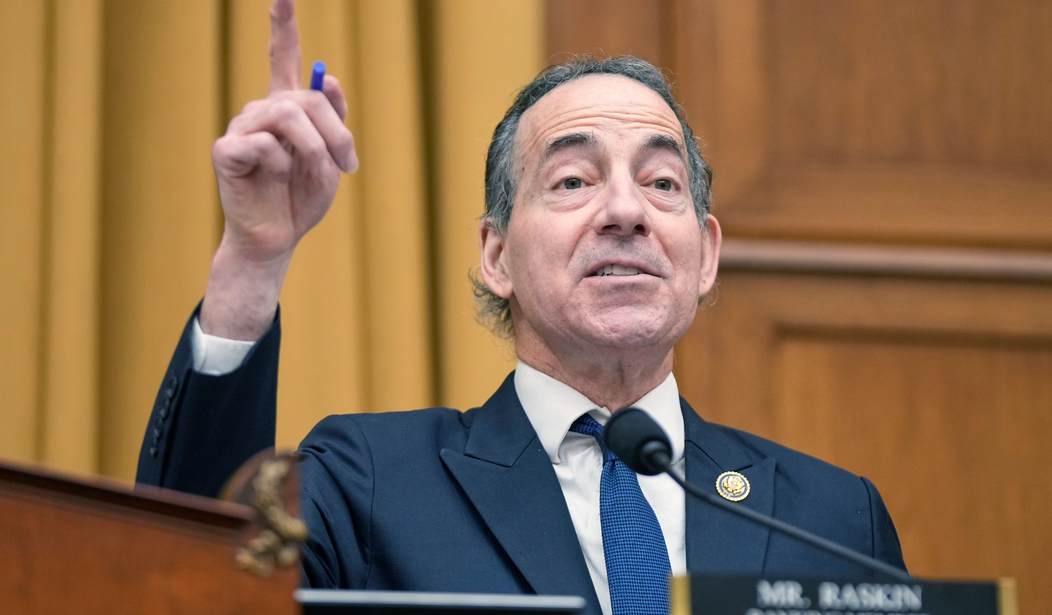
One prominent Democrat who has presided over this Congressional debauchery is Rep. Jamie Raskin (MD-08), who served as the lead impeachment manager during Trump's second "sham" impeachment trial and is positioned to become chairman of the House Judiciary Committee.
Raskin has previously described impeachment as a political option Democrats are prepared to exercise.
"It is a tool in the toolbox. We will not hesitate to use it if we need to use it," he declared.
Yet even Raskin apparently recognizes the dangers of pursuing impeachment simply because Democrats have regained congressional power.
"I think Donald Trump would love us to organize a campaign of impeachment against him right now because he thinks that's his last hope for rallying the dwindling MAGA base at this point," Raskin told Politico.
For once, Raskin may be onto something. Rep. Zoe Lofgren (CA-18), another veteran of the Trump impeachment proceedings, expressed similar reservations.
"Is the Senate going to convict? You need to weigh that in and whether to proceed," she said.
Democrat Rep. Gregory Meeks (NY-05) was even more emphatic. "No," he answered when asked whether Democrats should impeach Trump. "I'm a former prosecutor. You don't indict somebody if you don't think you can convict."
Democrat Rep. Bennie Thompson (MS-02), who chaired the House January 6 committee, was similarly reluctant. "Impeachment is not a priority for me," Thompson said, although he indicated he would support an impeachment resolution if it reached the House floor.
Not every Democrat shares these reservations. Rep. Rashida Tlaib (MI-12), who famously announced her desire to "impeach the motherfuc*er" shortly after entering Congress in 2019, continues to argue that impeachment should not be dismissed merely because it might become a political distraction.
Meanwhile, Rep. Becca Balint (VT-At Large) acknowledged the motivations driving some Democrat voters. "There's definitely a core of our base that wants revenge and vengeance, right?" Balint told Politico.
There it is. Whatever allegations might ultimately be included in articles of impeachment, the desire to remove Trump appears to precede agreement on the offenses that would justify removing him.
They are targeting the man and coming up with the excuses for impeachment. This reverses the constitutional logic of impeachment. Evidence of serious misconduct should lead to consideration of impeachment, not the desire for impeachment leading to a search for offenses.
Alexander Hamilton understood the danger. In Federalist No. 65, Hamilton warned that impeachment proceedings would inevitably inflame partisan passions, creating the danger that constitutional judgment would be subordinated to political faction.
He cautioned that such proceedings could be decided by "the comparative strength of parties, than by the real demonstrations of innocence or guilt."
That is precisely why the Constitution established separate responsibilities for the House and Senate. Under Article I of the Constitution, the House possesses the sole power of impeachment. A simple majority can approve articles of impeachment, effectively bringing formal constitutional charges against a federal officer.
But impeachment itself does not remove a president. That responsibility belongs to the Senate, where conviction requires the concurrence of two-thirds of the senators present. If all 100 senators participate, 67 votes are required.
The distinction is critical. A temporary House majority may accuse a president of wrongdoing, but it cannot independently overturn the result of a presidential election by removing him from office.
The Senate was intended to serve as an institutional barrier against precisely that possibility. The Founders were not naive about political parties or human nature. They understood that legislators would be tempted to use constitutional procedures for partisan advantage.
James Madison made a related argument during the Constitutional Convention of 1787. When George Mason proposed including "maladministration" among the grounds for impeachment, Madison objected that such an expansive and subjective standard would make presidential tenure dependent upon the Senate's political preferences.
"So vague a term will be equivalent to a tenure during pleasure of the Senate," Madison warned.
The Convention ultimately rejected "maladministration" and adopted the constitutional standard of "Treason, Bribery, or other high Crimes and Misdemeanors."
Presidents were not supposed to serve at the pleasure of Congress, as though the American republic were a parliamentary system in which a legislative majority could dismiss an executive whenever confidence in his leadership evaporated.
There is another historical consideration that makes this arrangement particularly interesting. The Senate of Hamilton's day was structurally different from the Senate Americans know today.
Originally, senators were selected by state legislatures rather than directly elected by popular vote. This arrangement protected the interests of the states while insulating the Senate from the immediate passions of national political movements.
That changed with ratification of the Seventeenth Amendment in 1913, which established the direct popular election of senators. The amendment eliminated an important feature of the Founders' original institutional design.
Senators became more directly exposed to electoral pressures, national political campaigns, partisan mobilization, and the shifting sentiments of the voting public. In that respect, the modern Senate is arguably more susceptible to the same popular passions that Hamilton feared could distort impeachment proceedings.
Fortunately, the constitutional requirement of a two-thirds majority remains intact. No American president has ever been convicted and removed from office by the Senate. Andrew Johnson survived conviction by a single vote in 1868. Bill Clinton was acquitted in 1999. Trump was acquitted twice during his first presidency.
The danger is not that impeachment is unconstitutional. It plainly is constitutional when exercised within its prescribed boundaries. The danger is that a legitimate constitutional safeguard can be abused for purposes contrary to its intended function.
And that is where Democrats may be making a serious political miscalculation.
First, using impeachment to remove a political opponent simply because he is politically unacceptable is an affront to representative government. The American people elect a president for a four-year term. Congress has a constitutional responsibility to hold the executive accountable, but not to substitute its partisan judgment for that of the electorate merely because an opposing party controls the House.
Second, the routine weaponization of impeachment undermines the Democrat Party's professed reverence for America's institutions. Democrats continually invoke the importance of defending democracy, constitutional norms and the rule of law. But treating constitutional safeguards as instruments for acquiring or consolidating political power suggests an opposing philosophy of government. Institutions are supposed to constrain the exercise of power, not merely provide additional means of weaponizing government.
Third, Democrats risk reinforcing the very political narrative that made Trump a formidable force in American politics. The MAGA movement has long portrayed Trump as an outsider facing relentless resistance from entrenched political institutions. Another impeachment proceeding, particularly one with little realistic prospect of conviction, would provide a fresh illustration of that argument.
Raskin himself appears to recognize the political danger. There is also a rather obvious succession problem that Democrats seem reluctant to contemplate.
Even if they somehow assembled the extraordinary Senate majority necessary to remove Trump from office, the result would not be a Democratic presidency. It would be President JD Vance.
Under the Twenty-Fifth Amendment, the vice president succeeds to the presidency upon the president's removal. And unlike Trump, Vance would not be constitutionally barred from seeking the presidency in 2028.
Indeed, removing Trump might strengthen Vance's position as the heir apparent to the MAGA movement, giving him the advantages of incumbency, a powerful political constituency and a compelling narrative about the removal of his predecessor.
Democrats might discover that an impeachment strategy intended to extinguish Trumpism had instead backfired in their faces. That would be a remarkable self-own.
Democrat House Minority Leader Hakeem Jeffries (NY-08) appears conscious of the risks, refusing to commit his party to impeachment.
"We haven't ruled anything in. We haven't ruled anything out," Jeffries told Politico.
Impeachment is not supposed to be a routine exercise in partisan messaging. It is not a substitute for winning elections, nor should it become a mechanism for delegitimizing every president whose political agenda offends the opposition.
The bitter irony is that the party most loudly proclaiming itself the defender of American democracy has helped normalize one of the most damaging forms of institutional warfare in modern American politics.
The biggest threat to democracy is now the Democrat Party itself.