
The National Flag League has some explaining to do.
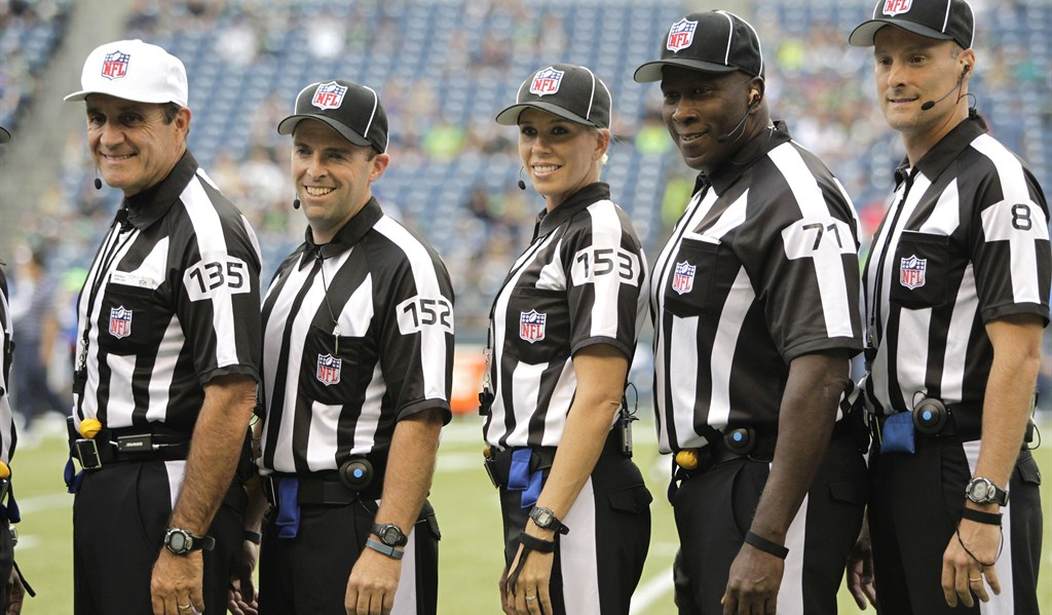
While today's professional football referees are tossing more laundry than a Chinese Washateria, many fans are wondering: Who are these funny people on the TV screen all the time and why are they deciding our football games?
There has got to be an explanation for why the NFL seems to be determined to kill the entertainment value of its own product.
Is it politics? Sports gambling? A bit of both?
Unfortunately, I don't have a Neuralink chip inserted into Roger Goodell's head that can tell me what the hell he is thinking. (At least, not yet: Stay tuned, VIP Gold subscribers!)
But what I do have is data. Lots and lots of data.
On this series of tubes called the "Internet," I was able to locate the current trends of NFL officiating toward teams whose owners contribute to political parties.
Before we look at the data, I want everyone lucky enough to be reading this article to venture a guess about the partisan leanings of NFL officiating.
Do you think that Republican owners or Democrat owners have teams that get flagged more?
The NFL needs to be investigated for its biased officiating. I don't know if it's a coincidence that 9/10 top penalized teams whose owners donate to political parties are Republicans. The least penalized teams whose owners donate to political parties are 6/10 Democrats. When you combine this with all of the sports gambling, all I know is that Goodell's NFL is extremely suspect.
— Kyle Becker (@kylenabecker) October 11, 2026
If you guessed "Republicans!" then congratulations, you are in full command of your mental faculties and there is no need to schedule a visit to a licensed neurologist. (Void where prohibited in California.)
Among the ten most-penalized teams in my comparison, nine of the ten owners with identifiable partisan giving leaned Republican.
Now consider the opposite end of the standings. Among the ten least-penalized teams, six of the ten owners in comparison leaned Democrat.
Nine out of ten at one end. Six out of ten at the other. Interesting, isn't it?
Let me be clear about what I'm saying here. I am not claiming to have uncovered a secret NFL directive instructing officials to penalize teams owned by Republican donors.
But here's the larger point. If the NFL had stayed the hell out of politics in the first place, nobody would have any reason to wonder whether political preferences might be influencing what happens on the field.
The league did this to itself. Remember the Colin Kaepernick controversy? The national anthem protests? The league's embrace of social justice messaging and the seemingly endless insistence that fans needed to receive a political sermon along with their Sunday football?
Goodell's NFL went out of its way to make political ideology part of its identity.
Now the league wants fans to assume that politics could never possibly influence its internal culture, its decision-making, or the people entrusted with enforcing its rules.
Sorry, but you don't get to spend years politicizing a sport and then act offended when people begin asking political questions.
And those questions are arriving at a particularly bad moment. As I reported last week at RedState, the NFL's officiating problem has reached absurd proportions.
According to an analysis by Warren Sharp, Week 4 of the 2026 season featured an average of 17 penalties per game, the highest total in any NFL week since 2015.
Offenses were flagged at a rate of 6.18 penalties per 100 snaps through the first four weeks, the highest rate for that stretch since 2000.
The flags are FLYING in the NFL this season 🚩 The NFL has seen the most accepted penalties through Week 4 since play-by-play data became available in 1978. Week 4 alone had 271 accepted penalties, the 2nd most in any week over that span. https://t.co/8JNfqTqzLG
— ESPN Insights (@ESPNInsights) October 6, 2026
And the penalties weren't simply occurring on inconsequential plays. They were disproportionately appearing in some of the most important moments of games.
Sharp found record levels of offensive penalties on third and fourth downs in the second half, along with an extraordinary number of red-zone flags. Through four weeks, 17 touchdowns had been wiped off the scoreboard by penalties. Seventeen.
At what point does the NFL stop being a competition between football teams and become an exhibition of referees deciding which plays are allowed to count?
I watched this nonsense unfold firsthand during the Jets-Bears game. And before anyone accuses me of being a bitter Jets fan, let me assure you that the Jets are perfectly capable of losing football games without any assistance whatsoever.
But watching interceptions disappear because of questionable penalties, including a bizarre hands-to-the-face call that the television broadcast never adequately showed, was enough to make anyone wonder what the officials were seeing.
Aaron Glenn Taunting The Refs With His Challenge Flag. 😂 😂 https://t.co/nJBgW2Ko7O
— SM Highlights (@SMHighlights1) October 11, 2026
The problem isn't merely that referees make mistakes. It's that the rules have become so subjective, their enforcement so inconsistent, and their consequences so enormous that a single official can effectively erase a touchdown, reverse a turnover, or determine the outcome of a game.
Now throw sports gambling into the equation. The NFL has transformed itself from an opponent of legalized sports betting into an enthusiastic business partner of the industry.
Sportsbooks advertise during broadcasts. Betting lines appear throughout football coverage. Fans are encouraged to think about point spreads, player props, and over-under totals almost as much as touchdowns and turnovers. And enormous sums of money are now riding on outcomes that can be influenced by one yellow flag.
As I reported in another RedState article, the NFL recently asked the Supreme Court to address the regulation of prediction markets, arguing that sports-related contracts should be subject to gambling restrictions.
According to CNBC, the league pointed to approximately $1.8 billion in football-related prediction-market trading on the opening Sunday of the season alone. The league itself has warned about bets involving circumstances that could be manipulated, including officiating decisions.
The NFL recognizes that certain betting markets create integrity risks involving officials, while fans are simultaneously watching an unprecedented avalanche of penalties reshape games.
Does that prove games are being fixed? No. But it creates precisely the environment in which suspicions flourish. And the NFL has done remarkably little to earn the benefit of the doubt.
The NFL could address some of this by making officiating data more transparent, publishing meaningful evaluations of officials, explaining controversial decisions, and allowing independent researchers to examine patterns in penalties across teams, crews, and seasons.
But there is little-to-no-accountability for bad officiating from referees who consistently get it wrong. They might as well be card-carrying members of the Democrat Party at this point.
Goodell's NFL wants fans to ignore what they're watching and trust that everything is fine. Well, everything isn't fine.
Football is supposed to be about amazing athletes making extraordinary plays. Instead, fans are spending an inordinate amount of their Sundays watching referees confer, broadcasters search for penalties on replay, and gambling lines shift while everyone waits to learn whether a spectacular play actually happened.
And if the people running it don't understand why fans are increasingly suspicious of both the officiating and the institution behind it, they have only themselves to blame.
You cannot politicize the game, monetize the gambling, turn the officials into the stars of the show, and then demand unquestioning confidence in the results.
The NFL built this credibility problem. Now it needs to prove the game is still worth trusting.
Because the most dangerous thing that can happen to a professional sports league isn't a bad call. It's millions of fans deciding that the whole thing has become a bad joke.
It's time to "fix" our NFL games. And not the way Vegas wants.