
If you have been paying attention to the national polls, one might think the Democrats are about to blow out the Republicans in a "blue wave" that would be more like a South Pacific tsunami.
But instead of running for the hills like it's a scene from The Impossible, GOP voters aren't batting an eye at all of the negative polls, such as the ones giving the Democrats a startling 8-to-9-point generic ballot advantage.
One mainstream pollster is coming clean with an astounding statistic about just how often his fellow pollsters underestimate GOP strength in election polls.
CNN chief data analyst Harry Enten recently highlighted data showing that early-October generic congressional ballot polling has understated Republican performance in 14 of the 16 election cycles since 1994.
CNN knows the polls are wrong… This is fun to watch! https://t.co/GtJCojF17f
— Tim Young (@TimRunsHisMouth) October 12, 2026
That's a horrible track record for an industry whose entire purpose is purportedly to measure public opinion.
Why do they constantly get it so wrong? Are they trying to measure public opinion or are they trying to manipulate it?
Whatever the answer, there doesn't seem to be a lot of willingness on the part of the polling industry to correct the faulty biases.
As of October 12, Nate Silver's Silver Bulletin puts Democrats ahead by 8.8 points on the generic congressional ballot. Its likely-voter adjustment stretches that advantage to 9.5 points.
Silver attempts to dismiss the underestimation of Republicans as sheer happenstance.
Since 2012, of course, there have been other systematic polling errors — but they usually haven’t been in Democrats’ favor. Instead, polls considerably underestimated Donald Trump and other Republicans on the ticket with him in 2016, 2020, and, to a slightly lesser extent, in 2024. (Irony #3: 2020 was actually the worst polling error of this trio, but the one election that Democrats won.)
To zoom out: In the 9 midterms or presidential years I’ve covered since FiveThirtyEight launched in 2008, polls have had a systematic bias against Democrats once, in 2012, a systematic bias against Republicans four times (the three Trump presidential elections + 2014), and were basically unbiased in the other four elections, including in the past two midterms.
That's harder to do when you zoom out further, like Harry Enten did. Yet Silver flatly refuses to "unskew" the polls and shift them towards Republicans.
RealClearPolling's average has also shown Democrats ahead by approximately eight points. Those are substantial margins. But the generic ballot is a survey of stated preferences, not a count of ballots actually cast. And the distinction matters.
There are several theories about what drives these discrepancies. When reached for comment, Rasmussen Reports' President Ted Carroll gave his professional opinion.
"Most pollsters are less than skillful and were, prior to Nov 2024, less than interested in accuracy and more interested in advocacy," Caroll told RedState. "With legacy media dominated by Democratic partisans, most pollsters wanted to please them and get pickup for their firm names across America."
"But they went way beyond their point of no return in shamelessly boosting Kamala Harris and have since suffered from it," he added. "We've kept our national likely voters survey party weighting the same for over 4 years now (D35, R33, I32) and it seems to work but the acid test will of course be next month."
"And the so called national Generic Ballot is not predictive when a successful targeted state race strategy is being utilized including massive midterms rallies and even a GOP convention," he continued.
"So we're not focusing on Generic Ballot but we run it for readers anyway," Caroll went on. "What we are most interested in now is likelihood to vote by demographic. We are running 'Excited To Vote?' questions in all our state surveys and we now follow our weekly national Generic Ballot question with an excitement question and will start reading the tea leaves on making any adjustments from it from now on out."
REMEMBER 2024 Flashback: "I think it surprised people, because there was these PUBLIC POLLS that came out in late September, early October, showing us with LEADS that WE NEVER SAW.” - David Plouffe Video - https://t.co/dL1E4Fbh6Y https://t.co/7xu3rZeB7R
— Rasmussen Reports (@Rasmussen_Poll) October 11, 2026
Enten's historical comparison, as presented in the circulating CNN clip, suggests that Republican performance has frequently exceeded what the polling indicated at this stage of the campaign.
When reached for comment, the People's Pundit Rich Baris discussed the problems with relying on the generic ballot to draw conclusions about election results.
"It's a complicated question because Harry Enten is notorious for cherrypicking arbitrary dates like he did with 1994 in this case," Baris said.
"The Generic Ballot has actually gotten a lot more accurate since 2004, even more so with each passing cycle even in the Trump era," he added. "Part of that was the advent of the RCP average and who was included in it, and the other methodological changes. It's the state polls I am more concerned about at this point."
Baris also explained the problems in a recent podcast episode.
3:15 mark: I do expect media/uni polls, particularly in certain states, to understate Republicans. The problem with prior comparisons to suggest prior misses indicate future misses citing averages, is that the averages have changed to include polls that did NOT understate them.
— Rich Baris THE PEOPLE'S PUNDIT (@Peoples_Pundit) October 13, 2026
"Here's the problem with the argument that Republicans are always understated in these polls and somehow that is going to lead to an overperformance in the Senate," Baris said. "Yes, that's possible. But it is at least if not more likely for a myriad of reasons that that doesn't happen, even though I do, I do, expect media and university polls to overstate, or I would say, overstate the Democratic margin."
"Because we haven't seen, in a lot of these states, Democratic candidates hitting 50% or above," he added.
"But when there's been polling misses, it's not that they have been very wrong about what share of the vote the Democrat was going to get, it's that they've been wrong about the share of the Republican vote," he went on.
"And here's the problem, number one biggest problem, with the argument Democrats will underperform and Republicans will overperform," he continued. "Most of the polls that have been accurately predicting Republican vote share and the margin were not in those cycles in the aggregate averages that all of these people were citing."
Baris added that the best pollsters of the Trump era, including himself, were not included in the historical data that Enten refers to when going back 16 election cycles.
So, that brings us to the question: is there something fundamentally wrong with polling of strong conservatives and Trump supporters?
The American Association for Public Opinion Research (AAPOR) has repeatedly examined polling failures involving Republican voters.
Its review of election polling accuracy acknowledges that polls underestimated Donald Trump's support in key states in 2016 and overestimated Joe Biden's support in 2020.
If the Republicans who readily answer surveys differ politically or behaviorally from Republicans who ignore them, conventional weighting may not eliminate the distortion.
That is the problem researchers call nonresponse bias. And it may be especially consequential in the Trump era.
Republican pollster Patrick Ruffini of Echelon Insights has examined geographic patterns in which strongly Republican voters appear especially difficult to reach.
As Newsmax reported, Ruffini found that polls conducted at comparable points between 2018 and 2024 overstated Democrat Senate support by an average of 6.2 points in Iowa, Michigan and Ohio. Those states feature competitive Senate races this year.
One is straightforward distrust. Voters who dislike the political establishment may also distrust polling organizations, news outlets and unfamiliar callers asking questions about their political preferences.
Another involves differences in political engagement. Someone who is frustrated with Washington may have little interest in participating in a survey but still consider voting a civic obligation.
A third concerns the distinction between dissatisfaction with Trump and actual support for Democrat candidates.
A Republican might disapprove of the president's handling of a particular issue without having any intention of voting for a Democrat.
And a fourth possibility is that turnout models fail to anticipate voters who become engaged only as Election Day approaches.
These explanations are not interchangeable. Some concern which voters answer surveys; others concern how respondents answer questions or whether they ultimately vote.
But all point to the same challenge: Measuring political sentiment is not the same thing as measuring the electorate that actually turns out.
This may be the most overlooked issue in the current polling debate. Republicans who are unhappy about inflation, foreign policy or congressional performance are not necessarily preparing to vote Democratic.
Some may be less enthusiastic about politics. Others may decline to identify themselves as Republican in surveys. Still others may be undecided about whether to participate.
But once confronted with an actual ballot, their choice can look quite different from their response to a hypothetical survey question weeks earlier.
That possibility helps explain why a sizable Democratic generic-ballot lead deserves scrutiny rather than automatic acceptance as an Election Day result.
Enthusiasm is another variable. A recent Reuters/Ipsos survey found that 48 percent of 2024 Harris voters were very enthusiastic about voting, compared with 30 percent of Trump voters.
Rasmussen found other numbers that were favorable to Democrats in the upcoming midterm elections.
How excited are you about voting in the midterm elections? VERY EXCITED TO VOTE All Voters: 54% Men: 52% Women: 55% 18-29: 33% 👈 30-39: 44% 40-49: 47% 50-64: 56% 65+: 74% 👈 White: 54% Black: 50% Hispanic: 45% Other: 51% DEM: 66% IND: 42% GOP: 51% https://t.co/ckKzTbGd7y
— Rasmussen Reports (@Rasmussen_Poll) October 11, 2026
Yet the fundamental difficulty remains: You cannot directly measure the political preferences of people who refuse to participate.
The question for 2026 is whether today's surveys are accurately capturing a Democratic advantage or overstating it because important segments of the Republican electorate are missing from the samples.
An eight- or nine-point national lead is a substantial claim about the political landscape. It deserves to be examined against historical polling errors, turnout patterns and the industry's documented difficulties reaching certain Republican voters.
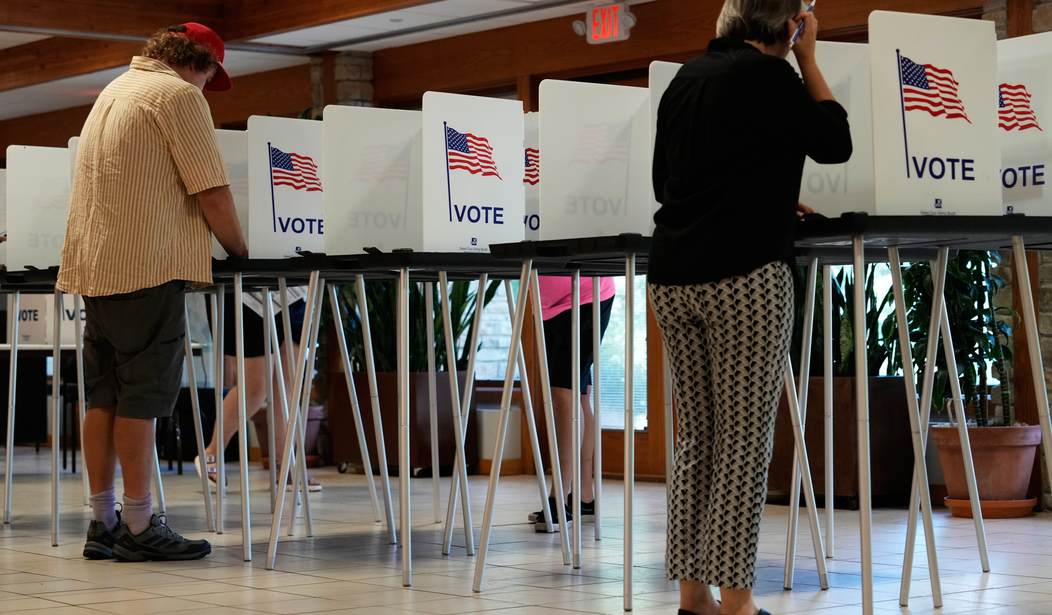
In the midterm elections, Americans will do something much more consequential than answer a telephone or online survey. They will vote.
And when voters go into their booth and choose to mark their ballots, are they going to be willing to mark (D) for the party that gave us an unmitigated disaster during the Biden years?
On November 3rd, Americans are going to find out.