






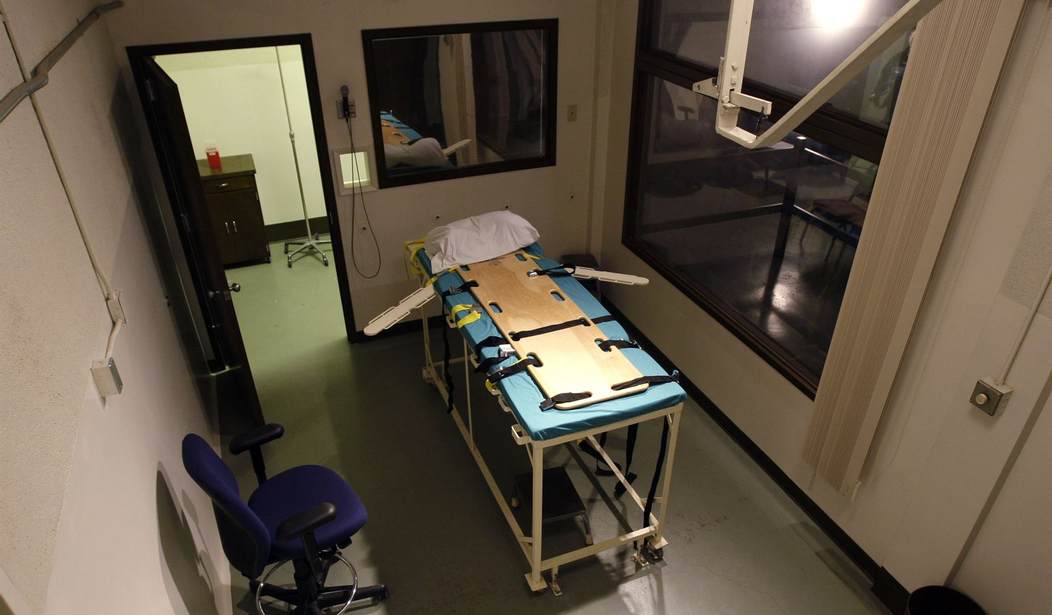
Tennessee has a competence problem on its hands.
After the state's attempt to execute Christa Pike went disastrously wrong Wednesday night, attention should now turn to the people and procedures responsible for carrying it out.
This isn't complicated. The state knew the execution date. It controlled the drugs, equipment, personnel, and death chamber. It had an established protocol and months to prepare for one of the highest-profile executions Tennessee has carried out in decades.
And Pike was still alive after the state tried to kill her.
As of this report, Pike was sent to the hospital after the failed attempted execution.
BREAKING: Christa Pike is on her way to the hospital and receiving medical care.
— Lauren Conlin (@conlin_lauren) October 1, 2026
"As a supplemental response, the respondent reports that the petitioner is being transported to a hospital and is receiving medical care." pic.twitter.com/Z9xdo5R4cU
That makes the qualifications and performance of the execution team fair game for scrutiny. It's an especially important question because Tennessee already had another execution failure this year. In May, the scheduled execution of Tony Carruthers had to be abandoned after officials were unable to establish suitable intravenous access.
And here's an interesting connection: Dr. Mark Walton Fowler, the physician involved in that failed procedure, told NBC News before Pike's execution that he planned to participate in hers as well.
That doesn't establish that Fowler did anything wrong Wednesday. But after two major failures involving the same state's execution system, investigators should be asking some fairly basic questions about personnel, training, and procedures.
Who placed Pike's IV? Who verified it? Who prepared the pentobarbital? Who administered it? Was the correct amount delivered? Did the drugs actually enter Pike's bloodstream as intended? What monitoring was performed as the execution progressed?
And what qualifications did the people performing each of those tasks have? Those questions become even more interesting because Pike's execution was never going to be an ordinary one.
Pike had made several unusual requests based on her history of sexual abuse by men. Tennessee officials said they would attempt to accommodate her request for female guards when she was transferred to Riverbend Maximum Security Institution, and reporting before the execution indicated that an all-female execution team could also be assigned.
Pike actually wanted to go considerably further. She reportedly requested that Tennessee execute her with an all-female firing squad rather than lethal injection. Tennessee law doesn't authorize firing squads, and Pike's lawyers also floated hanging as an alternative before a judge rejected that proposal.
The state therefore knew that personnel selection was an unusual issue in this particular execution. That leads to a question people are inevitably going to ask: Did Tennessee's effort to accommodate Pike's request for female personnel have any effect on who was selected for the execution team?
Right now, there is no evidence that it did.
I'm just going to say it, I think that the all-female execution team botched this on purpose.
— Cassandra MacDonald (@CassandraRules) October 1, 2026
Nor is there evidence that any female member of the team was unqualified, much less that the sex of the personnel had anything to do with the failed execution. The reported participation of Fowler, a male physician with previous execution experience, is also a significant fact cutting against simplistic explanations.
But that's exactly why Tennessee should disclose how the team was selected. The relevant issue isn't whether the executioners were men or women. It's whether every person assigned to the procedure was chosen first and foremost because he or she was the most qualified person available for that particular job.
If the answer is yes, say so. Explain their qualifications and explain what actually failed. Because there are plenty of other possibilities.
Pike's attorneys had warned before the execution that she had small veins and a blood condition that could complicate lethal injection, claims the state disputed. Their concerns weren't presumptive, given Tennessee's inability to establish adequate IV access during the Carruthers execution attempt.
Pike herself apparently saw trouble coming. Before Wednesday's execution, she declined to request the customary last meal and said she was "at peace" with dying.
"I am not afraid to die," Pike said. "I’m only nervous about the process."
That quote hits different now. There are technical questions Tennessee should answer before anybody settles on an explanation. The problem could have involved IV access, drug delivery, dosage, Pike's physiology, execution-team performance, the state's protocol, or some combination of those factors.
But that's why the competence question comes first. This was not some unpredictable emergency in which government employees had seconds to make life-or-death decisions. An execution is arguably the most controlled exercise of government power imaginable.
The state even has a written procedure for what happens if the first lethal dose doesn't work. What Tennessee apparently didn't have was a successful outcome.
This brings us to another eerie story out of Tennessee that had to do with switching medications, this time in a Nashville hospital.
As RedState previously reported, four patients undergoing joint-replacement procedures received potassium phosphate that had been mislabeled as mepivacaine. The consequences were horrific.
State investigators found all four patients had to be transferred to higher levels of care. As of investigators' Aug. 21 exit, one remained on ECMO life support while three continued suffering serious lower-body neurological impairment, including paralysis and loss of sensation.
And investigators found a disastrous chain of breakdowns before the wrong medication ever reached those patients.
Then there is this nugget from Fox News that throws everything into a new light. Her supporters wanted a Clancy-style mental health defense to prevent her execution.
Pike's supporters counter that her defense did a poor job presenting mitigating factors before her sentencing, including untreated bipolar disorder and PTSD stemming from repeated domestic violence and sexual assaults. Just under 25,000 people had signed a petition to Gov. Bill Lee asking him to commute her death sentence to life in prison.
Who was on that execution team? How were they selected? What were their qualifications? Did everyone follow protocol? And what, precisely, went wrong?
After one failed execution, those questions would be reasonable. After two troubled execution attempts in the same year, they're unavoidable.
Editor's Note: The mainstream media continues to gaslight, spin, and lie about President Trump, his administration, and conservatives.
Help us continue to expose their left-wing bias by reading news you can trust. Join RedState VIP and use promo code FIGHT to receive 60% off your membership.



Join the Conversation
VIP members get the ability to comment on articles.