








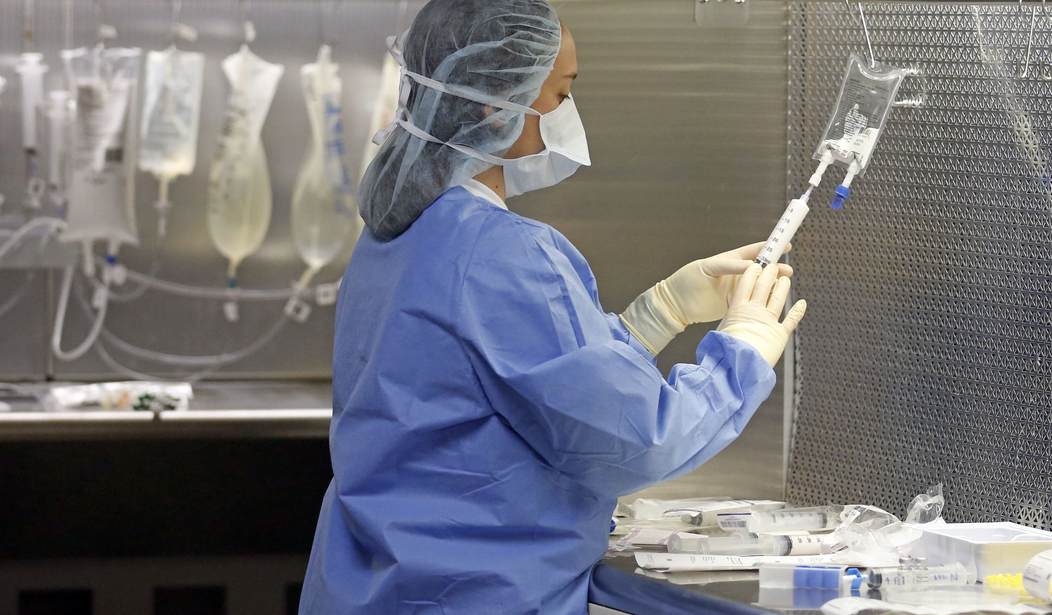
A routine trip to the hospital for joint-replacement surgery turned into a medical nightmare for four patients in Nashville after a pharmacy error allegedly resulted in them receiving a potentially dangerous potassium compound instead of an anesthetic.
Two of the patients were reportedly left paralyzed, one remains on a ventilator, and multiple patients went into cardiac arrest following the August 14 incident at Ascension Saint Thomas Hospital Midtown.
The Tennessee Bureau of Investigation is now involved. According to the hospital, the four patients were supposed to receive mepivacaine, a local anesthetic commonly used during surgical procedures. Instead, the hospital's pharmacy supplied potassium phosphate.
In excessive amounts or when administered too rapidly, potassium can cause potentially fatal changes in heart rhythm and cardiac arrest.
Ascension Saint Thomas acknowledged the error Friday.
“Our hearts remain entirely with the four patients and families impacted by the recent event at Ascension Saint Thomas Hospital Midtown,” the hospital said. “On behalf of our leadership and care teams, we extend our deepest apologies for the harm caused.”
Well, that's quite the "whoops." It is unclear if the "apology" will lead to damages paid to those who were harmed.
CBS News recently covered the drug mix-up:
A drug mix-up at a hospital in Nashville, Tennessee has reportedly left two patients paralyzed and at least one other on a ventilator. Officials say they were given the wrong medication prior to surgery. https://t.co/kDfkVGl4Yl pic.twitter.com/rpXp1N7ALV
— CBS Evening News with Tony Dokoupil (@CBSEveningNews) August 20, 2026
WZTV reported that the mistake originated inside the hospital pharmacy.
“Ascension Saint Thomas is revealing new details about a medication error at its Midtown hospital that harmed four joint replacement patients, saying the patients mistakenly received potassium phosphate instead of an anesthetic medication.”
The hospital said all four patients suffered adverse reactions and received immediate treatment. Its review has so far found no evidence that additional patients received the incorrect medication.
One of the affected patients was 72-year-old Glenda Dorton, whose family told FOX 17 (WZTV) that she had arrived at Saint Thomas Midtown for what was supposed to be a routine knee replacement.
Instead, she became one of four patients caught in the medication mix-up.
“The four patients experienced adverse health reactions and received immediate medical care,” the hospital said.
READ MORE: She Sold 2,956 Fake Nursing Diplomas - Thousands Are Still Licensed Nurses
Precisely how potassium phosphate came to be substituted for mepivacaine — and what safeguards failed to catch the error before the drug reached four separate patients — are now obvious questions for investigators.
The involvement of the Tennessee Bureau of Investigation also elevates the matter beyond an ordinary internal hospital review. The agency's investigation could determine whether the episode involved criminal negligence or other conduct warranting state action.
But some online have looked to the hospital leadership as a potential culprit in the shocking case.
Ascension Saint Thomas Midtown is led by Dr. Shubhada Jagasia, a longtime physician and endocrinologist who serves as president and CEO of Ascension Saint Thomas Hospital, Midtown and West campuses. Jagasia received her medical degree from Seth G.S. Medical College in Mumbai before completing postgraduate training in the United States.
There is no reported connection between Jagasia's education or credentials and the pharmacy error. But the incident comes amid a separate national debate about the increasingly international pipeline supplying America's healthcare workforce — and whether credential verification systems are keeping pace.
That debate intensified this summer after Indian authorities uncovered an enormous alleged academic-fraud network involving dozens of universities.
Investigators reportedly seized roughly 100,000 fraudulent degrees, certificates, transcripts and related documents from a network spanning at least 28 institutions. The forged credentials covered numerous fields, including medicine, nursing and engineering, and authorities said some may have been used to support applications for U.S. H-1B visas.
One university alone was accused of issuing more than 36,000 fraudulent degrees.
That doesn't mean foreign-trained physicians broadly present a quality problem. In fact, the available data point in a counter-intuitive direction.
The Federation of State Medical Boards' figures show roughly 250,000 internationally trained doctors among America's actively licensed physicians in 2024, up from about 189,000 in 2010.
India remains one of the largest individual sources, accounting for roughly 52,000 internationally trained physicians practicing in the United States. Pakistan, the Philippines, Mexico and several Middle Eastern countries also provide substantial numbers of doctors, while graduates of Caribbean medical schools have grown particularly rapidly.
Yet as America's reliance on internationally trained physicians has increased, paid medical malpractice claims have generally moved in the opposite direction.
National Practitioner Data Bank figures show paid malpractice claims have declined dramatically from their early-2000s peak of roughly 19,500 annually. Recent totals have generally landed somewhere between approximately 9,000 and 12,000 per year.
Other patient-safety measures have improved as well. Federal data show declining rates for several major hospital-acquired infections, while AHRQ measurements of adverse events among hospitalized Medicare patients fell from roughly 7.1 percent in 2021 to about 5.2 percent in 2023.
So it would be difficult to make the case from those numbers that a larger foreign-trained medical workforce has coincided with worsening patient safety. The broad trend actually appears to be the reverse.
But medical errors remain notoriously difficult to measure. Malpractice payments capture only cases ending in a financial settlement or judgment, not every mistake or adverse event. Hospital reporting systems also vary considerably, and researchers have long warned that many medical errors never make it into national statistics.
That's what makes the Nashville case so disturbing. This wasn't an obscure diagnostic disagreement or an unexpected complication during a difficult surgery. According to the hospital's own account, four patients were simply given the wrong drug.
And apparently the same mistake made it through the system four times. Hospitals have elaborate medication controls precisely because a seemingly small pharmacy error can become catastrophic once a drug enters a patient's bloodstream.
Now state investigators are trying to determine how it happened — and why nobody stopped the "mix-up" before patients began going into cardiac arrest.
Editor's Note: The mainstream media continues to gaslight, spin, and lie about President Trump, his administration, and conservatives.
Help us continue to expose their left-wing bias by reading news you can trust. Join RedState VIP and use promo code FIGHT to receive 60% off your membership.



Join the Conversation
VIP members get the ability to comment on articles.