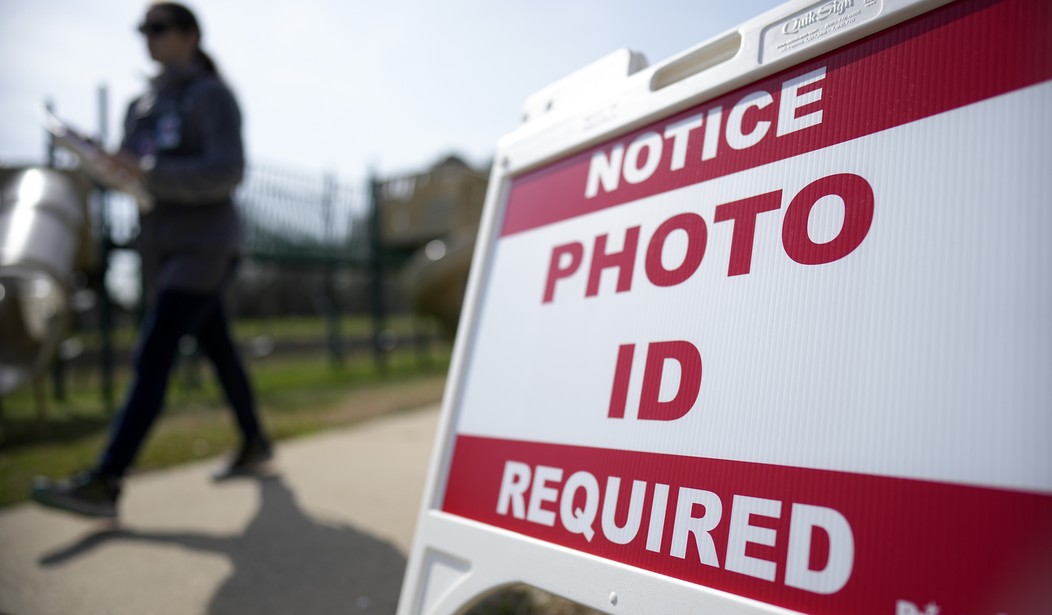

Why are Democrats so determined to stop voters from having to prove they are legally able to vote?
The Democratic Party's lockstep opposition to voter IDs is one of the most baffling positions that any major political party has staked out in American history.
Yet the Democrats are willing to risk the American people's wrath and openly defy them on the issue of election integrity. Why?
Well, America now has the Democrats on the record. Senate Dems just handed Republicans one of the biggest political contrasts imaginable heading into the midterms. In an early Saturday vote, not a single Democrat voted to advance legislation requiring voters to present photo IDs in federal elections.
S. 5271 failed 52-46, short of the 60 votes required to move forward. Every senator voting yes was a Republican. Democrats unanimously opposed advancing the measure. Mitch McConnell, unsurprisingly, was a “no show.” The bill would amend the Help America Vote Act of 2002 to establish a federal photo-ID requirement for voting, including identification requirements connected to mail ballots.
Sen. Alex Padilla of California argued on the Senate floor that the proposal goes further than voter-ID laws already operating in some states, particularly because of its requirements for people voting by mail.
Now, we wouldn’t want California voters to prove they are eligible to vote, would we?
The vote came during the Senate's final marathon session before lawmakers departed for August recess.
READ MORE: Senate Passes Stopgap Bill, Kicks Shutdown Fight Past Midterms
As Ben Smith reported, Senators separately approved a continuing resolution 90-6 that would fund the government through December 11, pushing the next funding deadline beyond November's midterm elections. Because the Senate version differs from the House-passed legislation, the funding fight isn't completely finished. The House still has to act on the Senate measure.
So, the money is a lot more popular than secure elections. Qu’elle surprise.
But on voter identification, there is no bipartisan coalition. Zero Senate Democrats voted yes. And that shouldn’t be something we shrug our shoulders about. It is one of the most brazen defiances of the popular will in American history.
A 2025 Pew Research Center survey found 83 percent of Americans support requiring voters to show government-issued photo identification. That included 95 percent of Republicans and Republican-leaning voters and, notably, 71 percent of Democrats and Democratic leaners.
Gallup found an even higher number: 84 percent support requiring photo ID at the polls. Gallup also found 83 percent support requiring proof of citizenship when someone registers to vote for the first time.
So, we're talking about a policy supported by more than eight out of every ten Americans.
Yet it couldn't attract one Democratic vote in the Senate. And requiring voters to establish their identity is hardly some uniquely American or radical idea. 176 nations on earth require some form of voter ID.
Ghana, for example, tells voters to bring their voter ID card to the polling station, where officials check their information and verify their identity using a verification machine. Ghana used that system during its 2024 presidential and parliamentary elections.
India, the world's largest democracy, maintains Electoral Photo Identity Cards and an electoral roll through its Election Commission. Its election authorities specifically instruct voters to verify their registration and identity information before voting.
And Argentina, which held national legislative elections in 2025, requires voters to appear on the electoral register and present an authorized physical identity document. A digital ID, passport or driver's license isn't enough.
In other words, countries across Africa, Asia and South America have managed to combine mass democratic participation with voter identification.
The standard Democratic argument in the United States has long been that stricter identification requirements risk suppressing turnout, particularly among minority and lower-income voters. But major research deflates that disingenuous argument.
A National Bureau of Economic Research study examining a nationwide dataset covering elections from 2008 through 2018 found no negative effect from strict voter-ID laws on registration or turnout, including when voters were broken down by race, gender, age and party affiliation.
Another NBER analysis found that the number of ballots cast without identification in Florida and Michigan was so small that strict ID requirements were unlikely to have a meaningful effect on either overall turnout or election outcomes.
A study of Georgia's law estimated an overall turnout reduction of roughly four-tenths of one percentage point in 2008 but found no evidence of a racial or ethnic suppression effect.
So, there isn’t any real-world evidence to back up the left’s hysteria about voter IDs leading to mass voter suppression.
Valid elections should take priority over that concern anyway. If someone wants to vote in an election, that person should be able to vote, provided that person can prove their identity — even if it means getting a free voter ID.
So, here’s the basic question Republicans are going to hammer Democrats with between now and November: Why oppose making voters prove they are eligible to vote?
Federal law already prohibits noncitizens from voting in federal elections. The dispute is over what evidence voters should have to provide to demonstrate identity and eligibility.
Americans are already accustomed to identity verification throughout ordinary life.
Banks are federally required to maintain procedures allowing them to reasonably verify the identity of people opening accounts.
Air travelers face federal identification requirements at TSA checkpoints.
Government programs routinely require identity verification to establish eligibility and prevent fraud.
Yet when Republicans proposed a nationwide photo-ID standard for voting, 46 senators voted against even advancing it, with not one Democrat supporting cloture.
The problem for Democrats is it's not just that Republicans support voter ID. The American public overwhelmingly does too.
When 83 to 84 percent of the country supports a policy, including large majorities across party and racial lines, calling that policy “extreme” is a difficult sell.
After today's Senate vote, Republicans have an extraordinarily simple message to take into the midterms: We tried. Every Senate Democrat who voted said no.
Democrats shouldn’t have to explain “why” at this point. The American people should answer with voting out as many Democrats as possible. While they still can.