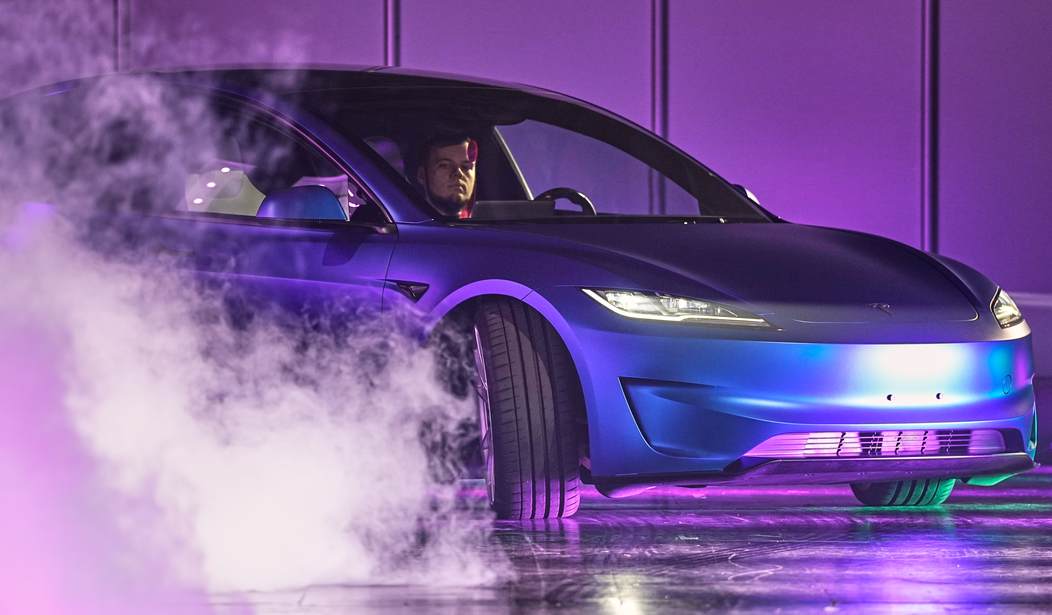

There was plenty of reaction to the Thursday night livestream held by Tesla and SpaceX CEO Elon Musk, where the prototype of his insane new “flying Roadster” made its debut on the world stage.
Many observers were thrilled, with OpenAI CEO Sam Altman tweeting, “Wow the new roadster looks quite amazing, good job @elonmusk” and the automotive information company Edmunds writing, “The Tesla Roadster is real and it can fly and it looks incredible in person.”
It’s hard to argue that the display was anything less than dramatic:
This is unbelievable. The new Tesla Roadster can fly. pic.twitter.com/yajNrUvYFA
— Clay Travis (@ClayTravis) October 16, 2026
President Trump was enthused, but said he probably wouldn’t get behind the wheel computer of one anytime soon.
Donald Trump on the Tesla Roadster: “I don’t know whether you’re going to see me in that car but it’s very impressive” 🤣 pic.twitter.com/KHLhsqQA4Y
— ALX (x/acc) 🎃🇺🇸 (@alx) October 16, 2026
But there was also plenty of negativity surrounding the event. Wrote one social media user:
I hate to be the one to burst the Tesla bubble today, but the spectacular “flight” we witnessed at the Roadster reveal needs a little context. The car is carrying around 250kg of compressed air, plus the weight of the tanks, valves and thrusters needed to contain and release it.
Based on the published figures, that gives it roughly 1.5–2 seconds of maximum thrust before the system needs to be refilled.
In short, it's a gimmick.
Other commenters raged that the three models that will purportedly go into production in 2028 are unlikely to be street legal, seem highly dangerous, are hopelessly impractical, and are a stupid waste of time and resources.
To them, I say bah, humbug. Being tech-cautious is understandable in this day and age, but progress is inevitable and those who try to fully put the brakes on it rarely succeed.
Do you know what fashion shows are for? Not to get you to buy the $10,000 couture dress sported by a skinny model who looks angry because she's hungry. It’s to get you to go, “Oh, wow, that’s nice. I like that designer.” Then you go overpay for one of their T-shirts at Macy’s. A spectacle like this isn’t just to convince the local billionaire to come out and drop $500K on a car that can jump; it’s also to entice regular folks into venerating the company and buying a far lower-priced model in the future.
Meanwhile, do you think the first lightbulb was practical or safe? Hint: It wasn’t. It was invented in the 1880s, but Thomas Edison’s creation took 40-70 years to be adapted, refined, and improved to the point where it became an essential feature, lighting up cities and homes around the world.
And think of this: Before SpaceX came along and nuked the narrative, most observers, experts, and investors thought there was no way in hell a private orbital launch company could succeed on a commercial scale.
Now Elon Musk is the richest man in the world, and they’re not.
We were years away from autonomous vehicles… until suddenly we weren’t. Now there are Waymos driving all over Hollywood, and frankly, they make me nervous, but I have to admit that from what I’ve been seeing, they operate more safely than the vehicles of yahoos I often see screeching down Sunset Boulevard.
As I observed in my coverage of the Roadster debut, we’re in the midst of an unmatched technological revolution:
There’s a popular statement going around that goes something like this: “People alive today have seen more technological change than in all of human history combined.” We can split hairs and argue whether that’s 100 percent accurate, but I think we can agree on a modified version: “People alive today are experiencing technological change at a pace unmatched in human history.”
If you still don’t like that one, how about: “Holy… What the heck did we just watch?!” What a time to be alive.
The point is that we’re looking at one of the great innovators in modern times, and what the naysayers miss is that perfect products don’t come out of nowhere. They are developed, improved over time — often decades — until they change the world as we know it.
Do you remember your first personal computer? If you could get it up and running today, you would find it utterly useless. The beginnings of the internet were similarly unimpressive — you could send a few lines of green text to someone; that was about it. No videos, no social media, no pictures; in fact, there was very little of use except for the fact that it seemed kind of cool.
Who knew that it would eventually alter our life experience, and that the technology would morph into iPhones and Facebook and high-speed internet that would come to dominate the planet.
Love him or hate him, Elon Musk continues to be perhaps the biggest innovator on the globe, and he keeps pushing us forward into the future. Are these new Roadsters “practical” for everyday Americans? Am I going to run buy one the second it comes out?
No, and no. What they represent, however, is progress. Without that, what you get is stagnation.
Stagnation kills nations.
For all those freaking out about the safety implications, it will undoubtedly take years of regulation, new laws, and design improvements before you’ll ever see flying cars over the highway.
There’s a legendary Dear Abby column from 2000 where a 36-year-old was complaining about how long it would take to get a medical degree:
If I go back to college and get my degree, then go to medical school, do my internship and finally get into the actual practice of medicine, it will take me seven years! But, Abby, in seven years I will be 43 years old. What do you think? — Unfulfilled in Philly
Dear Unfulfilled:
And how old will you be in seven years if you don’t go to medical school?
Maybe Musk/Tesla/SpaceX didn’t deliver the perfect car for most commuters today — what they did is give us a glimpse of what’s coming tomorrow. And that’s important.
“Shoot for the moon. Even if you miss, you’ll land among the stars.”
Of course, we could always settle for this:
USA vs. Europe pic.twitter.com/PVBaoUfr2L
— ColdJack (@TheColdJack) October 16, 2026