






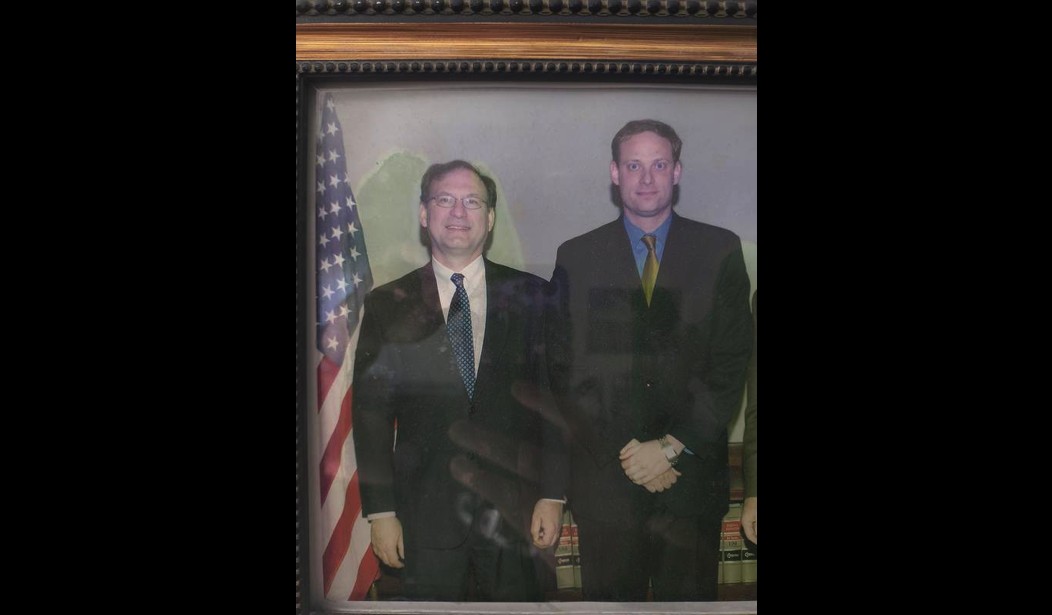
The conservative majority of the Supreme Court looked around, and all they saw were Democrats gerrymandering congressional districts based on race to maximize the number of Democrat-held U.S. House seats. And they wept for our country. So, Justice Sam Alito, my old buddy from my Senate Judiciary Committee days, gave his five comrades advice on how to deal with the whole degraded system:
“I say we take off and nuke the site from orbit. It's the only way to be sure.”
Despite Justice Elena Kagan’s whining complaints, which can be seen here, that is exactly what the Court did.
As Redstate has reported:
The U.S. Supreme Court on Wednesday struck down Louisiana's congressional map in Louisiana v. Callais, finding that the state's second majority-Black district violated the Equal Protection Clause. In the 6-3 decision, Justice Samuel Alito wrote the majority opinion, joined by Chief Justice John Roberts and Justices Clarence Thomas, Neil Gorsuch, Brett Kavanaugh, and Amy Coney Barrett.
Soon after, the U.S. Justice Department vowed it would enforce the ruling in every state with racially gerrymandered districts.
READ MORE: Trump DOJ Vows to Enforce SCOTUS Ban on Racial Gerrymandering Nationwide—Obama Hardest Hit
This is great news. The Callais decision affects much of the South. The Court greatly restricted racial gerrymandering, such as what occurred in Louisiana, by limiting – but not eliminating – the use of Section 2 of the Voting Rights Act to require the creation of a majority-minority district. As a respected conservative legal expert has opined:
(The Voting Rights Act) may have addressed issues that were still live when it passed in 1965, but for almost all of its history it has been a thumb on the scale for the benefit of the Democratic Party. The prevailing principle seemed to be that gerrymandering by Democrats was legal, while gerrymandering by Republicans was illegal. But the Supreme Court has chipped away at the baleful effects of the Voting Rights Act, and today’s decision was another step forward.
This decision certainly has nuked the Democrats' plans — and racial gerrymandering — from orbit. Of course, it also led to an over-the-top response. Democrat House Leader Hakeem Jeffries (NY-08) denounced the Supreme Court as “illegitimate” and complained that this was a GOP plan to “rig the midterm elections.”
Callais will almost certainly affect the battle for control over the U.S. House in 2026. Here is what the Southern states are doing:
- Louisiana: Louisiana postponed the House primaries originally set for May 16 so the state can re-draw their map for the 2026 midterms. The only question is whether the Republican state will target one or two of the Democrat districts. District 6, represented by Rep. Cleo Fields, is a goner, as this ridiculously gerrymandered district was struck down. Interestingly, this will be the second time that Rep. Fields has seen his district overruled for racial gerrymandering; the last time it was in 1996. But District 2, which is more compact and comprises New Orleans, is more likely to survive.
- Alabama: Alabama is not redistricting, because the state has its own judicial appeal that has not been decided. The Supreme Court could decide to reverse an earlier lower court decision that forced Alabama to create its second black majority district, or it could go further, and both black majority Democrat-held districts could go.
- Florida: Florida had already acted to redistrict its delegation, which could shift four more House districts to the GOP. In fact, Gov. DeSantis’ plan anticipated Callais and unwound the 20th district that was racially gerrymandered.
- Georgia: Republican Gov. Brian Kemp has said that the Callais ruling will not impact the 2026 midterm, but that changes will be coming in 2028. If the GOP wants to, it may reduce the five-seat Democrat delegation to just three members.
- Mississippi: The Republican governor of Mississippi had already called for a special legislative session to redistrict in anticipation of Callais, but that was focused on State Supreme Court districts. Other major GOP players in the state also want to go after Rep. Bennie Thompson (MS-02), the lone Democrat in the House delegation whose seat was originally created by Section 2. Even if this is done, however, it is unclear if the change could occur by 2026.
- Missouri: The GOP already took out one majority-black Democrat seat that was not protected by Section 2, but they could theoretically revise that plan again to remove the other Democrat seat that was protected. But this may be tough for 2026, as filing for Missouri’s August primaries has closed, meaning any attempt to redraw boundaries again would face hurdles. However, there could be more new maps drawn in time for 2028.
- South Carolina: Following the decision, several Republican candidates for governor called for a new map to oust the lone Democrat in the House delegation, former House Majority Whip and longtime political boss Jim Clyburn (SC-06). But the GOP establishment seems to be opposed, and in prior redistrictings, they cooperated with Clyburn.
- Tennessee: Republican U.S. Sen. Marsha Blackburn, the favorite for Tennessee governor in 2026, has called for redistricting, as has President Trump, both publicly on Truth Social and in his private conversation with current Gov. Bill Lee. The state legislature is willing. The GOP would be targeting the Memphis-based 9th district. This district, although black majority, is represented by a long-time white Democrat incumbent, and ironically, if it is revamped, it could empower a black Republican.
In response to these GOP moves, Democrats have discussed diluting majority-minority districts in their own Democrat-controlled states to help draw more Democrat seats. But the problem they face is that “Black, Hispanic and Asian American voters who represent a large chunk of the Democratic base may not be eager for their party’s leaders to dismantle majority-minority seats.”
All that remains for the House picture is the final decision by the Virginia Supreme Court on whether the unconstitutional and illegal Democrat redistricting in Virginia may proceed. My former boss, Ken Cuccinelli, is optimistic about that decision.
Me, not so much. But "We'll (Just Have to) See What Happens."
Editor’s Note: The 2026 Midterms will determine the fate of President Trump’s America First agenda. Republicans must maintain control of both chambers of Congress.
Help RedState continue to report on the Democrats’ radicalism and inform voters as our nation faces a crossroads. Join RedState VIP and use promo code FIGHT to receive 60% off your membership.



Join the Conversation
VIP members get the ability to comment on articles.