


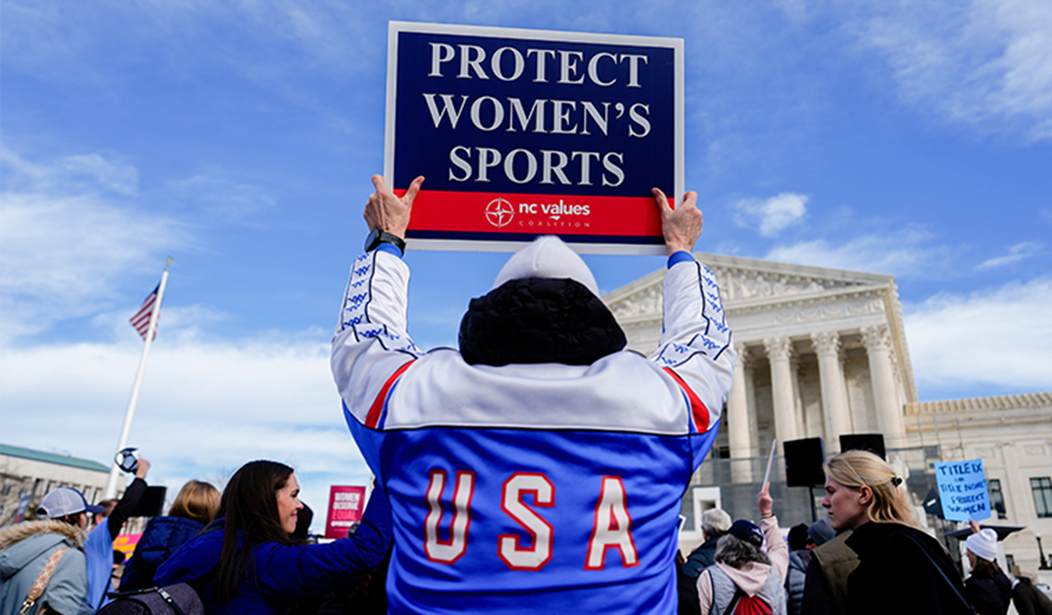

We may have just seen a blue wave election, but there were some victories for common sense, including in the several states where voters approved ballot initiatives barring boys and men from girls' and women's sports. As I've said and written for many years, this is a fundamental matter of fairness that should transcend politics.
All too often, though, it doesn't. Colorado, where I hung my hat for many years, is now one of the hotspots for this issue. The voters have approved Proposition 134, limiting school-sponsored sports to three categories: males/men/boys, females/women/girls, or coeducational or mixed. Now, it's up to the schools and the school boards to figure out how to enforce this. Colorado doesn't allow schools to demand access to a kid's birth certificate, but they do require a physical examination — although not, as the pro-trans people like to complain, an invasive genital check.
So far, the reaction from Colorado schools has been on the fuzzy side.
The proposition, which passed by 52%, is set to be implemented on Jan. 1. The guidance document was sent to all school districts in the state on Tuesday to help schools implement the policy.
Critics, such as One Colorado, an LGBTQ+ advocacy organization, argue Prop. 134 unfairly targets transgender students, whereas proponents point to the differences and advantages biological males have over female students.
Nadine Bridges, the executive director of One Colorado, told The Center Square in an email that the organization is working closely with the newly elected members of the executive branch to “prevent harm to LGBTQIA+ students and protect their rights to be safe and supported at school.”
The guidance document states that the proposition could present challenges for some schools and districts. “Many questions are left unresolved by the new statutory language, and future litigation or legislation may attempt to resolve issues presented by the new law.”
First of all, One Colorado is Wrong Colorado. This proposition is not out to "target transgender students." It's about ensuring fairness, in fact; fairness for girls and women in sports, in that they should now and will not be forced to compete with boys and men, who have all the physical advantages of being boys and men. That's what this does, and One Colorado is doing nothing more than scare-mongering.
And these "challenges" are mostly imaginary. But there is one possible loophole that should be addressed.
Following the passage of Prop. 134, Gov.-elect Phil Weiser told media outlets in a post-election interview that this ballot measure, among others, would require a “hard look” prior to their implementation. Weiser, a Democrat who is currently the state attorney general, has been an outspoken critic of the proposition on numerous occasions, previously telling The Center Square that he supports “equality for all” and worries that the new law could damage existing protections for transgender students.
The proposition restricts students’ sports participation on teams to align with their biological sex, but CDE’s guidance does not require verification of a student’s biological sex and discourages intrusive eligibility checks.
Now that's where this thing may start to come apart. The guidance documents don't require verification of sex, although that can be done quickly, cheaply and easily, with nothing any more invasive than a cheek swab. And let's be honest; most of these boys and men trying to pass as girls and women to cheat in the competitions — and yet, cheating is precisely what they are doing — well, most of them just plain don't pass.
The state does require a physical examination. That's a matter of safety and liability. So why not include a cheek swab? Probably because the woke-dominated school apparatus and school boards are trying to skirt the issue?
Although students are required to submit a doctor-approved physical examination before enrolling in a school-based sports team, state law prohibits schools from collecting birth certificates. Colorado law also permits the issuance of new birth certificates that align with an individual’s gender identity.
More strikingly, the department’s guidance explains that it will not require schools or districts to implement a complaint process if there are alleged violations of the statute. It explicitly recommends against creating such a process to prevent bullying and harassment of LGBTQ+ students.
The language of Proposition 134 was pretty clear.
Shall there be a change to the Colorado Revised Statutes creating new law restricting participation in all K-12 and collegiate school sports based on the participant’s sex as determined by certain aspects of their biological reproductive system, and, in connection therewith, requiring a school, institution of higher education, or athletic association to designate each school or intramural athletic team or sport as male, female, or coeducational; only allowing participants to compete on the team or sport of their designated sex or to compete on a coeducational team; creating an exception to allow a female to participate on a male-designated team or sport if there is no female team available; prohibiting a government entity, licensing or accrediting organization, or athletic association from entertaining a complaint, opening an investigation, or taking other adverse action against a school for maintaining separate teams or sports for females; and providing the commissioner of education with the authority to enforce the proposed initiative for K-12 school districts?
In simple language, every student athlete is treated equally and fairly: Boys on boys' teams, girls on girls' teams.
This is a matter of fairness. Having an X chromosome gifts the bearer with more speed, strength, and stamina. These are facts. The voters of Colorado made it pretty plain they want their kids' school sports to acknowledge those facts.
Even in blue Colorado, the voters sent a very plain message, and it sure looks as though the state and the schools are already trying to find ways to tapdance around implementations. The voters of Colorado, the voters who support fairness in girls' and women's sports, have won a big one — but it's become apparent that this thing ain't over yet.