
We, and by "we" I mean pretty much all of the online news media and commentariat, have been spilling a lot of virtual ink on this year's midterm elections. That's appropriate, of course. These are, as I've been continually pointing out, the most consequential midterm elections in recent history. This election and the 2028 elections, for which the campaigns will start in the next 24 hours — yes, that's how things seem to work now — will set the course for our nation for a generation or more.
But there have been other elections of great import in living memory, and by "living memory" I mean my memory. One of those was not only an election of great historical import, but also the first election in which I was able to vote. In fact, it was the election that got my interest in politics really spun up, and I've been a political/public policy information junkie ever since.
That election happened in 1980.
I had graduated high school in May of that year, in the middle of the infamous Carter administration's "malaise" economy. I remember my father complaining about the effects of Carter's economy. My Mom was working in the Illinois Central railroad's credit union, and regularly brought back the complaints of the railroad workers about gas lines and stagflation. And, of course, in Iran, 52 Americans were being held hostage by the Islamist goblins who had taken over that country the previous year, a situation which President Carter seemed unable to deal with.
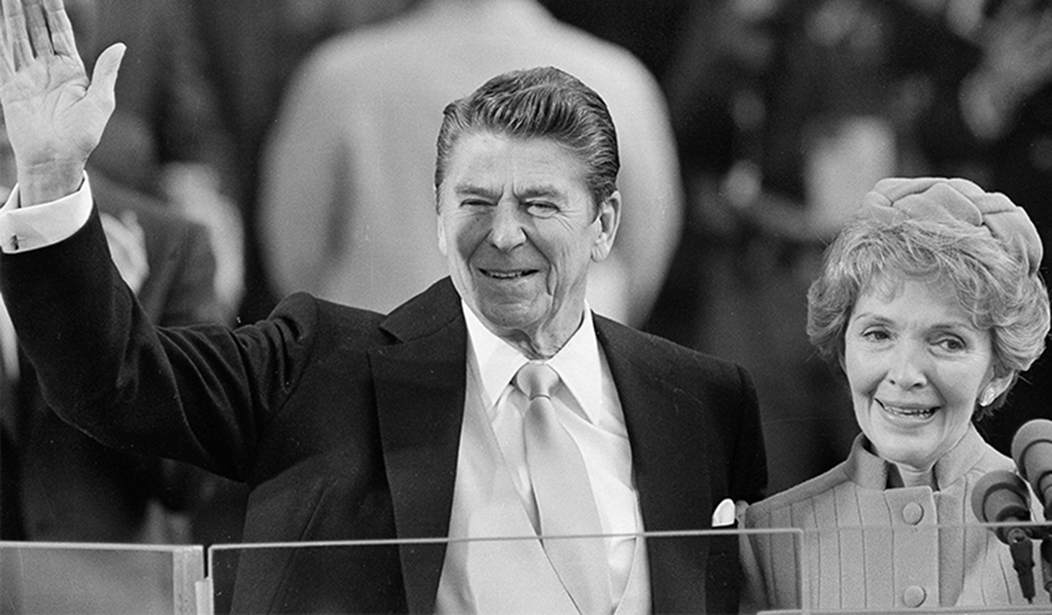
I wasn't very sophisticated, politically, at the time. My primary concern was the Second Amendment, being that I was already starting to collect guns I thought were cool and I loved to shoot and hunt. I knew that if you opposed stupid gun control laws, your obvious choice then as now was the Republicans. But, then as now, I was innately curious about almost everything. In or around July of that year, I noticed a small Reagan campaign office, so I wandered in, picked up a bumper sticker, and ended up talking to a local campaign worker. In the end I ended up asking what I could do to help. That was my first and only stint as a campaign worker of sorts; I manned tables and handed out many campaign flyers and bumper stickers, and when the day came, I marched into the polling place, set up in the gymnasium of a local elementary school, and voted the straight Republican ticket, including a vote for Ronald Reagan and another vote for a young whippersnapper running for what would become his first Senate term, fellow named Chuck Grassley.
We all know how that election ended up: Carter repudiated, Reagan won 489 electoral votes to Carter's 49. This was Reagan's first of two great landslide election wins, wins by a margin we haven't seen since. Oh, and we sent Chuck Grassley to the Senate, as well, and he's still there today.
Bear in mind how different things were then. There was no internet. There were no online live blogs or live streams. Conservative talk radio, as pioneered by the late, great Rush Limbaugh, wasn't really a thing yet. There were the three television networks, all of whom had live election coverage. That night, after my parents had also gone to vote, I sat down with the Old Man to watch the returns come in. We watched Reagan win, and we watched the Republicans win control of the Senate for the first time since 1954. This was a major shift in the picture of American politics.
Reagan won this landslide by being right on some key issues.First, Iran: He promised to deal harshly with Iran if they didn't release our people. The hostages were released the day Reagan assumed office; the Iranians, used to dealing with the invertebrate Carter, weren't quite sure what the cowboy Reagan might do, and they didn't want to find out.
Second, the economy. The phrase "it's the economy, stupid" hadn't been coined yet, but it applied nonetheless. The Carter economy wasn't repaired overnight, but Reagan ran on fixing things, and as evidence that it worked, just look at his 1984 "Morning in America" reelection campaign, and how he won an even greater landslide that year.
Third and finally, it was simply time for a change. The Republicans had three presidents in the post-World War II era before 1980: Eisenhower, Nixon and Ford. National politics shifted briefly towards Republicans after the war, with the GOP landing control of both House and Senate in the 1946 midterms, during the first term of President Truman. But the Democrats surged back, and had controlled Congress for much of the post-war era. But President Reagan started the change that was later described as the Republican Party changing from the "country club party" to the "Sam's Club party," the party of small business, of home owners, of working people, the party of a strong economy and limited government.
That's where we are today.
Ronald Reagan's legacy still looms large on the American political landscape. It will do so, likely, for generations yet to come. No president since his two terms has won the electoral landslides that Ronald Reagan won. And given our current political landscape, it doesn't seem likely that any such landslide will be in the offing again.
Now, today, though, we do have the chance once again to determine the course for America going forward. So, in the parlance of 1980, let's go win one for the Gipper.
Now, if you'll excuse me, I have to go vote.