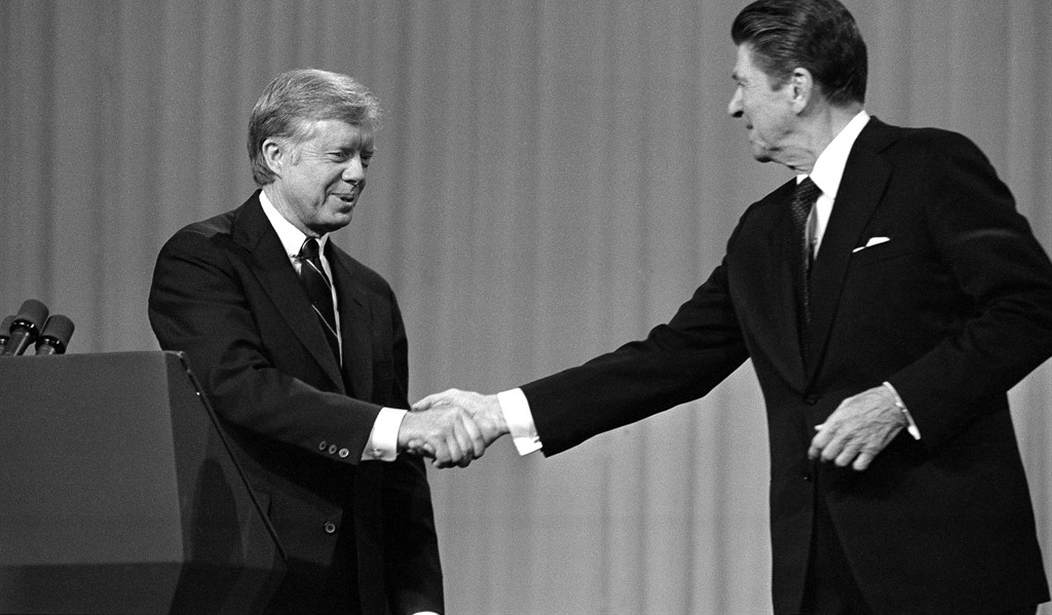

There's an old saying in politics: "It took a Carter to bring us a Reagan."
Some of us have been kicking around long enough to remember the Nixon/Ford/Carter years, and the combination of inflation, low growth and high unemployment that came with those years, in the mid to late 1970s. There was a term for it — stagflation — and it did the economy a lot of damage, damage that frankly both political parties tried to fix with things like wage and price controls. The United States was stuck in that cycle until President Reagan took office, and the damage was repaired in part by the ruthless application of high interest rates that cauterized the inflation, and tax rate cuts that encouraged growth. It hurt for a year or two, but Reagan's policies led to an economic boom that lasted until the dot-com crash in 2000 and the Great Recession of 2008.
Free markets, low taxes and low interest rates work every time they are tried, but these days, it seems like every downturn is greeted with demands that government do something, even if history tells us that the best thing government, any government, can do for an economy is leave it alone. Government has a role to play in making trade deals with other nations, but as far as internal meddling, it too often yields bad results.
So, when polling indicates increasing support for socialist economic meddling, even by people who really ought to know better, that's a matter for concern. On Thursday, an Issues & Insights editorial reported on just this phenomenon.
A new Wall Street Journal survey finds that “Americans in both parties back government-imposed price caps and other market interventions to make life more affordable.”
Significant majorities (more than 70%) also support caps on prescription drugs, credit card interest rates, and child care costs. Sixty-one percent back a wealth tax on millionaires, nearly 60% favor socialist Sen. Bernie Sanders’ government takeover of healthcare, known as “Medicare for all,” and 57% want to raise the minimum wage to $20 an hour.
Our own I&I/TIPP survey found a shockingly high number of adults support the idea of the government owning key industries. (See: “POLL SHOCKER: Socialism Is Infecting The GOP As Well.”)
That's not surprising, not with the "democratic socialist," or, let's call this spade a freaking shovel, communist wing of the Democrat Party becoming more and more influential. The problem is, in tetchy economic times, these well-intentioned but ultimately futile ideas tend to grow legs. An economy can't just be commanded to be prosperous, no matter how much the advocates for central planning wish for it. Wage controls and price controls fall afoul of supply and demand; when you place an artificial cap on prices, you place a cap on profits; when you place a cap on profits, you place a cap on growth.
Another thing those of us who were around in the '70s remember is the Misery Index, a combination of inflation and unemployment rates; during the '70s it spiked, reaching a high of 21.98 in 1980, which may have contributed to President Carter losing the presidential election that year. In 1990, a recession brought it up, but only to 10.0; ditto for the 2008 Great Recession. As of August of this year it was a 7.5, a near-historic low.
Now's not the time to be flirting with bringing back the Carter-era economic policies.
What’s next? Calls to re-regulate the airline industry? Slapping price controls on oil and gas? The return of wage and price controls? The rebirth of New Deal programs and FDR’s economically ruinous “bold, persistent experimentation”? Once you give up on the free market, there is no end to the mischief.
We know where this all leads. And it’s not a road that makes America great again. Just ask anyone who still can remember what times were like when Jimmy Carter was president.
And yet, the I&I/TIPP poll taken last July presents us with some uncomfortable results. That poll asked about a communist tenet, government control of major industries; the question was "To what extent do you agree or disagree with the following statements: I believe the government should control or own key industries such as healthcare and energy." The "Agree" numbers are startling; 42 percent of all respondents agree, which is alarming. 43 percent of Democrats agree, but 43 percent of Republicans also agreed. For conservatives and liberals, those numbers were 41 percent and 42 percent.
Have we learned nothing from the 20th century? Major nations' economies ruined (the Soviet Union, East Germany, North Korea, Cuba) not to mention millions killed, some by starvation due to idiotic, collectivist agricultural systems, many more due to government crackdowns on the desperate subjects of socialist and communist states.
The Republican Party and every Republican candidate in particular need to take a good, hard look at this issue. The Carter years are slipping into the past, and every year there are fewer people who remember them; I was in junior high and high school in those years, and I'm sure no spring chicken. But the lessons of those years should be burning brightly in the minds of every conservative activist, advocate, and politician: Socialist policies, like price and wage controls, like government ownership of key industries, fail, every time they are tried. On the other hand, free markets succeed every time they are tried. There is, as noted, a role for government in international trade; that's necessary, as every nation pushes their own best interest in foreign trade, and that's honestly what they should do.
Domestically, though? These socialist policies will usher in a repeat of the 1970s stagflation. This is inevitable. It would be nice not to have to get a new lesson in this, within the space of one long lifespan. We can do better.