


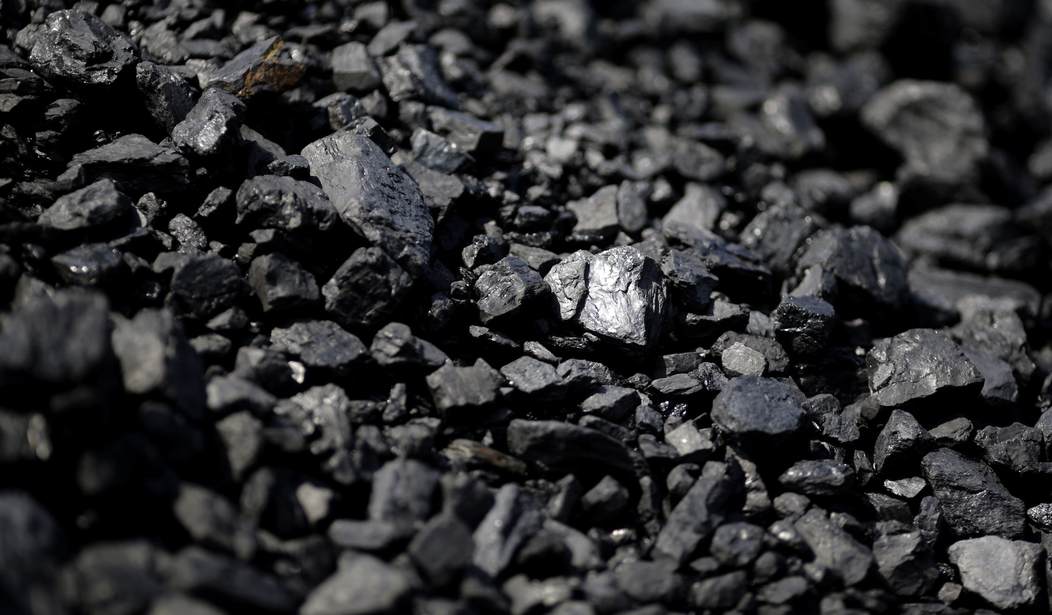

When coal first came into widespread use, it was a filthy energy source. When urban households all contained coal scuttles and coal was used for heating water, cooking, and keeping the place warm in winter, the usual exhaust system was a pipe through the roof. Cities were covered in soot. Even rural areas were covered with coal soot, and in some places, that lasted longer than one might think; I remember the farmhouse my family lived in when I was a pre-schooler was heated by a furnace that burned either wood or coal, and my father told me years later he always burned wood because coal was, as he put it, "filthy stuff."
That was then, this is now. Electrification has replaced household coal use, along with clean-burning natural gas and home heating oil. Coal is, now, primarily used to generate electricity. Now, Democrats and the climate scolds — and that would make a Venn diagram with a great deal of overlap — want to halt the use of coal for generating electricity, claiming that it is still, as Dad put it, "filthy stuff."
And, as is so often the case, they are wrong. Coal as used today, in electrical generation, is a vital part of our energy portfolio, and it's cleaner than ever, when used in modern power plants. Why? Because of high-tech scrubbers.
In the climate debate, coal is treated as if it still belches the same smoke it did in 1970. This is a major error. Modern coal plants combine a variety of technologies before and after combustion, as well as monitoring systems to verify compliance with today’s environmental laws with criteria pollutants (see Appendix A). As with petroleum, coal today is an environmental product, part of the increasing sustainability of fossil fuels.
Scrubbers, selective catalytic reduction, and the rest of the air-pollution control suite are rarely mentioned. That silence is not neutral. It erases one of the clearest engineering successes of the past thirty years and flattens a complicated fuel into a single villain.
One of the major undesirable outcomes of coal combustion, apart from carbon dioxide (CO2), is sulfur dioxide (SO2), which contributes to acid rain when it reacts with water and other substances in the atmosphere. We know this because volcanoes frequently emit tremendous amounts of SO2, and we can measure the acid rain that accompanies them. But the new technologies employed in new coal plants reduce that emission to negligible amounts.
Selective catalytic reduction systems cut nitrogen oxides (NOx) by 80–90 percent or more when properly operated. Activated-carbon injection and the co-benefits of the other controls have driven mercury reductions well into the high double digits on many units.
These are not laboratory numbers. As of 2022, roughly 82 percent of the remaining U.S. coal fleet carried flue-gas desulfurization, and nearly 58 percent had selective catalytic reduction. Nearly the entire fleet has some form of NOx control.
The result is visible in the emissions record. Under the Acid Rain Program and its successors, power-sector sulfur dioxide emissions fell by roughly 95–96 percent from 1990 levels, while nitrogen oxides fell by about 89–90 percent.
Technology tends to become more efficient over time, and more efficient technology is also clean technology. Scrubbers are making coal plants more competitive with natural gas plants all the time.
Why is this good news? Because the United States, alone, has centuries worth of recoverable coal reserves at current usage rates. Assuming increases in extraction capacity, there could be as much as 600 years' worth of coal, just in the United States alone. And that's assuming current usage; while the demands for electricity are bound to increase, the move to nuclear power will inevitably increase. Why? Because, as I'm continually pointing out in these matters, it's all about energy density. Every major step in human technology has been accompanied by a major increase in the energy density of that society's primary fuel, and this is no exception.
That's no reason, however, not to make use of the coal we have. But the climate scolds and their fellow travelers are ignoring this new technology, and seek to treat every coal plant as though it were a 19th-century operation belching black smoke and covering the countryside with soot and cinders. There's also the (correct) claim that these scrubbers don't remove CO2 as well as SO2, but that's an entirely different technological ball of wax — and an entirely different calculation where climate is concerned.
The next few years are going to see dramatic increases in demand for electricity, and not just in the United States. Artificial intelligence (AI) and the massive server farms that support it will only continue to grow and demand more and more electricity. This favors not windmills, not solar panels, but an all-of-the-above approach. Natural gas has its place in the picture. Nuclear power has its place in the picture, and its place should grow, as nuclear power, with the newer, safer, more efficient reactors, is the technology of tomorrow that will solve the problems of today. But coal still has a place, too; not only because it's still reliable and efficient, not only because new technologies are making it cleaner, but also because we literally have hundreds of years' worth of it.
Editor's Note: This article was updated post-publication for clarity.