
In the journalism business, there are a few names that command a certain amount of respect. (I hope to be one of those.) There are other names that command nothing but contempt, but those people seem to always find a job with the legacy media or some far-left outlet.
Then, there are the other names. Journalists who go into harm’s way, who bring us news from the fighting front of war, from danger zones around the world, talking to the regular people involved, bringing us the unvarnished story. You have those people who are legitimate heroes.
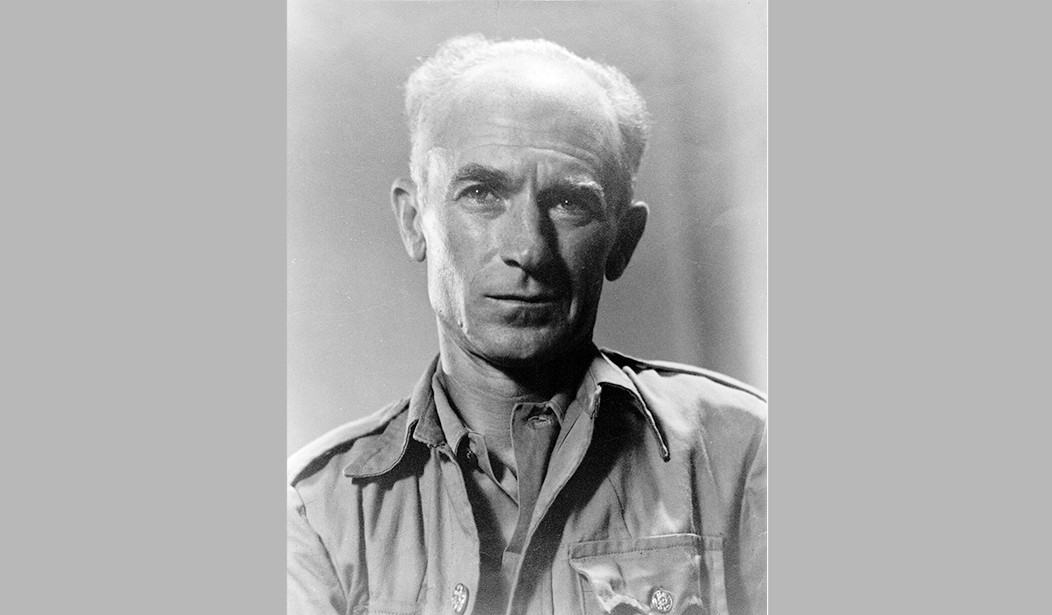
And then, beyond even them, you have Ernie Pyle. My parents and grandparents spoke of Ernie Pyle’s World War II reporting with admiration and awe, and as I grew older, I began to understand why, and why it was appropriate that when Ernie fell, he fell among the soldiers he loved and now rests among them.
His Humble Origins
Ernest Taylor Pyle was born in August 1900, on a small farm in Indiana, to Maria and William Pyle. The senior Pyle was a tenant farmer on the property of a family named Elder.
Ernie, an only child, didn’t care much for farming. After graduating high school, he entered the U.S. Navy Reserves during the U.S. involvement in the Great War, but the war ended before he finished his training. So, he decided to do what any ambitious young man with his abilities would do: He went to college. Indiana University, which Ernie entered in 1919, didn’t offer a journalism degree, so Ernie pursued a degree in economics, while loading his schedule with every journalism class he could. But during his junior year, Ernie dropped out and, with some companions, boarded the merchant ship S.S. Keystone State, which stopped at a number of exotic Asian ports.
On his return, Ernie found a job as a reporter for the Daily Herald in La Porte, Indiana, and married his wife, Geraldine Elizabeth “Jerry” Siebolds.
That marriage wasn’t without its problems, but that’s a story for another time. When war broke out again, Ernie was ready and willing to cover it.
His War Correspondence
In December 1940, Ernie went to London to cover the Battle of Britain. He returned to the States after that battle was decided, but in 1942 he was back in Europe, as a correspondent for the Scripps-Howard news service. He was generally at the front, with the troops, starting in North Africa in 1942. But he also maintained relationships with the upper echelons in Europe, including General Omar Bradley and General Dwight Eisenhower, who helped ensure Ernie’s access to the fighting front.
He was the troops’ undying advocate; because of his connections with the brass, he traveled the front freely and talked to anyone he pleased. In 1944, Ernie wrote a column demanding “fight pay” for combat troops, and in response, the U.S. Congress passed legislation authorizing an additional 50 percent pay for serving in combat; the new bill was known as the “Ernie Pyle bill.”
Ernie got around a lot. Aside from his covering of the North Africa campaign, he also covered the Italian campaign and the D-Day landings at Normandy.
Then, in January 1945, Ernie headed for the Pacific.
At the time, the Navy had a policy that correspondents in the theater were not to mention the names of any personnel they spoke with. Ernie challenged the policy, and it was lifted – but only for him. His coverage of the Navy, most notably the life led by sailors on ships, was colored by comparisons of how infantrymen in Europe were living.
Then, he went on to the Battle of Okinawa.
His Heroic Legacy
Throughout the war, Ernie had said and written to several of his personal friends about his doubts that he would survive the war. He was, sadly, proven correct. In April of 1945, Ernie came ashore on Okinawa with the Army’s 305th Infantry Regiment on Le Shima, an island northwest of Okinawa. The island had been reported to be clear of enemy troops, but there were some holdouts. On April 18, Ernie was traveling in a jeep with the 305th’s commander when a burst of Japanese machine-gun fire hit the jeep. The men took cover in a ditch, still under fire. After they popped their heads up to look around, the commander, Lieutenant Colonel Joseph Coolidge, noticed Ernie had been hit. A Japanese bullet had hit him just under the brim of his helmet, killing him instantly.
Ernie Pyle’s remains were buried, fittingly, among the troops, in a United States military cemetery on Okinawa. Later he was moved to the National Memorial Cemetery of the Pacific in Honolulu, where he remains today.
Ernie Pyle was one of the greatest and most resolute war correspondents in World War II, and probably in our nation’s history. He covered the war as it happened, at the front.
Most of all, Ernie was there for the troops. In his World War II memoir Up Front, Stars & Stripes cartoonist Bill Mauldin described listening in on a conversation of a bunch of infantrymen in France at the time the War Department was yanking Combat Infantry Badges (CIB) from front-line medics, as they were non-combatants. The troops hated the idea, and Mauldin described the real threat to the brass over this policy in the form of a Browning Automatic Rifleman with thick glasses, whom Mauldin quotes as saying, “Wait until Ernie Pyle hears about this!”
That’s not the worst legacy for any journalist.