






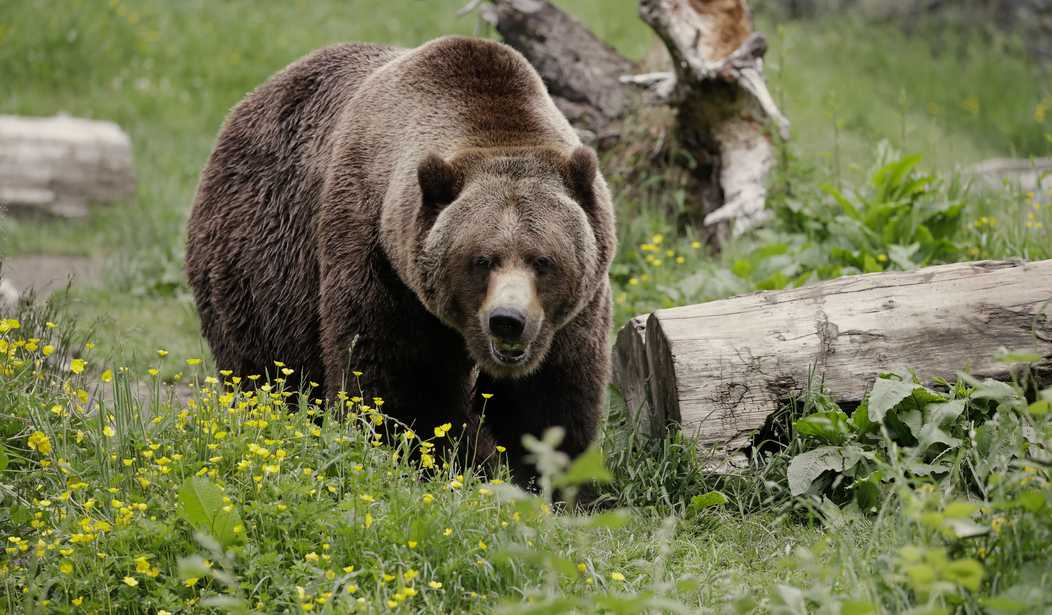
This time of year, bears will eat pretty much anything, and grizzlies can eat a lot of anything. In areas where bears and agriculture coexist, this often leads to bears eating crops. And that can lead to what biologists call "unfavorable human-bear interactions," which generally end up badly for the bear and sometimes for the humans.
In Montana, grizzlies have learned the wonders of cornfields, at least until a combine scatters them like a bunch of huge, furry mice.
Grizzly bears scatter like gigantic mice at the approach of a combine in a Montana cornfield, in a video reportedly taken Thursday near the tiny Rocky Mountain Front community of Augusta.
As many as seven grizzlies can be seen fleeing every which way as the noisy farm implement rumbles in, apparently disrupting their corn feast.
One of the bears turns and starts running back toward the combine. But then it cuts back toward the corn, as if trying to run and hide, before changing its mind and turning tail again.
The video, unfortunately, is on Facebook, which doesn't embed, but this isn't an isolated incident.
There's a problem, and it's a familiar one to anyone who lives in bear country: When bears start associating people with food, it rarely ends well. And yet, that sure seems to be what's happening in Montana in these crop fields.Local Rancher Neal Collins had a similar response when contacted by Cowboy State Daily.
Such incidents have become “common enough that it doesn’t get talked about that much,” he said in a text message.
In June, Collins had what he described as a “herd” of seven grizzlies on his property.
The video was apparently taken by another local, Ben Wipf, who could not be reached for comment by publication time.
The corn in particular isn't the best thing for bears, for added reasons that have nothing to do with humans; the problem is, cornfields may be an attraction for bears looking to pack on the calories for their long winter's nap, but corn isn't the best forage for bears. Corn is a grass, albeit a highly derived one, and as such, it's not the easiest to digest. You will have noticed this for yourself, likely the next day after a feast that included corn on the cob; you will see signs, later, that not all of the kernels are, well, digested. In fact, most mammals and birds can only digest the "germ" of the plant, the part that grows into a new corn plant; the rest is just passed through.
Corn is also, again, like most grasses, full of silica. It's bad for the teeth. When looking at the remains of people from New World indigenous populations, archeologists can generally tell when a society adopted corn as a staple, because of the wear on their teeth.
Still, when looking at a human cornfield, all a grizzly can see is a big, waving field of calories, calories that, being bears, they can smell from miles away. It's like the famous grizzlies here in the Great Land lining the salmon rivers, only corn doesn't try to evade capture; then again, no humans are driving enormous combines up the rivers.
Electric fencing would probably help. But these Montana cornfields are going to continue being a big draw for bears, teeth wear or not.
Editor's Note: Do you enjoy RedState's conservative reporting that takes on the radical Left and woke media? Support our work so that we can continue to bring you the truth.
Join RedState VIP and use promo code FIGHT to receive 60% off your membership.



Join the Conversation
VIP members get the ability to comment on articles.