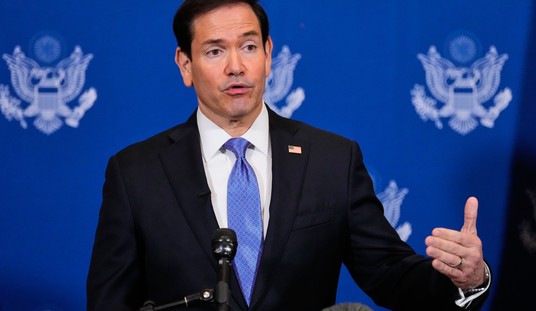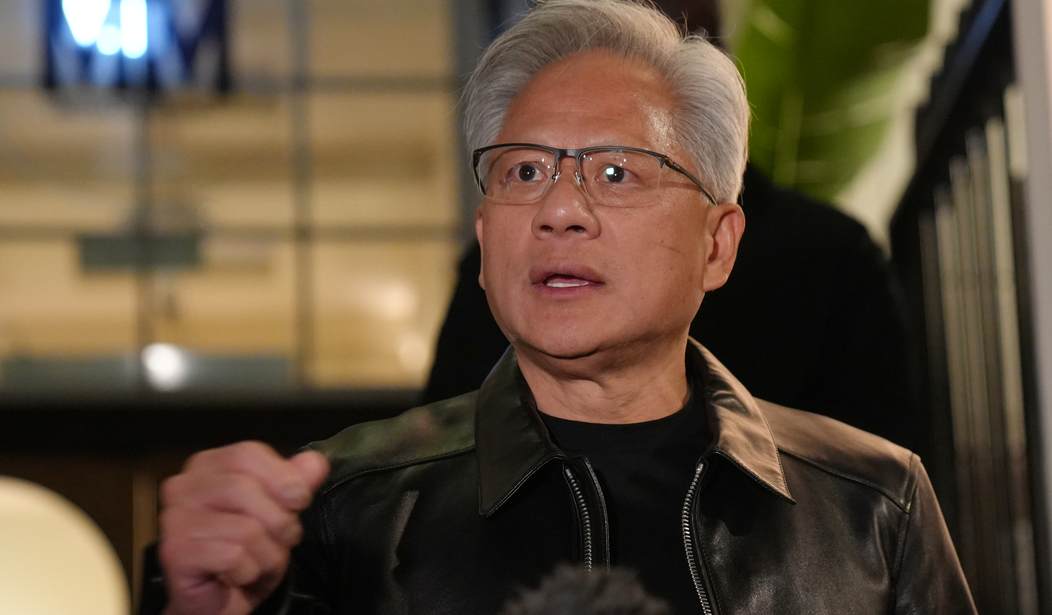

The imminent downfall of Nvidia CEO Jensen Huang has come with a huge twist.
The billionaire who built one of the world's most important technology companies has resigned amid a scandal involving extramarital affairs and allegations of Chinese espionage.
But as the dust settles, another question is emerging about what his departure means for America's artificial intelligence industry, and whether the Chinese Communist Party stands to benefit from the loss of one of the strongest advocates for open-source AI.
Huang resigned Thursday after acknowledging an affair with Alice Huang, a Chinese businesswoman and former executive at Singapore-based Megaspeed International. U.S. intelligence officials reportedly identified her as a Chinese intelligence asset, raising national security concerns about her relationship with the man running the world's leading AI chipmaker.
The allegations are serious, especially given Megaspeed's substantial purchases of Nvidia chips and federal scrutiny over whether advanced semiconductors were being diverted to China. Additional reporting about Huang's relationship with a female Nvidia executive compounded the controversy, prompting the company's board to accept his resignation and appoint Chief Financial Officer Colette Kress as interim CEO.
Huang admitted his infidelity in a message to employees, writing, "I was unfaithful to my wife... There is no excuse for what I did."
The personal misconduct is troubling enough. The potential national security implications are another matter entirely. But the rush to discard Huang may carry consequences that extend far beyond Nvidia's boardroom.
Consider what TechCrunch reported following his resignation. Huang was among the technology industry's most influential advocates for open-source artificial intelligence, arguing that developers, businesses and governments should have access to models they can download, inspect, modify and operate independently.
That position put him at odds with advocates of tighter government restrictions and companies seeking to maintain control over proprietary AI systems.
As Huang explained in a July policy letter, "Open models strengthen safety and cybersecurity, accelerate innovation and diffusion, and enable sovereignty."
The last word is especially important. Sovereignty means users and institutions can operate technology without remaining permanently dependent on a handful of companies that control access, pricing, development and permissible uses.
Huang had pushed Nvidia to develop its Nemotron family of open-weight models and supported a broader ecosystem of independent AI developers. Nvidia was also pursuing a nearly $13 billion acquisition of Hugging Face, the platform that has become central to distributing open AI models.
Now Huang is gone, and the company's commitment to open source faces fresh resistance.
AI researcher Nathan Lambert warned that Huang's departure would be "very very bad for the open model cause in the US."
Hugging Face CEO Clément Delangue was similarly concerned, declaring, "We'll keep fighting for open-source AI, harder than ever. This is too important to slow down now."
There's a commercial dimension here, too. Nvidia benefits when more companies develop AI products because those businesses need computing power. Open models create customers outside the handful of major AI laboratories developing closed systems. Huang's strategy therefore supported both Nvidia's business interests and a more distributed AI industry.
That makes the timing of his departure extremely disturbing.
The Chinese espionage allegations have already intensified demands in Washington for additional restrictions on advanced semiconductor exports. But restrictions on chip sales to China and restrictions on open-source AI are not the same thing. Policymakers who conflate them risk limiting American innovation while claiming to protect it.
And China's intelligence operations appear to be escalating. According to Reuters reporting published Saturday, Huang misled senior Nvidia executives about his relationship with Alice Huang, describing their interactions as ordinary business dealings. Reuters also reported that Nvidia's independent directors retained outside lawyers to investigate the relationship and the espionage concerns.
China denies that Alice Huang worked for its intelligence services. The American intelligence assessment has not been accompanied by a publicly released evidentiary record. Nevertheless, the relationship created an obvious counterintelligence vulnerability involving a company central to American technological and national security interests.
China's own laws explain why such relationships warrant scrutiny. Article 7 of the country's National Intelligence Law requires Chinese organizations and citizens to "support, assist, and cooperate with national intelligence efforts" in accordance with the law.
That obligation creates a serious security problem whenever Chinese nationals obtain privileged access to sensitive American technology or influential corporate executives. Intelligence collection can involve personal relationships, commercial partnerships and seemingly ordinary exchanges of information, including material that never appears in classified government documents.
The concern extends beyond Nvidia. China has an obvious strategic interest in limiting America's technological advantages, particularly in semiconductors, computing infrastructure and artificial intelligence. And some of the organizations opposing American AI development have relationships that deserve closer examination.
A recent Bitcoin Policy Institute investigation documented the involvement of the Party for Socialism and Liberation in campaigns opposing data-center construction across 14 states. According to the report, those efforts contributed to delays, restrictions or cancellations involving approximately $23.6 billion in proposed AI infrastructure investment.
The organization has overlapping leadership and political connections with groups associated with Neville Roy Singham, an American businessman whose financing of activist organizations and connections to pro-Beijing messaging have gotten the attention of congressional oversight.
One example emerged in Prince George's County, Maryland, where activists opposed a proposed $5 billion data-center development at the former Landover Mall site. The local campaign itself acknowledges that the Party for Socialism and Liberation helped amplify the opposition.
Residents also raised concerns about electricity demand, environmental impacts and local government transparency. Those issues may warrant concern, but substantial evidence points in the direction of them being overblown. But the involvement of organizations associated with broader anti-capitalist political networks introduces an additional question about whose interests are being advanced when American infrastructure projects are obstructed.
This is the larger strategic problem facing the United States. America needs to protect sensitive technology from Chinese intelligence operations while preserving the entrepreneurial freedom that made its technology industry successful.
Huang's resignation is a threat to the momentum behind open source technology.
There's already a backlash against his departure, including from people who have little reason to excuse his personal behavior.
As The Washington Post reported, Elon Musk has joined calls for Huang's reinstatement. An internal Nvidia discussion reportedly attracted more than 1,600 comments, many supporting the company's longtime leader.
Musk said he would sign a petition seeking Huang's return. When another user suggested he hire Huang himself, Musk replied, "That would be an honor."
That's worth considering. Huang helped build Nvidia from a graphics-chip company into a central supplier of the hardware powering the AI revolution. His technical knowledge, relationships and understanding of the industry would be difficult to replace.
There are serious governance questions about his conduct, and Nvidia's board has a responsibility to protect the company. But the American technology industry also has a strong interest in preserving the expertise of one of its most accomplished founders.
Perhaps Huang can return to Nvidia after an appropriate security review. Perhaps another American company can put his talents to work. Either way, the national interest should be part of the discussion rather than allowing the scandal to determine the entire future of his contribution to the industry.
The political implications may ultimately be more significant than the corporate drama.
China's government maintains extensive controls over information, industry and technological development. The United States has historically benefited from a different approach, one that allows independent entrepreneurs and developers to experiment, compete and build without obtaining permission from a centralized authority.
That advantage matters enormously as AI becomes integrated into nearly every sector of the economy.
The danger is that a legitimate espionage scandal becomes an opportunity to impose sweeping controls that weaken America's open technological ecosystem. Huang's resignation could leave fewer influential voices resisting that outcome.
Americans should demand a thorough investigation into the security questions surrounding Nvidia. They should also pay attention to what happens to the company's open-source commitments and the broader policy debate in Washington.
Because the outcome of this controversy will affect more than one executive's career. It could help determine whether the next generation of artificial intelligence remains accessible to independent American innovators or becomes increasingly concentrated in the hands of governments and a small number of powerful corporations.
Those are huge stakes for the future of humanity when considering if Jensen Huang should keep his job despite his personal faults.