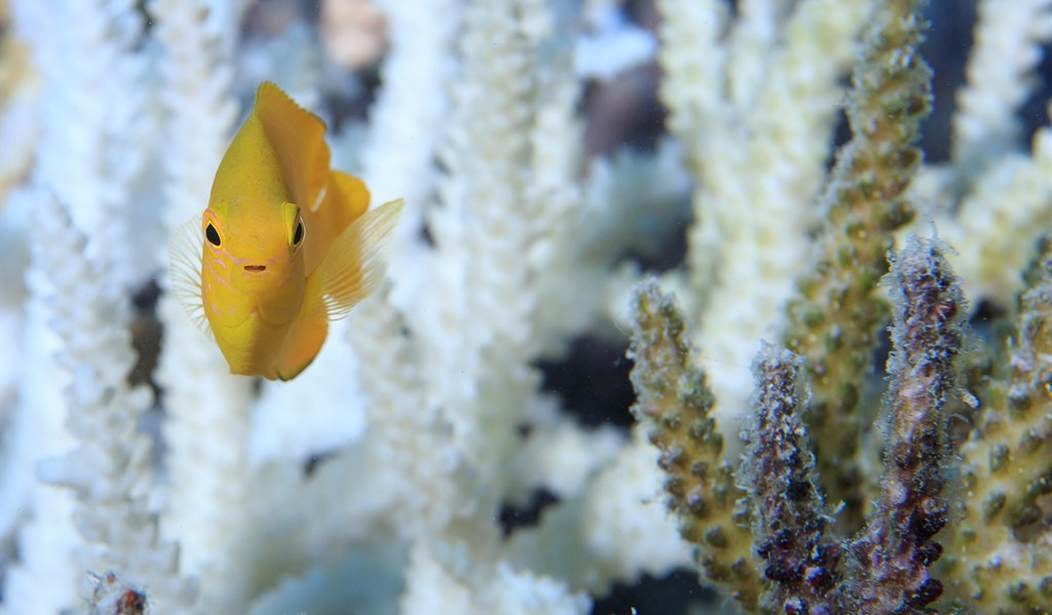

One of the amazing things about the natural world is its resilience. Life, as the old saying goes, finds a way, even life that seems fixed in place, like corals. Corals are remarkable beings, invertebrates of the phylum Cnidaria that build huge colonies. They have been around for around 500 million years, through warming trends and cooling trends, through continents moving together and splitting apart again, through thermal maximums and ice ages. They will likely be around long after we humans are gone.
In fact, the largest structure on the planet produced by living beings was built by corals: Australia's Great Barrier Reef. This structure is over 1,400 miles long, and encompasses 133,000 square miles. Once damaged by ocean pollution, it's been cleaned up admirably over the last few years, but now climate scolds are warning that the reef is in danger from climate change.
Now, a new report from Bjorn Lomborg, a Danish political scientist and climate change sceptic, indicates that this, too, is nothing to worry about.
Australia’s marine scientists released their annual audit of the Great Barrier Reef last month, and it contains news you almost certainly haven’t heard: Coral cover held steady or increased across most of the reef. The scientists measure the percentage of living hard coral cover, and in the 40 years of systematic study, the five best years on record are the five most recent. That is the sound of a catastrophe not happening.
You haven’t heard the good news because the reef has an entire public relations industry built around predicting its imminent demise as a result of global warming. In 2012, researchers from the Australian Institute of Marine Science reported that the reef had lost about half its coral cover since the mid-1980s — falling from 28% to just 13.9% — and projected that cover could halve yet again by 2022. In 2014, the Guardian published an interactive obituary for the reef. In 2016, Outside magazine agreed, declaring the reef dead at age 25 million.
There's just one problem: That didn't happen. As with so many of the hand-wringing declarations of the climate scolds, the prediction didn't materialize. It bounced back.
The patient, it turned out, hadn’t read the notices. By 2021, coral cover was higher than at any point since measurements began in 1986. It stayed at unprecedented levels through 2022 and 2023 and climbed to a new all-time high in 2024. The reef answered two decades of death sentences with more coral than anyone had ever measured.
The scientists even stopped publishing the reefwide statistic — making it harder for the layperson to easily see that the reef was defying long-held predictions. But researchers from AIMS continued publishing regional averages, making it possible to effectively re-create their reefwide average — which clearly kept increasing.
That's good news. People will be diving on the reef for some time to come, it seems.
There are a lot of factors behind this resurgence of corals. For one thing, Australia has been aggressively controlling a creature called a crown-of-thorns starfish, which consumes a large amount of live coral. Tropical cyclones can do a lot of damage to living coral, and yes, warming waters in some areas can reduce coral growth - while making other areas more amenable. That's how nature works. Life finds a way.
Corals, furthermore, aren't a brand-new thing. As noted, they've been around for 500 million years. They were growing in the Cambrian oceans, through the Carboniferous, when temperatures and oxygen levels were much higher than today. They were around in the warm, humid Jurassic and in the cooler, drier portions of the Cretaceous. They survived the Paleocene-Eocene Thermal Maximum, and they survived the last several major glaciations. Right now, we are in a warming spell following the last major glaciation, and have been, with some dips and spikes, for about 11,000 years now. Corals have survived no fewer than five mass extinction events, and they will survive the current interglacial warm period.
Conditions change continually. They always have. They always will. Life finds a way. Animals adapt, or they die out. Corals are no different in this respect than any other animal, save for the remarkable resiliency they show that has led to their being around so long.
No, the really remarkable thing about this episode in the long, long lifespan of the Great Barrier Reef is how the climate scolds are now counting coup over the resurgence of the reef, as though they had something to do with it. As Mr. Lomborg points out:
When catastrophe fails to arrive, a second story stands ready: Take a bow and send the bill. Australia’s federal and Queensland governments have spent more than 5 billion Australian dollars on reef programs since 2014, and when UNESCO declined in July to put the reef on its “in danger” list, Australia’s ministers hailed the decision as recognition of the country’s world-leading reef management. It takes nerve to spend decades forecasting an ecosystem’s death and then claim credit for its historically high coral cover and remarkable resilience.
Yes, it takes nerve; it also takes a stubborn adherence to an agenda. That agenda doesn't have anything to do with science. It's a political agenda. And the distortion of reporting on this remarkable place in the planet's oceans, of the resilience of corals in general, is in service of that political agenda. When you remember that, everything else falls into place.