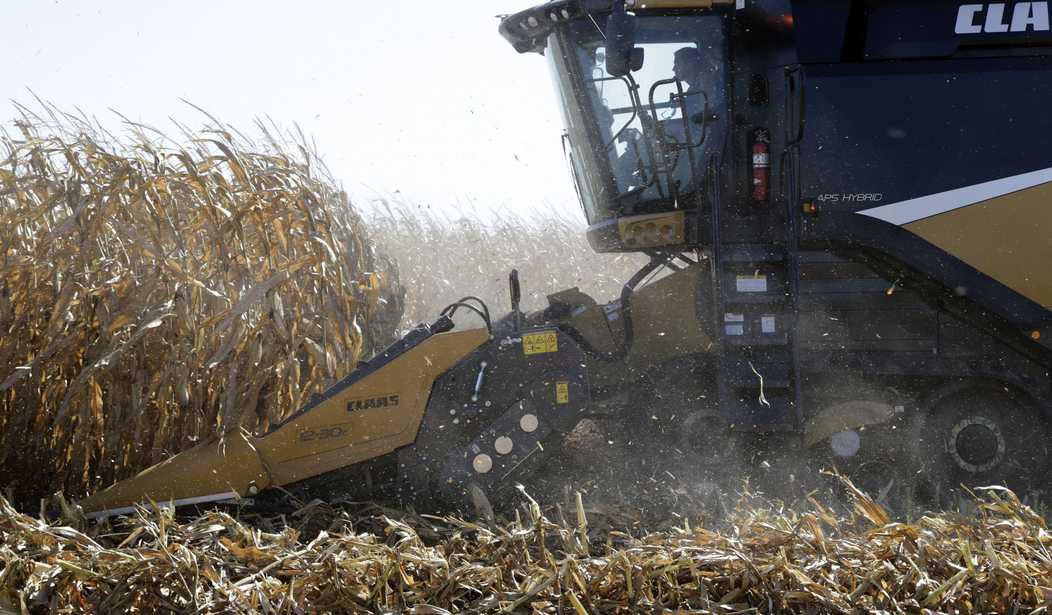

One of the key things that makes our modern lifestyles possible is modern agriculture. The original Agricultural Revolution led to the first towns and cities, the first systems of currency, and the first governments (I leave it to the reader to determine the costs and benefits of that last one). Later, the Industrial Revolution led to the mechanization of agriculture, with all the increasing efficiencies in production, to the point where, in the developed world, a smaller proportion of the population is involved in food production than at any time in human history.
Now, being in an interglacial period, the global climate is a long, slow, gradual warming phase, and with that, and yes, to some extent due to human activities, the percentage of carbon dioxide (CO2) in the atmosphere is increasing. That's good for plants, not bad; it's essential for photosynthesis. And, yes, it's good for crops, although Bloomberg would have us believe otherwise, having gone all-in for climate-scold panic-mongering.
H. Sterling Burnett, Ph.D., is the Director of the Arthur B. Robinson Center on Climate and Environmental Policy and the managing editor of Environment & Climate News, and he has some debunking to show us about Bloomberg's claims.
The Bloomberg story, “What Climate Change Costs You at the Checkout,” begins by listing a variety of factors, from the COVID lockdown to the Iran war, that have spiked food prices periodically over the years, complete with a graphic detailing geopolitical events that caused price spikes and the subsequent equally sharp declines once the various crises were over. So far, so good. Then the story goes off the rails.
“[A] less obvious force is also ratcheting up prices, but its effects risk lasting longer and being harder to predict,” claims Bloomberg. “Climate change is turning one-off weather shocks into more regular events that can decimate harvests and strain supply chains.
“As their effects compound, extreme heat and droughts threaten to make climate inflation an economic fixture,” the Bloomberg story continues. “Economists predict that the higher temperatures climb, the more bloated household costs like groceries may become.”
Those paragraphs are replete with false claims about both worsening weather and worsening crop production.
Grocery prices have gone up in recent months, although here in the United States, they are trending downward again. But this price increase was not due to weather or climate (they aren't the same thing) but to inflationary government fiscal and monetary policies.
First, data debunk claims that climate change is making heatwaves and extreme weather more frequent or extreme. As detailed in dozens of stories at Climate Realism, neither droughts, nor floods, nor the number and temperatures of extremely hot days have increased or become more severe. In fact, the U.N. Intergovernmental Panel on Climate Change (IPCC) reports it has “low confidence” climate change has had a measurable impact on flooding, in the process admitting that climate change is as likely to have reduced flooding as it is to have made flooding events more common. The IPCC has also been unable to identify any clear global trend in worsening drought, much less any trend in worsening drought that can be scientifically attributed to human greenhouse gas emissions.
We have reported in the past, many times, about even the UN's reluctant admission that there isn't any clear trend towards severe weather events. There have, of course, always been severe weather events, and there always will be severe weather events. It's the trendline we're looking for, and that trendline has been and remains flat. And, as it happens, there's a lot of evidence of increasing, not decreasing, crop yields:
Global warming lengthens growing seasons, reduces frost events, and makes more land suitable for crop production. Also, carbon dioxide is an aerial fertilizer for plant life. These factors have resulted in the largest decline in hunger, malnutrition, and starvation in human history.
Whether one examines the production and yield of staple cereal grains, fruits and nuts, legumes, or less critical but still widely consumed crops like coffee and cocoa, the story is the same around the globe: increased yields and production
But wait! There's more!
Previous Climate Realism posts show agricultural productivity has increased dramatically, for example, in Africa, here, here, and here; in the Middle East, here and here; in Latin America, here, here, and here; in Asia, here, here, and here, and in North America, here, here, here, here, and here.
That's a lot of information, and it merits review.
Read More: Ehrlich’s Population Bomb: Still a Dud 58 Years Later
Australia's Net Zero Folly: Soaring Costs Now Forcing Massive Crop Cuts
Here's the thing: There's no climate-related food crisis. There just isn't. The number of people suffering from chronic hunger in the world has dropped dramatically from 1990 to the present. And a look at the planet's history over the long term reveals some interesting data; through most of the planet's history, it's been warmer than now. In the Eocene, there were tropical forests in Germany. As recently as the Roman Warm Period, people were raising wine grapes in Britain. CO2 levels have been, throughout geological time, generally higher than now, and there were no sport utility vehicles, no coal-fired power plants, no factories, and through most of that time, no people. And yet, life on this planet just kept ticking along. Even when there were actual catastrophic events, like the Permian mass extinction, life bounced back. Nature, as it happens, is not only resilient but self-moderating, and it operates on a scale that is, literally, planetary; we are a small part of it. And another thing that historic data shows: Warm weather and CO2 are good for plants, including our food crops.
Bloomberg, in their article, based their entire argument on one doom-crying reference. That's not science, and it's not good reporting. The facts are startlingly different from Bloomberg's claims. Dr. Burnett has the numbers. And we have the full dinner plates.