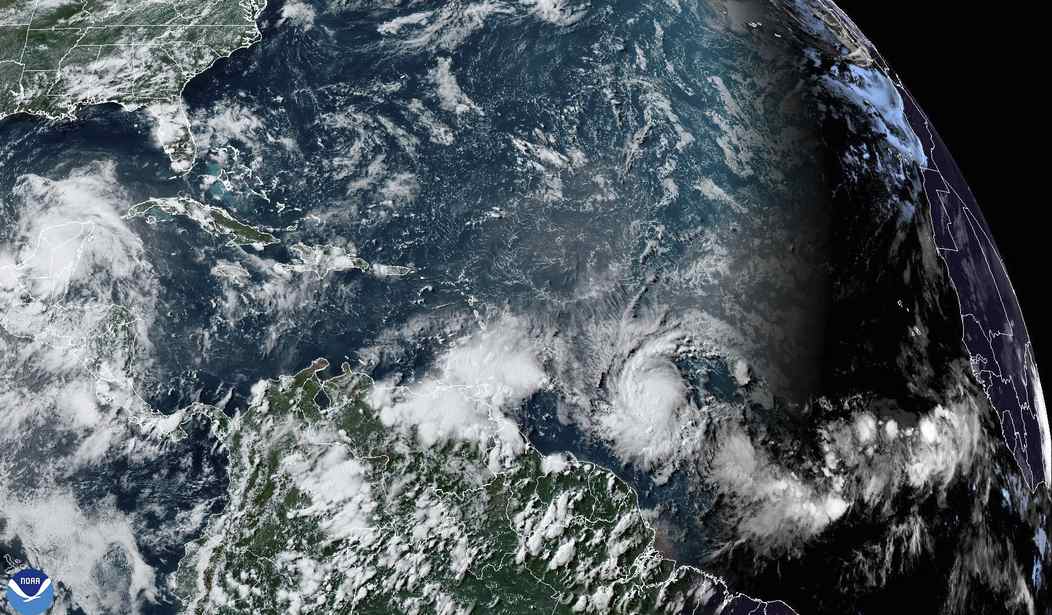

Robert Heinlein, in his novel Stranger in a Strange Land, described a protagonist raised on desiccated Mars coming to Earth, and on his first flight over the Atlantic, referred to what he called the "ungrokkable vastness of ocean." I've always liked the phrase, as the vastness of the oceans that cover so much of the planet's surface and plunge in places to five and six miles deep is indeed ungrokkable; it's hard to wrap one's mind around how truly vast the Earth's oceans are, much less to understand all of its cycles, currents, effects, and influences.
And yet, we are learning. That's a process that should never cease. We're learning more all the time about ocean currents and cycles, and a fair amount of scrutiny has been placed on the Atlantic Meridional Overturning Circulation (AMOC), a sort of warm-water conveyor belt that brings warm tropical waters north and cooler waters south, in a process that keeps parts of Western Europe warmer than it might otherwise be. The AMOC is also a source of panic-mongering among climate scolds, who claim that a sudden reversal or cessation of the AMOC would wreak havoc on the planet's climate. But now Paul Voosen, the earth and planetary science reporter at Science, has a piece on some new research that should calm some furrowed brows - namely, that the AMOC is more resilient than the scolds claim.
The crowd on the bridge (of the RRS Discovery, a U.K. research ship) reflected the importance of the mooring, one of 10 in a vital climate observatory called the RAPID array. For more than 2 decades, RAPID’s instrument-packed moorings, spaced across the Atlantic Ocean at 26°N between the Bahamas and the Canary Islands, have monitored the changing strength of ocean currents called the Atlantic Meridional Overturning Circulation, or AMOC. The currents usher tropical waters and heat to the northeastern Atlantic, allowing cabbage palms to flourish in Ireland and keeping Norwegian ports ice-free in winter. As the waters move north, they cool and become saltier as sea ice forms and rejects brine. The resulting cold, salty water becomes dense enough to sink to the abyss, carrying heat and carbon dioxide down with it. The water returns south along the floor of the Atlantic, heading to the Southern Ocean and beyond.
That's how the AMOC works, and yes, it keeps the UK, Ireland and even Scandinavia warmer than they might be. Things have been this way since more or less the end of the last major glaciation.
Here's the part that will have the climate scolds rending their garments and gnashing their teeth:
Climate models have long warned that global warming could weaken “deep-water formation”—the density-driven sinking that is the engine of the AMOC. The logic is straightforward: As Greenland’s ice sheets melt and sea ice formation declines, North Atlantic waters will freshen. Combined with warmer sea temperatures, the freshening makes surface waters more buoyant. The AMOC was thought to have shut down abruptly during past climate warmings, and a handful of researchers now argue such a tipping point could occur this century. A sputtering AMOC could trigger a sharp cooldown in northwestern Europe, rising seas along the U.S. east coast, and shifts in tropical rainfall. “It is a risk that would really have severe impacts,” says Stefan Rahmstorf, a climate scientist at Potsdam University and a prominent voice warning of the threat.
Yet for all the alarming headlines, most climate researchers think the AMOC is more resilient than these worst case scenarios make it seem. Emerging evidence suggests the AMOC may not have actually collapsed in the warm climates following ice ages. More detailed climate models suggest it could weaken but not collapse in the current surge of warming. And studies of the AMOC’s present behavior do not yet show any clear signs of trouble. They’re also exposing new facets of the circulation that could buffer any eventual weakening.
“The paradigm has been, if we warm and freshen these areas, we’ll get less dense water and AMOC will slow down,” says Susan Lozier, an oceanographer at the Georgia Institute of Technology. “That paradigm isn’t holding up.”
So, in other words, right now, there isn't a lot to worry about. That always seems to be the case with these kinds of dire predictions, be it Al Gore warning of polar bears going extinct or Greta "Doom Pixie" Thunberg bemoaning an ice-free Arctic.
Read More: Wrong Again: Atlantic Current Isn't on Brink of Collapse, Science Shows
Damming the Bering Strait: A New Catastrophic Climate Fix Doomed to Backfire
Here's the fun part: Over at Watts Up With That, columnist Charles Rotter breaks down how and why these dire forecasts come about.
If the direct measurements are this equivocal, where do the mid-century-collapse forecasts come from? They come from two places, and it is worth knowing which is which.
The first is a statistical argument. In 2023, Peter and Susanne Ditlevsen of the University of Copenhagen published a paper estimating that the AMOC would collapse around 2057, with a 95 percent confidence range running from 2025 to 2095. That is the source of most of the “mid-century” headlines. The estimate was not built on the RAPID measurements. It was built on a single proxy, a fingerprint extracted from sea-surface temperatures in the subpolar Atlantic, run through statistical early-warning indicators borrowed from the math of tipping systems. The trouble, as Voosen reports and as the wider literature has noted, is that those indicators have a habit of pointing toward collapse regardless of what the underlying data are doing. A confidence interval that spans 2025 to 2095 is not a forecast. It is an admission that the method cannot tell you the answer.
The second is modeling. René van Westen and Henk Dijkstra at Utrecht have produced the most-cited collapse simulations, including the 2024 “early-warning signal” paper and the 2026 Gulf Stream “precursor” study. Van Westen puts the tipping risk at around 2.5 degrees of warming and a buoyancy flip around 2063. These are real results from serious people, and I am not going to wave them away. But Voosen does the thing good reporters do, which is to ask what it takes to get those outcomes. The answer is freshwater inputs well beyond what Greenland is actually expected to deliver.
That statistical argument is a canard, based not on measurements, but on one measurement, washed through computer models. It's far too imprecise to be meaningful. The modeling argument is a little better, but this notes that the freshwater inputs to cause a tipping of the AMOC are far larger than we have any reason to expect.
So, what does all this boil down to? Simply this: We're learning more about even the vastness of oceans, and as we learn more, as serious people do serious work to try to understand these vast, chaotic, complex, and, yes, largely ungrokkable systems, we learn more and more that the outrageous claims of the climate scolds are without merit. There rarely is reason to panic about something as vast and often self-moderating as the global climate. (Local weather, like tornadoes and so on, is another story.) And now, we're gathering more evidence that a catastrophic collapse of the AMOC isn't likely. The planet's systems are far more resilient than some people think - and so are we.
My standard disclaimer applies once again: Yes, the global climate is warming, slightly. That has been happening, with some spikes and dips, since the end of the last major glaciation. Yes, human activities do have some influence. Everything does. But, once again, we are informed that the claims of the panic-mongers can be safely ignored; our influence and the current slight warming are not a reason to suddenly abandon our modern, energy-hungry, comfortable, technological lifestyles.
The scolds are, once more, simply wrong.