
Only a year or two before my father passed, he told me some stories of the year or two after he got home from his World War II service, in the spring of 1946. One of the first things he did, of course, was to pay a call to the girl he had been thinking about a lot while he was away. They got married in March of 1947, and that girl would in time become my Mom. The other thing Dad did was to take up a small farm near Independence, Iowa.
Those were things I had always known. What I didn't know was that, for several years, when he started farming, Dad didn't have a tractor. He farmed with horses. I asked him once if he knew what breed the horses were, and he said he had no idea; he said, though, "They were sure big."
Jethro Tull's 1978 song, Heavy Horses, posits a future return of draft horses "after the oil barrels have all dripped dry." I'm not too worried about that. Green energy activists and environmental extremists have been shouting about peak oil for decades, and yet we just keep finding more. But I am concerned with the enormous house of cards that is our modern high-tech society; a hit on our power grid, the collapse of our major cities and their outlying areas, and we could easily find ourselves back in the technological 19th century.
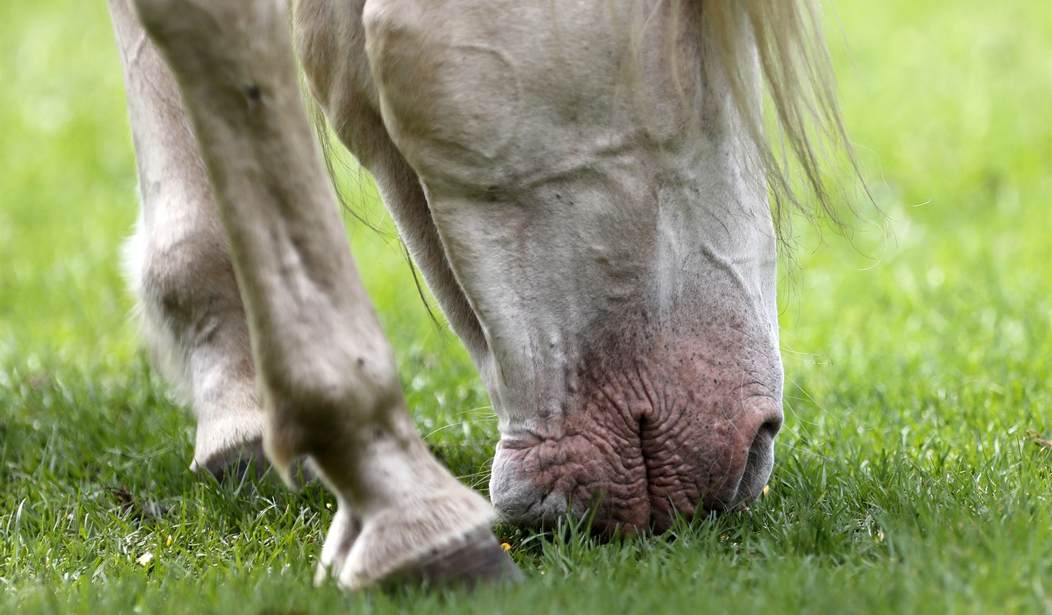
Some people are keeping these old breeds, these gentle giants, alive, and we should be grateful for that. I've had the chance to see and interact with some of the heavy horses myself, at one time or another, and I feel fortunate to have had that opportunity. Some of those breeds are amazing creatures indeed.
The Clydesdale:
If you’ve ever watched the Super Bowl commercials, you’re probably familiar with Clydesdales. These horses are almost always bay in color, with beautiful and abundant white feathering at the feet. They were originally a Scottish breed, developed in the late 1800s, but have gained popularity throughout the world since then.
The original Clydesdale was shorter in stature than today’s typical draft horse, but after the blood of other, larger drafts was introduced in the 1940s, the breed standard became taller. Today, most Clydesdales stand between 16 and 18 hh and weigh between 1800 and 2000 pounds.
The Percheron:
Originating in France, the Percheron was imported into the United States sometime before World War I. The horse is best known for its dapple gray coat, though black is a common color as well. Percherons, on average, stand between 15 and 18 hh and weigh between 1100 and 2600 pounds.
A college friend of mine came from a family that raised Percherons. Amazingly enough, they had saddles made for these giants, and used to ride them; I'm not sure how that worked, and I remember the one time I visited their farm, I saw that climbing aboard one of these horses required a ladder of some kind. Amazing.
The Shire:
Shires hail from Great Britain and are large draft horses most often found in black but also in bay and gray. Shires stand between 16-18 hh and weigh between 1800 and 2500 pounds. The largest horse in recorded history was a Shire named Sampson, who stood 21.25 hh and weighed over 3300 pounds. He was foaled in England in 1846, and after he reached his mature size, his name was changed to Mammoth.
The Shire are some of the grandest - and biggest - of the heavy horses. These are the one-ton diesel pickups of horses, able to pull anything ever made to be pulled by horses. The one time I saw one, at the old National Dairy Cattle Congress that regularly took place in Waterloo, Iowa, when I was a young man, I saw it in a stall in the show barns. When I stopped to look, it came to the gate, slowly, with enormous presence and dignity, and bent its head down to allow me to scratch its ears. Amazing creatures.
Read More: Farmers Are Essential to Making America Healthy Again
Prepping for War and Shortages: Why Growing Your Own Food Is Now the Smart Move
I don't know if we'll ever need these great horses again on the societal level. I'd like to think that any major Fourth Turning event won't be so serious as to set us back to the 19th century. But bear this in mind; if we do need them, if we are stripped of mechanical horsepower and returned to actual horsepower, many people lucky enough to have survived the initial event will be glad that these giants are still among us.
The band Jethro Tull describes these magnificent beasts with perfection:
They'll beg for your strength, your gentle power
Your noble grace and your bearing
And you'll strain once again to the sound of the gulls
In the wake of the deep plough, sharing
Who knows? If the unthinkable happens, the one thing we'll have to do is eat. And in a post-technological society recovering from disaster, we might find ourselves wishing for "a wheel of oaken wood, a rein of polished leather; a heavy horse and a tumbling sky, brewing heavy weather."
This seems, well, more than appropriate.