






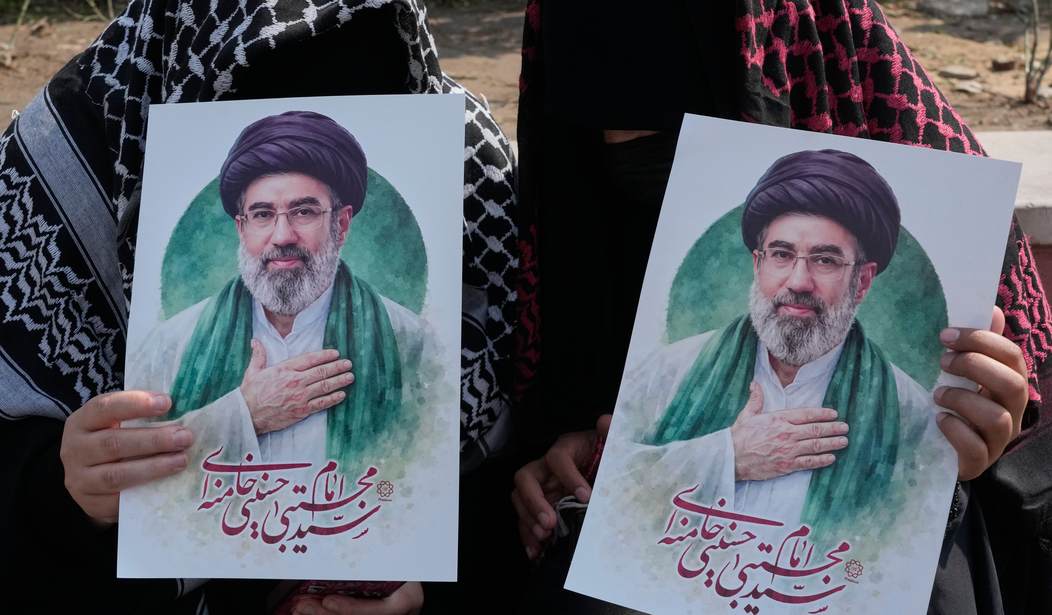
Iran has a new offer on the table to resolve the ongoing American naval blockade of Iranian ports in and around the Strait of Hormuz. Given what the Islamic Republic is offering, it seems likely that their offer will go down like a lead duck — especially since part of their proposal includes a "delay" in nuclear talks.
Iran has offered to end its chokehold on the Strait of Hormuz if the U.S. lifts its blockade on the country and ends the war in a proposal that would postpone discussions on the Islamic Republic’s nuclear program, two regional officials said Monday.
U.S. President Donald Trump seems unlikely to accept the offer, which was passed to the Americans by Pakistan and would leave unresolved the disagreements that led the U.S. and Israel to go to war on Feb. 28.
With a fragile ceasefire in place, the U.S. and Iran are locked in a standoff over the strait, through which a fifth of the world’s traded oil and gas passes in peacetime. The U.S blockade is designed to prevent Iran from selling its oil, depriving it of crucial revenue while also potentially creating a situation where Tehran has to shut off production because it has nowhere to store oil.
Of course, Iran doesn't really have much of a "chokehold" on the Strait of Hormuz; it would be more accurate to say that they are making a nuisance of themselves, which is about all they are capable of doing now. And, as noted, President Trump has made defanging Iran's nuclear program the one rock-solid sticking point, so he's not likely to look on Iran's latest "offer" with favor.
Secretary of State Marco Rubio, on Monday, also commented on the ongoing negotiations.
Secretary of State Marco Rubio revealed what he believes to be that largest impediment to coming to an agreement with Iran in an interview with Fox News' Trey Yingst on Monday.
Rubio referenced Iran's "fractured" leadership and said Iranian negotiators often are in disagreement with other factions within the Iranian regime, severely limiting the scope of peace talks.
"Other than the fact that the country is run by radical Shia clerics, that's a pretty big impediment. The other is that they're deeply fractured internally, and I think that's always been the case, but I think it's far more pronounced now. The best way to understand Iran is you have a political class now. I think, look, people talk about moderates and hardliners. They're all hardliners in Iran. But there are hardliners who understand they have to run a country and an economy, and there are hardliners that are completely motivated by theology," Rubio said.
There are several complications in these negotiations right now.
Read More: The New York Times Says Trump Created Iran's Nuclear Problem. The Record Says Otherwise.
First, it's unclear who the United States is technically dealing with in Iran right now. Nobody's even certain that their new Supreme Leader is still alive. The Islamic Revolutionary Guard Corps (IRGC) still controls what's left of its military. There are still some remnants of their civil government. It's a complex situation, but one thing is certain about this latest "offer", and that is that President Trump is almost certainly going to reject it out of hand. He has, up to now, not budged on his insistence that Iran's nuclear program be shut down, and it's not likely he's going to agree to any postponement on nuclear talks.
Second, the IRGC is still dominated by the radical Shia clerics that Secretary of State Rubio mentions, and they have, so far, shown every indication of being willing to go down fighting rather than to make any kind of deal that would be acceptable to the United States.
Secretary of State Rubio also, on Monday, pointed out Iran's ongoing economic collapse:
"I think they are serious about getting themselves out of the mess that they're in, there are all the problems Iran had. They had riots a few months ago, and these were economic riots, all the riots and all the, I'm sorry, all the problems that Iran had before the start of this conflict are still in place and most of them are worse. Price inflation is worse. They still have a drought going on. They still have trouble making payroll. Their economies flattened, they face crippling economic sanctions around the world. All those problems are there and many of them are worse. And now they have half the missiles, none of the factories, and no navy and no air force. All of that's been destroyed. So they're worse off and weaker," Rubio said.
That last statement is an eloquent summary of the situation: Iran is worse off and weaker. They will continue to grow worse off and weaker until the United States lets up the pressure, and that won't come without Iran agreeing that their nuclear program will be shut down, for good and all.
Editor's Note: For decades, former presidents have been all talk and no action. Now, Donald Trump is eliminating the threat from Iran once and for all.
Help us report the truth about the Trump administration's decisive actions to keep Americans safe and bring peace to the world. Join RedState VIP and use promo code FIGHT to get 60% off your VIP membership.

Join the Conversation
VIP members get the ability to comment on articles.