



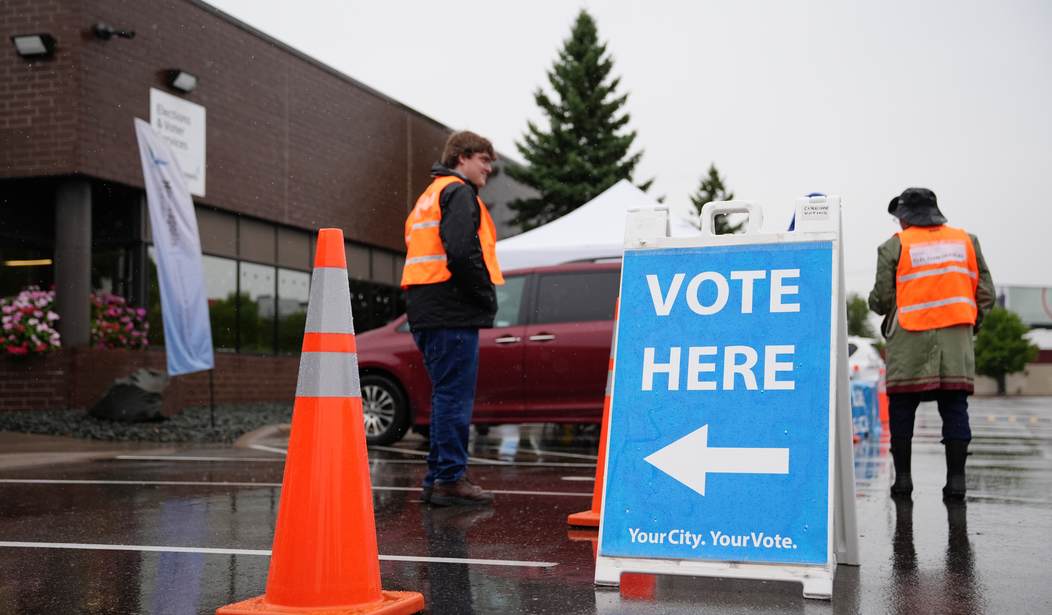
The Washington Post and George Mason University’s Schar School set out to survey one of the country’s least-polled competitive Senate races this fall. What they found should underscore that the numbers, regurgitated ad nauseam by the media, should never dissuade you from showing up at the ballot box.
WaPo Polling Director Scott Clement reports that they contacted voters in Kansas for the contest between Republican Sen. Roger Marshall and Democrat challenger Adam Hamilton.
After more than 85,000 phone calls and nearly 50,000 text messages, a clear problem emerged: registered Democrats were "more than twice" as likely as registered Republicans to complete the survey.
Liberals love to talk to the media. Conservatives do not. Shocking.
Once they answered the phone, Democrats were much happier to discuss the Senate race than their Republican counterparts — 32 percent versus 12 percent — with a similar gap appearing among those reached by text.
"This was a supersize version of a concern that has vexed pollsters for the last decade," Clement wrote.
We polled Kansas. Democrats wanted to talk. Republicans, not so much. Gift link -> https://t.co/wfKuq8TQvd https://t.co/jMule4djir
— Scott Clement (@sfcpoll) October 30, 2026
Now, you have to love how it's presented as "more than twice" the difference when, mathematically, the Democrats talked about this particular race 2.67 times more. That's closer to three times, but the Post tries to present it as just a shade over two.
Those little biased things count.
Better yet, the report finds Mark Rozell, dean of the Schar School of Policy and Government at George Mason University, to contend that the polling enthusiasm gap is actually evidence that things are worse for the GOP. Why? Because right-leaning voters have a case of the sads.
“The partisan enthusiasm gap likely explains the disconnect between Democratic and Republican willingness to respond,” said Rozell. “With an unpopular president, inflation, a war that Trump voters never asked for, the lack of GOP enthusiasm is not surprising."
"Are Republican voters this late in the election cycle feeling so down about their party’s chances that they just don’t want to talk about it?”
In short, no, Chief. Trump isn't causing people to shrink from pollsters. If anything, he's the biggest motivator pushing Republicans to talk. They just don't want to talk to a poll run by a newspaper pretending it's not actually a mouthpiece for the Democrat Party. Especially when they're researching something that's been presented incorrectly time and time again.
You don't get to pretend Hillary Clinton is a shoo-in and Kamala is a legitimate threat in the swing states, only to fall flat on your face, and then come back and pretend, 'Hey, we're definitely going to get it right this time.'
You can only take so much of a sports handicapper giving you guaranteed winning bets, then watching your money disappear, before you walk away from that prognosticator.
Thing is, the numbers are likely worse from the WaPo's perspective.
"The Kansas poll was designed to minimize this disparity (in responses)," Clement wrote. "We drafted a shorter-than-usual questionnaire and conducted more than 8 in 10 interviews using live operators, who are more effective at contacting hard-to-reach voters."
They attempted to contact thousands of additional Republican voters to ensure the numbers weren't skewed.
He added, "But it’s possible those efforts fell short."
Pollster Frank Luntz, as recently as last week, warned that Democrats should not be complacent when it comes to midterm elections.
"What do you think the polls may be missing? Do you think they're under-sampling the kind of voter that Trump usually brings out, that sort of non-engaged voter that may not respond to a phone call from a pollster?" anchor Boris Sanchez asked.
"We know that they don't respond to phone calls," Luntz said.
"They thought that the polls were all biased (in 2016)," Luntz said. "And that's what Republicans are being told right now: 'Don't believe the polls. They're not accurate.' Well, they may be. We're about to find out."
Don't believe anything the media tells you. The Kansas effort offered a transparent, real-time illustration of why everyone should be skeptical of the numbers.
Editor’s Note: The 2026 Midterms will determine the fate of President Trump’s America First agenda. Republicans must maintain control of both chambers of Congress.
Help RedState continue to report on the Democrats’ radicalism and inform voters as our nation faces a crossroads. Join RedState VIP and use promo code FIGHT to receive 60% off your membership.

Join the Conversation
VIP members get the ability to comment on articles.