



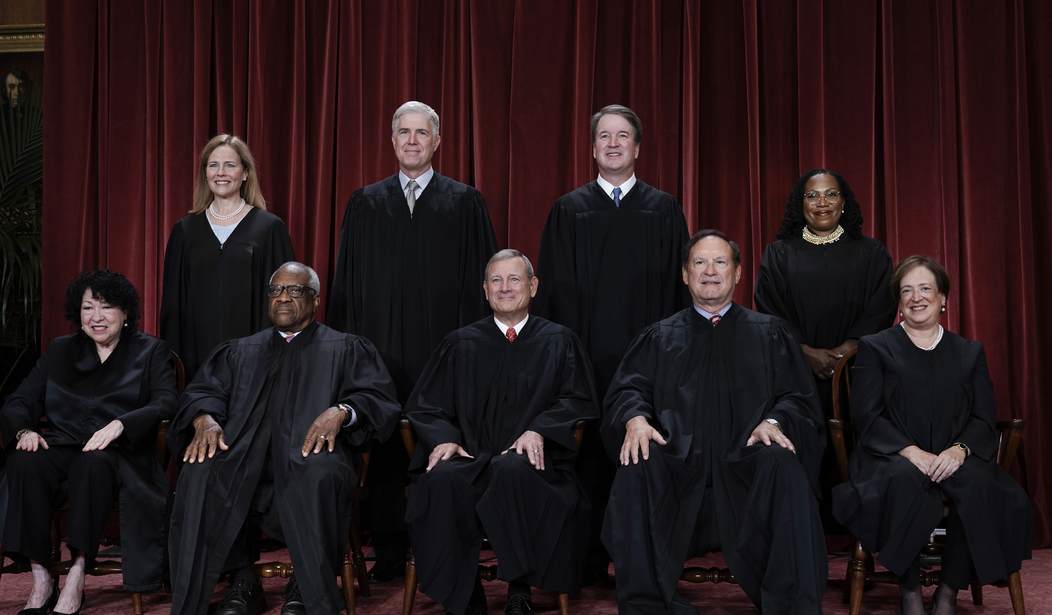
House Minority Leader Hakeem Jeffries (NY-08), in describing the Supreme Court as a “subsidiary of the MAGA Republican Party,” recently called for the Court’s expansion from nine to thirteen justices. His remarks echoed a growing refrain from the Left that the Court’s composition should mirror the number of federal appellate circuits. In September, Democrats defeated a Republican-led effort in the House of Representatives to pass a constitutional amendment capping the Supreme Court at nine justices. Few doubt that if Democrats regain control of Congress, they will move to amend the Judiciary Act and add four seats.
Contrary to popular belief, the Constitution does not specify how many justices should serve on the Supreme Court. Article III establishes “one Supreme Court” but leaves its size to Congress. The Judiciary Act of 1789, for instance, set the Court at six members — one Chief Justice and five Associate Justices — illustrating that the number has always been a matter of legislative discretion rather than constitutional mandate.
Throughout American history, Congress has adjusted the size of the Supreme Court several times to meet the nation’s evolving judicial needs. The number of justices rose and fell in response to political pressures and the expansion of federal circuits, settling at nine in 1869. That figure has remained unchanged for more than 150 years, becoming a symbol of institutional stability even though it was never constitutionally fixed. By and large, Americans accept the legitimacy of the Court's decisions, even in cases of profound popular and legal disagreement.
The Left, however, has no respect for the Court in its current iteration. Despite decisions overturning President Trump’s executive orders on birthright citizenship and tariffs — two signature actions — Democrats continue to accuse the Court of rank partisanship. They are not satisfied unless every decision goes their way (particularly in immigration removal cases), and that means nullifying the so-called “conservative” bloc. Adding four seats would, in theory, create a new supposedly “progressive” majority of seven: four new justices along with Justices Kagan, Sotomayor, and Jackson.
If and when Democrats win the White House and control both houses of Congress, they will quickly abolish the filibuster rule in its current form. They will press for new legislation expanding the Court and force Republicans to engage in a traditional filibuster to block their action. After exhausting this option, Republicans (and the country) will have no option but to accept a new and larger version of the Court.
A 13-member court will be perceived as a less objective, non-partisan body and more like an appendage of the Democrat Party. The four new justices will be selected based on their proclivity to support the Left’s policy goals, not to narrowly and objectively rule on legal issues before them. Expect decisions affirming disparate impact, abolition of the Electoral College, and even reversing the Dobbs decision. The idea that justices should call balls and strikes and set aside their personal beliefs will be cast aside in favor of political expediency.
Once this Rubicon is crossed, Republicans will have little incentive to hold back once they assume power. Why not add four more seats by nominating and confirming new justices who will advance their agenda? The Court will then be reduced to little more than a political appendage of whatever party manages to obtain control of Congress and the Presidency. It will have lost any legitimacy it may hold in the eyes of the American people.
Today’s iteration of the Supreme Court is not political. False characterizations by the Left purposefully ignore the multiple instances where the Court has refused to ratify actions by the President (tariffs, birthright citizenship) or even uphold decisions that may favor Republicans (limiting days a state may count mail ballots).
Expanding the Court will set our country down a dangerous path. The Court’s legitimacy depends not on its number of seats but on the public’s faith in its independence. As calls for additional seats grow, lawmakers should weigh not only the political gains of expansion, but the enduring cost to the institution that stands as the final arbiter of the nation’s laws.
Michael O’Neill is the Vice President of Legal Affairs at Landmark Legal Foundation, a public interest law firm in Leesburg, VA, and Kansas City, MO.
Editor's Note: Do you enjoy RedState's conservative reporting that takes on the radical Left and woke media? Support our work so that we can continue to bring you the truth.
Join RedState VIP and use promo code FIGHT to receive 60% off your membership.


Join the Conversation
VIP members get the ability to comment on articles.