
Radical Democrats are making it painfully clear how far they're willing to go to remake America's political institutions.
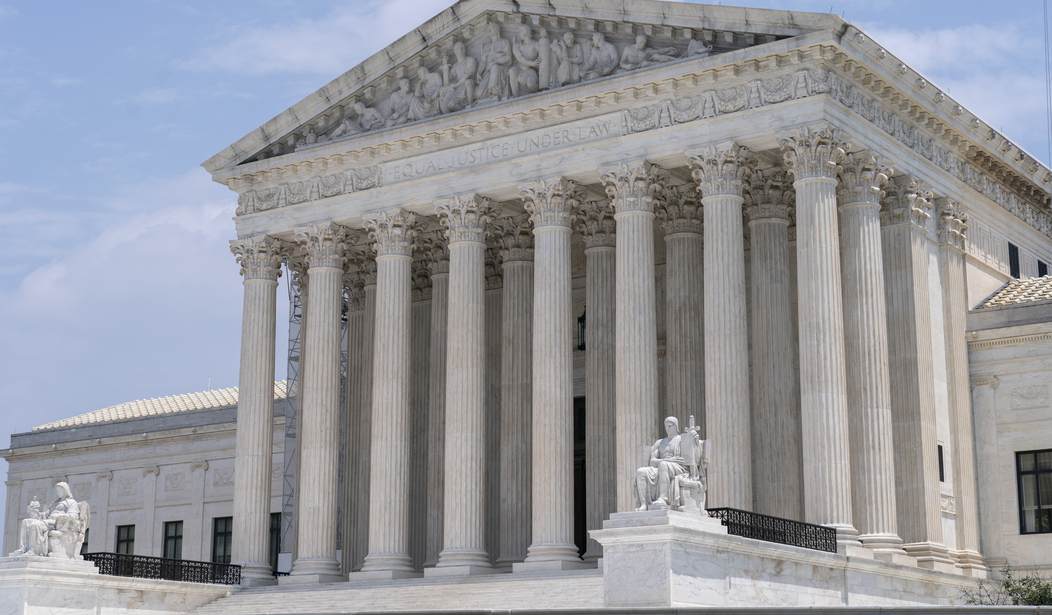
House Republicans brought forward a proposed constitutional amendment that would have permanently set the number of Supreme Court justices at nine.
The language could hardly have been simpler: “The Supreme Court of the United States shall be composed of nine justices.”
In other words, no court-packing. No future president and congressional majority could add seats simply because they didn't like the ideological composition of the Court.
Nearly every House Democrat voted against it.
The proposed amendment failed 212-206, well short of the two-thirds majority necessary for a constitutional amendment to clear the House. Only one Democrat, Rep. Don Davis (NC-01), joined Republicans in voting for it.
That was precisely the kind of vote GOP House Speaker Mike Johnson (LA-04) wanted. Before the measure reached the floor, Johnson said Republicans intended to force Democrats to “put their money where their mouth is” on court-packing.
For years, Democrats have insisted that their complaints about the Supreme Court are about ethics, legitimacy and institutional reform. But prominent Democrats have also kept proposals to change the structure of the Court very much alive.
Democrat House Minority Leader Hakeem Jeffries (NY-08) recently said “dramatic” Supreme Court reform would be necessary if Democrats regain control of the House. He said Rep. Jamie Raskin (MD-08) would lead that effort as Judiciary Committee chairman and notably refused to take any particular option off the table.
“There’s a variety of different options that are on the table,” Jeffries said. “And I think that we can’t foreclose any single one of them.”
Wednesday gave Democrats the opportunity to foreclose one of them. They declined.
Democrats argued during debate that permanently fixing the Court at nine seats would improperly constrain Congress and effectively lock in its current 6-3 conservative majority. Rep. Mary Gay Scanlon (PA-05) called the amendment a “grave mistake” that would “permanently tie Congress’ hands.”
Raskin went further, accusing Republicans of engaging in “court packing on steroids” through the confirmation battles that produced the current conservative majority.
But that definition conveniently blurs a rather important distinction. Filling an existing vacancy with a justice whom Democrats dislike is not court-packing. Creating new seats so that a governing party can appoint enough new justices to change the Court's ideological balance is.
And this isn't some theoretical danger Republicans invented for Wednesday's vote.
Court-packing has moved increasingly into respectable progressive political and legal debate. As recently as June, an essay in The UnPopulist argued that adding four Supreme Court justices had become an “unfortunate necessity” to combat what the author characterized as America's authoritarian drift. The proposal argued that the Court itself had created a crisis of legitimacy and that expansion could therefore be justified — even if a proposed constitutional settlement designed to prevent retaliatory packing never materialized.
Cato's Dan Greenberg, writing in response, identified the obvious danger: Once one party decides that its disagreement with the Court constitutes an emergency serious enough to justify changing the Court's composition, the other party acquires precisely the same incentive when power changes hands.
That is how a nine-member Supreme Court becomes 13, then perhaps 17, as each governing majority discovers a new “crisis of legitimacy” requiring another correction.
Greenberg noted that political forces might promise future restraints after obtaining the immediate benefit of court-packing, but there is no guarantee subsequent lawmakers would honor them. The more likely danger is another round of retaliation, with each faction nursing the grievance created by the last expansion.
This is hardly a new warning. The Supreme Court has had nine seats since 1869. Franklin D. Roosevelt's infamous 1937 court-packing proposal became one of the great cautionary tales of American politics after FDR sought to add as many as six justices while the Court was frustrating parts of his New Deal agenda.
The proposal was so radical that members of Roosevelt's own Democrat Party helped defeat it.
For decades afterward, court-packing remained politically toxic. Even Joe Biden, amid pressure from the progressive wing during the 2020 presidential campaign, was reluctant to embrace it.
“I’m not a fan of court packing,” Biden finally said in October 2020 after repeatedly avoiding a definitive answer during the campaign.
The political logic behind court-packing, however, never disappeared. It simply became more attractive to Democrats after President Donald Trump's three appointments produced a 6-3 conservative majority.
That is precisely why Wednesday's vote matters. Republicans weren't asking Democrats whether they approved of every decision made by the current Court. They were asking whether either political party should be able to respond to unfavorable decisions by changing the number of justices.
Only one House Democrat was willing to say no.
And the vote becomes more revealing when viewed alongside what has been happening elsewhere inside the Democrat Party this week.
Just one day earlier, House Democrats voted on a Republican resolution condemning socialism “in all its forms,” including the Democratic Socialists of America, while also backing the SAVE America Act.
The resolution passed 220-192. Only eight Democrats supported it, while two voted present.
Getting that measure to the floor produced its own Democratic meltdown. Republicans were on the verge of losing the procedural rule necessary to advance several bills when two Democrats — Reps. Jared Golden (ME-02) and Marie Gluesenkamp Perez (WA-03) — crossed the aisle. Their votes gave Republicans the 210-208 margin they needed, blindsiding Democrat leadership.
Jeffries, Democrat House Minority Whip Katherine Clark (MA-05), and Caucus Chairman Pete Aguilar (CA-33) responded by publicly rebuking their own members.
“The decision by two of our colleagues to blindside the entire House Democratic Caucus and join with the Republican majority to pass a procedural rule on the brink of failing represents a significant breach of trust,” the Democrat leaders said.
“It is an action that necessitates a serious response.”
Golden and Gluesenkamp Perez now face possible internal consequences for breaking ranks.
Taken together, the votes offer an interesting snapshot of where the Democrat Party stands. Nearly the entire caucus refused to make nine Supreme Court seats permanent. A day earlier, 192 Democrats opposed a resolution condemning socialism and the Democratic Socialists of America. And when two moderates helped Republicans force that vote onto the floor, Democrat leadership threatened a “serious response.”
This comes as democratic socialists have become increasingly influential within the party's coalition, winning Democrat primaries and pushing policies that would have been far outside the party's mainstream a generation ago. Rep. Alexandria Ocasio-Cortez (NY-14), one of the country's most prominent DSA members, is also widely discussed as a potential presidential contender in 2028.
Political arguments many Americans thought had receded with the Cold War are therefore returning to the center of American politics: capitalism versus socialism, the proper limits of government power, and now whether the composition of the Supreme Court itself should remain beyond the reach of a temporary political majority.
There is a deeper problem with court-packing that goes beyond which party benefits today.
A Supreme Court capable of being expanded whenever its decisions anger the governing party ceases to function as an independent constitutional check in any meaningful sense. The incentive becomes obvious: Deliver decisions acceptable to the political branches or risk having those branches change the composition of the Court.
Court-packing advocates sometimes argue that extraordinary circumstances justify extraordinary measures. But that logic contains its own trap. Once one political faction establishes that violating a longstanding institutional norm is justified because the other side has supposedly violated norms first, there is no limiting principle left for the next majority.
As Greenberg observed in his critique of the latest court-packing proposal, such reasoning amounts to saying that “those who encounter a breach of norms are therefore entitled to breach other norms.”
That isn't institutional reform. It is an escalation mechanism.
There are legitimate debates to be had about Supreme Court ethics, judicial philosophy and even term limits. Some term-limit proposals could temporarily result in more than nine justices as newly appointed members overlap with sitting lifetime justices, which Democrats cited as one complication with Wednesday's amendment.
But none of that changes the central question Congress confronted.
Should the party that controls Washington be able to add Supreme Court seats because it wants different Supreme Court decisions?
For generations, even politicians who bitterly disagreed over the Court understood why the answer should be no. The losing side in a Supreme Court case could attack the reasoning, elect presidents who nominated different judges, pass constitutional legislation or pursue the extraordinarily difficult process of amending the Constitution.
What it could not safely do was change the number of referees until it liked the score.
House Republicans offered Democrats the opportunity Wednesday to take that temptation away from both parties permanently.
All but one House Democrat refused.
As I mentioned before, and it bears repeating: The midterm elections are not a referendum on Donald Trump. It's a referendum on what kind of America people want to live in.