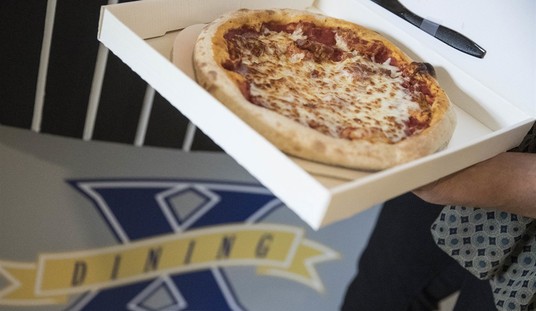
Something strange is going on at American military bases.
Over the summer, refrigeration units began going haywire across the country. Federal investigators have uncovered evidence there may be something more sinister going on than freezer malfunctions.
And this disturbing news comes as governments around the world are issuing warnings to people to "stock up" in the case of an emergency.
The trouble began with freezers at military commissaries, the on-base grocery stores where service members and their families purchase food.
According to an exclusive Reuters investigation published Thursday, refrigeration equipment at least six military installations malfunctioned in late August, leaving substantial quantities of food spoiled.
The Pentagon is now investigating whether these incidents were cyberattacks, according to four officials familiar with the matter.
At Fort Huachuca, Arizona, the malfunction was particularly unusual. The equipment didn't merely stop cooling. It apparently began heating the food it was supposed to preserve.
The installation's official Facebook account explained the situation on August 26:
"Our freezer went into defrost mode where it heated up all the food. Trust us when we say it was 'spoiled.'"
Similar incidents are happening at other locations. U.S. Cyber Command is involved in the investigation, along with the Army Criminal Investigation Division's Cyber Field Office.
And U.S. investigators have been communicating with French law enforcement.
Why France? Because something similar happened there earlier this month, except French authorities have confirmed that hackers were involved.
On October 12, supermarkets across France began reporting that their refrigeration systems were malfunctioning. Frozen food was thawing, refrigerated merchandise was spoiling, and some equipment was overheating badly enough to start fires.
According to Reuters, hackers manipulated temperature controls affecting more than 350 locations.
Rather than simply disabling the refrigeration systems, the hackers reportedly changed their operating temperatures, causing equipment intended to preserve food to destroy it instead.
One supermarket owner estimated that the attacks might ultimately cost businesses tens of millions of euros.
Investigators also discovered a troubling weakness in the technology. Danfoss, a Danish company whose refrigeration controllers were used at many affected locations, acknowledged that some equipment was obsolete or operating with outdated firmware, potentially allowing hackers to exploit vulnerabilities.
The refrigeration equipment had become vulnerable because systems originally intended to be adjusted by technicians on location were increasingly connected to computer networks. Sounds like some of our election horror stories.
Bill Moore, chief executive of industrial cybersecurity firm Xona Systems, explained the consequences to Reuters.
"It can definitely disrupt the supply chain for food," Moore warned.
The broader threat is very real. Modern food distribution depends heavily on refrigeration, from processing facilities and warehouses to trucks, supermarkets and military installations.
Reuters noted that federal prosecutors in Los Angeles accused a Ukrainian woman in December 2025 of participating in a suspected Russia-backed hacking operation that disabled refrigeration at an American meatpacking facility in 2024. That alone reportedly destroyed more than 2,000 pounds of meat.
Warnings are also going out about cyberattacks and governments are urging people to stockpile emergency supplies.
According to Newsweek, numerous countries have been issuing or renewing public warnings advising households to stockpile food, water, medicine and other emergency supplies in preparation for potential disruptions.
These warnings cover armed conflict, natural disasters, infrastructure failures and cybersecurity threats. It is a non-specific warning that ranges the spectrum.
Meanwhile, France and the United Kingdom have emphasized maintaining enough supplies to survive at least 72 hours without normal access to essential services.
On Tuesday, a government account representing the French region of Normandy issued a particularly direct message: "Don't wait for the emergency: prepare now!"
And France isn't alone. Sweden and Norway are advising households to prepare for approximately one week of disruptions, while Germany recommends maintaining enough supplies for as long as 10 days.
The Netherlands, Denmark, Finland, Poland and several Baltic countries have also promoted emergency preparedness.
Outside Europe, countries including Canada, Mexico, Japan, Taiwan, Israel, Singapore, Australia and New Zealand have issued their own guidance about maintaining household emergency supplies.
This isn’t just fearmongering, however. It’s good life advice. Don't assume grocery stores, utilities and other essential services will always be available when you need them.
We all saw what happened during Hurricane Katrina.
These warnings don't necessarily mean intelligence agencies are expecting a major cyberattack next Tuesday. Governments have been issuing emergency preparedness recommendations for decades.
The United States has been offering comparable advice through the Department of Homeland Security's Ready.gov website, which encourages Americans to have enough food, water and other essentials to last for several days.
Former FBI Deputy Director Dan Bongino recently discussed emergency preparedness on his podcast.
"The way to reduce anxiety and panic in tumultuous times is to be prepared," Bongino said.
He recommended keeping an emergency radio, batteries, food supplies and water-filtration equipment available.
He's right about the practical value of having basic supplies on hand. There's no reason to wait until the grocery store shelves are empty or the electricity goes out to start thinking about what your family needs.
Here’s one way to start preparing: Make sure your deep freeze didn’t “fall off” a military truck.