
France is burning again, and the timing isn't a coincidence.
Behind the demonstrations is an increasingly violent struggle over who will govern France after President Emmanuel Macron leaves office in 2027. And as it devolves into chaos, the Islamist-socialist alliance is once again flexing its muscle.
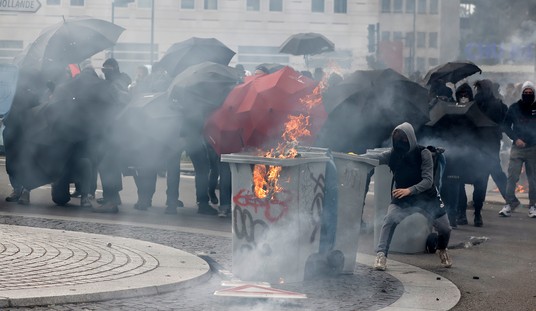
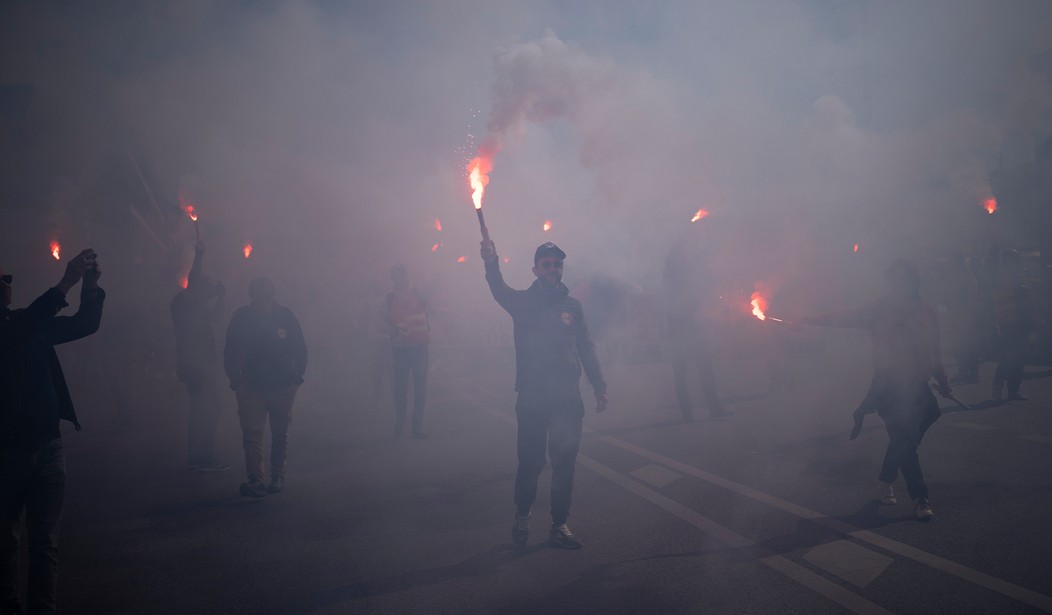
As the country's presidential election looms just six months from now, violent unrest has swept through major French cities. Rioting has left historic buildings damaged, businesses looted, and police battling masked rioters in the streets.
The videos from Saturday's protests in France were alarming. As RedState's Nick Arama documented, rioters set fire to Lyon's historic tourism office, vandalized public buildings in Marseille, attacked police, and damaged shops and national monuments in Paris. In Marseille, vandals reportedly toppled a bust of Marianne, the female figure symbolizing the French Republic.
Les scènes de liesse autour de l’office de tourisme en flammes se multiplient à Lyon https://t.co/oZfAg4tUsC
— Lyon Mag (@lyonmag) October 17, 2026
Some protesters carried Palestinian flags. Others displayed anarchist symbols. The hammer and sickle was spotted.
Another photo from her. The URC flags with the sickle & hammer are another pro Communist/Marxist/Lenin group. https://t.co/65CXErwCHr
— Bill Melugin (@BillMelugin_) October 17, 2026
The tumultuous demonstrations have brought together socialists, college students, trade unionists, Muslim immigrants, and Yellow Vest activists who say they are angry over rising living costs, deteriorating public services, and economic inequality.
French Prime Minister Sebastien Lecornu said the government would not be "intimidated" by violence, and blamed the unrest on the "far-left" and criminals just months before a presidential election next year.
"To those who clearly want to use this violence as a 'warm-up' before the presidential election, I say clearly: We will not let ourselves be intimidated. No one will impose their political agenda through violence," he wrote in a post on X.
An estimated 800,000 people participated in the unruly protests nationwide. French authorities reported hundreds of arrests as violent groups clashed with police.
And if you want a chilling preview of what might happen if France falls, then I encourage you to check out fellow RedState VIPer Ward Clark's new column.
A look at the protesters, the rioters, the rebels, is a look at a witch's brew of groups who appear to have formed a temporary alliance: French students, alongside people who appear to be North African and Middle Easter immigrants. Some of them are wearing black bloc. There are flags waving: Palestine flags, Antifa flags, even a few French flags- but exceedingly few of those. As Nick goes on to report, the country is coming apart at the seams. Historic buildings that have stood for centuries are ablaze. Cars are burning, businesses are being looted. The rioters are brushing French police aside, and are shouting about storming the Bastille; and this time, there's no Napoleon to administer a "whiff of grapeshot."
So, what happens if the unthinkable occurs — and these rioters win? What happens if they manage to overthrow the French government?
And that brings us to Jean-Luc Mélenchon. The leader of the hard-left La France Insoumise party, or France Unbowed (LFI), has been actively supporting the protest movement, appearing alongside demonstrators and seeking to position himself as a political champion of disaffected young people.
The Associated Press reported that Mélenchon recently praised the student protests during a presidential campaign rally, calling the movement evidence of young people's political maturity and proposing to lower France's voting age to 16.
That would give many of the students currently demonstrating a direct role in choosing France's next president. It's not hard to see the political calculation. Mélenchon is trying to make himself the political beneficiary of that discontent. And the French government is taking notice.
As Le Monde reported, Lecornu accused Mélenchon's party of attempting to exploit the unrest for electoral purposes.
"Violence is part of your political plan to throw the country into chaos between now and the presidential election," he told LFI lawmakers.
The prime minister also accused the party of portraying French police as racist while encouraging protests that have repeatedly descended into police confrontations. This is a fantastic example of being bitten by the crocodile that you fed.
The BBC has reported on allegations that the hard left is using the student movement to advance Mélenchon's presidential ambitions. Its reporting also noted that demonstrators have been heard chanting "Mélenchon for President!"
The unrest has become a political organizing opportunity, with Mélenchon presenting himself as the candidate most closely identified with the protesters.
Macron cannot run for a third consecutive term. His departure will leave the presidency open in April and May 2027, with a fractured political establishment competing against the National Rally party of Marine Le Pen and Jordan Bardella.
Recent polling has placed Le Pen well ahead of individual rivals in first-round voting intentions, while Mélenchon, former Prime Minister Édouard Philippe, and other contenders compete for support in the fragmented field.
That fragmentation creates an opening for Mélenchon to consolidate the hard-left vote by mobilizing younger voters, working-class neighborhoods, and communities with immigrant backgrounds.
The demonstrations provide him with a ready-made platform for doing exactly that. And the timing is critical, because the “red-green alliance” of socialists and Islamic immigrants is taking to the streets amid public opinion polling that reflects deep angst over the economy.
A remarkable new survey suggests that France is deeply divided over what a Le Pen presidency would mean, particularly among Muslim voters and supporters of Mélenchon's party.
According to Ifop polling for Marianne, 46 percent of Muslim respondents said they would consider leaving France if Marine Le Pen were elected president.
The survey also found that 43 percent of Mélenchon's voters would consider leaving under the same circumstances.
The findings went further. Among Mélenchon's supporters, 75 percent said they would be willing to refuse compliance with laws they considered unjust under a Le Pen administration.
That is an astonishing level of political resistance before a single vote has been cast. It is reminiscent of the TDS-afflicted Democrats whose political platform has devolved into, "whatever Trump is for, I'm against it."
It also provides important context for the growing confrontation between the hard left and National Rally. The "red-green alliance" brings together elements of the radical left and constituencies organized around Muslim political identity, particularly on alleged grievances involving immigration, discrimination, secularism, and the Israeli-Palestinian conflict.
For the hard left, those overlapping grievances create opportunities to mobilize constituencies that might otherwise have little in common.
That is how critical theory works: It not only unites disparate groups around identity politics grievances, it also veils their underlying socialist agenda.
Superstructure and base is the name of the game: Drive the grievances in the culture, use those as a rationalization to capture the economic base.
And the economic base has taken a beating after decades of leftist policies. An October survey from Sciences Po's CEVIPOF research center found that 45 percent of French respondents identified inflation and purchasing power as major concerns. Public debt was another growing worry.
Those anxieties intersect with France's immigration debate. National Rally has long argued that immigration policy affects public spending, housing, and access to services, while the left emphasizes inequality, underinvestment, and economic pressures affecting working-class communities.
The competing explanations matter politically because both sides are seeking support from voters frustrated by the cost of living.
There is another remarkable finding in the Ifop survey: 80 percent of respondents supported banning organizations linked to the Muslim Brotherhood. The results show that concerns about Islamist political organizations extend well beyond National Rally's electorate.
Le Pen, meanwhile, has sought to distinguish ordinary Muslim religious practice from Islamist political movements. In a recent interview with Europe 1, she said Muslims would remain free to practice their religion under her presidency, while arguing that Sharia and Islamist fundamentalism are incompatible with the French Republic.
A Reuters report on October 12 described polling scenarios in which Le Pen and Mélenchon occupied the top two first-round positions, illustrating how deeply the political center has been squeezed.
And the emerging political alliances in France have a recognizable counterpart in the United States. Consider the recent developments in Michigan. Rep. Alexandria Ocasio-Cortez (D-NY) has committed $1 million to support Democrat Senate nominee Abdul El-Sayed, the progressive candidate who defeated Rep. Haley Stevens in the party's primary.
The financial support from Ocasio-Cortez is striking because it illustrates how the Democrat Party's socialist wing is investing in Islamist candidates. Former President Barack Obama endorsed El-Sayed in a campaign advertisement and is scheduled to campaign alongside him in Detroit on October 24.
El-Sayed has campaigned on progressive economic policies, including Medicare for All, while also criticizing American military support for Israel. This is how Islamists "talk the talk" of socialism while baiting leftists into fellow-traveling with them. Democrats are "useful idiots" for going along with this schtick, to put it bluntly.
Then there's New York City Mayor Zohran Mamdani. During his mayoral campaign, Mamdani received Ocasio-Cortez's endorsement and later appeared at a major rally with Ocasio-Cortez and Sen. Bernie Sanders. Now wonder AOC was giggling with Mamdani on 9/11, something far too many Democrats believe America deserved.
In France, the additional question is whether the protest movement will become a lasting source of political organization ahead of the 2027 election.
France's streets have become a stage on which leftists and Muslim immigrants are staging violent riots over the country's future, demanding free healthcare and schooling amid rising living costs driven by higher government spending and ensuing inflation.
It was a ticking time bomb that was set decades ago by the socialist left.
Now, it has exploded all over France. Is America next?