
Spain's immigration crisis has taken a very bizarre turn, and a fresh controversy centers on what thousands of migrants are telling authorities to justify their asylum claims.
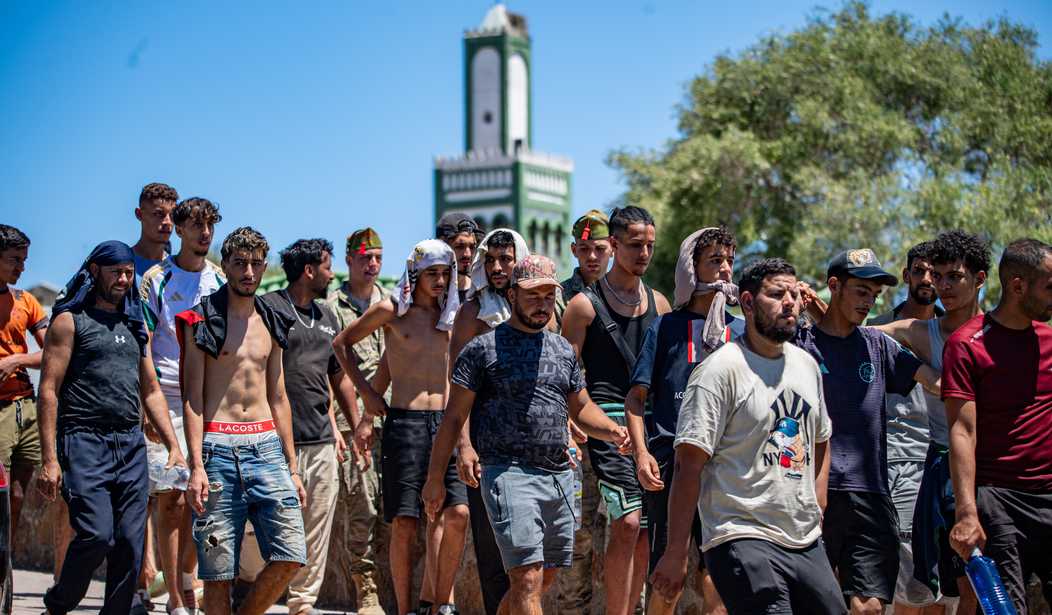
The country is still dealing with the fallout from the migrant invasion into Ceuta, the Spanish territory on North Africa's Mediterranean coast, in late July. Tens of thousands of people entered the enclave from Morocco, overwhelming local authorities and igniting protests across Spain.
Now Spanish police sources say they've noticed an unbelievable change in the explanations migrants are giving for why they cannot return home. Literally unbelievable. As in, nobody should believe them.
They say they are “gay.” As many as 70 percent of them, according to some reports.
Either there is something in the Northern Mediterranean Sea, or a lot of them are lying.
(Somebody cue a “gay fish” joke.)
According to a recent report in Spain's ABC newspaper, approximately 70 percent of asylum applications in the Ceuta cases under review now cite persecution based on sexual orientation.
That's a ludicrous figure, particularly considering that the overwhelming majority of the applicants reportedly come from Morocco.
Police sources told ABC that roughly 95 percent of the asylum applications came from Moroccan nationals, with other nationalities accounting for the remaining five percent.
During the initial weeks following the July border crisis, many applicants reportedly cited economic hardship, unemployment, or the desire for a better life in Spain. More recently, police have observed a surge in claims involving persecution for homosexuality.
While it’s believable that gays can be persecuted by Muslims, that begs the question: Why are so many European countries that espouse to protect homosexuals also importing so many migrants from Muslim-majority countries?
That’s a riddle that is apparently too difficult to solve for the mindless virtue-signalers.
The surge in “gay” asylum seekers has prompted suspicions that migrants are receiving advice about which grounds for asylum offer the best chance of remaining in Spain.
According to ABC, police sources suspect that outside organizations, potentially including nongovernmental groups, may be providing such guidance. The report does not identify a specific organization responsible or establish that the claims are fraudulent.
Spain's Unified Police Union (SUP) has also raised concerns about the pattern and called for stronger verification procedures.
There's a reason the sheer volume of gay sexual-orientation claims is dubious.
Morocco is overwhelmingly Muslim, and its penal code criminalizes same-sex sexual activity. People who are gay can face genuine legal and social persecution there, making sexual orientation a potentially valid basis for asylum under Spanish and international refugee law.
But the fact that persecution exists in a country does not automatically establish that every applicant claiming to be gay has a well-founded personal risk.
Spanish authorities must evaluate individual accounts, supporting evidence, inconsistencies, and conditions in the applicant's home country. (No, they don't actually watch applicants "prove" they are gay.)
And there is already evidence from elsewhere in Europe that dishonest immigration advisers have exploited precisely this type of asylum claim.
In April, the BBC published an undercover investigation exposing immigration advisers in Britain who allegedly offered to help applicants fabricate claims of persecution based on homosexuality.
Reporters posing as Pakistani and Bangladeshi students whose visas were about to expire approached legal advisers to find out how they could remain in the United Kingdom.
What they discovered was a business built around manufacturing asylum narratives. RedState's Bob Hoge broke this scam down in a great article published earlier this month.
“Most people here aren’t gay,” one attendee told an undercover reporter. “When you go for your (Home Office) interview,” he continued, “you have to be shameless.”
“Are you actually gay?” the reporter asked another man. The pretender just smiled and shook his head. “We shouldn’t talk like this here,” he said. Pressed further, he revealed, “Nobody here is gay.”
According to the BBC, one law firm quoted an undercover reporter £7,000 to pursue a fabricated asylum claim. Another adviser offered assistance creating false evidence, including purported relationships and supporting documentation.
One woman who spoke to an undercover reporter allegedly explained the strategy with startling candor.
"Listen to me. There is nobody who is real. There is only one way out in order to live here now and that is the very method everyone is adopting," she said after the reporter explained that he wasn't gay.
She went on to describe the process as a human-rights asylum claim based on sexual orientation.
"There is no check-up to find out if the person is a gay," she reportedly told him. "The main thing is what you say. You just have to tell them that 'I am a gay and it is my reality'."
Now Spanish police are describing a suspicious shift toward similar claims among migrants who entered Ceuta.
The parallel raises an obvious question: Are applicants independently describing genuine experiences of persecution, or are some being coached to present a particular identity because they believe it improves their chances of obtaining protection?
The Ceuta situation is particularly troubling because the asylum process has already become entangled with a larger enforcement problem.
According to ABC, approximately 99 percent of applications in the reported group have been rejected. The newspaper also reported that at least 19 claims had been approved by mid-October, including five involving persecution based on sexual orientation.
Yet rejection doesn't necessarily mean an applicant is immediately removed.
Spanish authorities must formally notify applicants of decisions, and police sources told ABC that some rejected migrants have left reception facilities and disappeared into surrounding neighborhoods or other locations before officials could complete the process.
Spain's Unified Police Union put the enforcement problem bluntly: "There's no point in denying a request if the person then disappears and the police can't locate them."
As I reported in July, the Ceuta crisis followed a Spanish Supreme Court ruling restricting the government's use of immediate returns against certain migrants intercepted at sea.
The July crossing brought an extraordinary number of people into an enclave whose population was only about 80,000. The scale of the episode raised serious questions about border enforcement, Spain's relationship with Morocco, and the European Union's ability to control its external frontier.
By September, the political consequences had spread across the country.
In RedState’s earlier report on the mass protests against Prime Minister Pedro Sánchez, I documented demonstrations from Ceuta to Madrid, where protesters accused the socialist government of failing to protect Spain's borders.
Some demonstrations turned violent, and the crisis produced tensions with other European governments over migration enforcement and border controls.
Westerners are tired of their immigration systems being exploited by foreigners who have no desire whatsoever to assimilate, and thus, can defraud their host countries with dubious claims of “refugee” status based on self-descriptions they can simply fake.
Ilhan Omar, anyone?