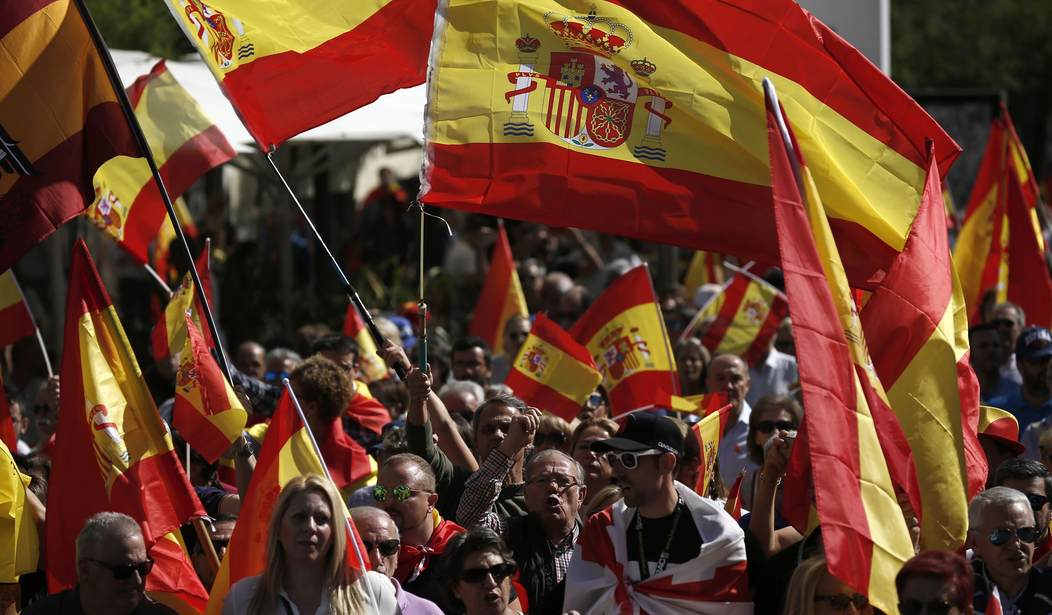

Mass protests are once again exploding across Spain. A major uprising in the nation’s capital of Madrid is putting extreme pressure on the socialist leader Pedro Sánchez, whom some have labeled as a “traitor.”
Tens of thousands of people took to the streets in protests stretching from Ceuta itself to Madrid and cities across the mainland. On Wednesday, the Spanish revolt turned violent.
Organizers listed more than 500 separate gatherings, mostly outside town halls, turning Ceuta Day into a nationwide show of anger over what happened.
🇪🇸🇲🇦 | Madrid está en la calle apoyando a Ceuta contra el régimen marroquí de Mohamed VI. pic.twitter.com/GTEeL4XL9B
— ʜᴇʀQʟᴇs (@herqles_es) September 2, 2026
The flashpoint was the sheer scale of the Ceuta crisis. More than 70,000 people crossed from Morocco into the Spanish enclave on July 30 and 31, an astonishing number considering Ceuta itself has a population of only around 80,000.
Most eventually returned to Morocco, but roughly 5,000 were still in Ceuta by the beginning of September.
The public outrage has been building for weeks. On August 28, protesters in Ceuta marched chanting “Invasores, expulsión” — “Invaders, expulsion.” By September 2, the demonstrations had spread across Spain.
In Madrid, crowds gathered at Cibeles and outside the Congress of Deputies. Spanish flags filled the demonstrations, and some of the chants left little doubt about where the outrage was being directed.
“Es invasión, no inmigración.”
“It is invasion, not immigration.”
“Sánchez, traidor, dimisión.”
“Sánchez, traitor, resign.”
And: “España es cristiana y no musulmana” — “Spain is Christian, not Muslim.”
The protest outside the Spanish Congress turned violent. Objects were thrown at police, riot officers moved in and fighting spilled into the surrounding streets. Four people were arrested, including two minors, and four police officers were injured.
Television journalists were assaulted as well. A TVE reporter was surrounded and pushed before police helped him leave, while journalists from La Sexta also faced confrontations.
The Ceuta crisis has triggered a national political argument. Now tens of thousands of people are demonstrating across Spain and police are clashing with protesters outside the national parliament.
For Pedro Sánchez, that is a dangerous escalation.
At the center of it is the question that has hung over the entire affair from the beginning: what exactly happened on the Moroccan side of the border?
Sánchez appeared before Congress on September 3 and said his government has no firm evidence that Morocco planned or ordered the mass crossing. But he also acknowledged that Moroccan police allowed people to cross for roughly ten hours.
A Spanish police report described the Ceuta migration as planned and beyond what ordinary migrant-smuggling networks would normally be capable of organizing.
Moroccan security forces were unusually passive and thinly deployed. There have been accounts of Moroccan personnel directing migrants toward the frontier.
In other words, many Spaniards now believe this crisis was staged.
Morocco denies deliberately orchestrating the migrant crossing, and there is still no publicly established evidence showing that the Moroccan government ordered it.
But politically, Sánchez is sitting on a powderkeg.
His socialist government has spent years saying cooperation with Morocco is one of the foundations of Spanish immigration policy. Sánchez now has to explain how its
“partner” apparently allowed tens of thousands of foreigners to flood Ceuta.
The backdrop is crucial. Morocco claims sovereignty over Ceuta and Melilla. Sánchez revealed this week that Spain summoned the Moroccan ambassador on August 21 after comments from Moroccan ministers concerning the two territories.
So, here is the question for Sánchez: Did the Spanish government see this foreigner invasion coming and turn the other way due to politics?
The prime minister says Spanish security services, the CNI intelligence service and Frontex did not provide warning proportional to what was about to happen. His government is releasing reports and communications from before the crisis to support that position.
Americans have heard this kind of ‘plausible deniability’ before, particularly, in regards to January 6. But when there is a major deviation from established protocol, it can become its own kind of evidence that the government might have allowed a crisis to happen.
If the government received a clear warning and failed to act, it has a serious problem. If Spanish and European intelligence genuinely had no idea that a movement of more than 70,000 people was developing around one of Europe's most sensitive borders, that is also a serious problem.
Then there is Brussels. Ceuta is Spanish territory, but it is also part of the European Union's external frontier. That means the July crisis was not simply a failure at Spain's border. It was a failure at Europe's border.
The timing could hardly have been worse for the EU. Its new Pact on Migration and Asylum only became applicable in June after years of promises that Europe had learned from the migration crises of the previous decade.
The new system is supposed to mean stronger external borders, faster screening, quicker asylum decisions, more effective returns and better mechanisms for helping countries facing sudden migration pressure.
Then the Ceuta crisis happened. In one extraordinary episode, more than 70,000 people crossed an EU external border. The number reportedly exceeded the irregular entries recorded across all European external borders earlier in 2026.
That makes Ceuta an early and rather brutal test of Europe's claim that it has finally developed a workable migration system.
Several European governments are already unhappy. Italy temporarily restored certain border controls involving Spain, prompting reciprocal measures from Madrid, while Denmark and Finland have pushed for Spain to be temporarily suspended from Schengen.
So Sánchez is being squeezed from multiple directions at once.
For a Sánchez government already facing an aggressive opposition, pressure from European partners and growing public anger over migration, it is an explosive situation.
The Ceuta crisis has become yet another flashpoint that points toward Europeans’ growing impatience over watching their cultures eroded by mass migration.