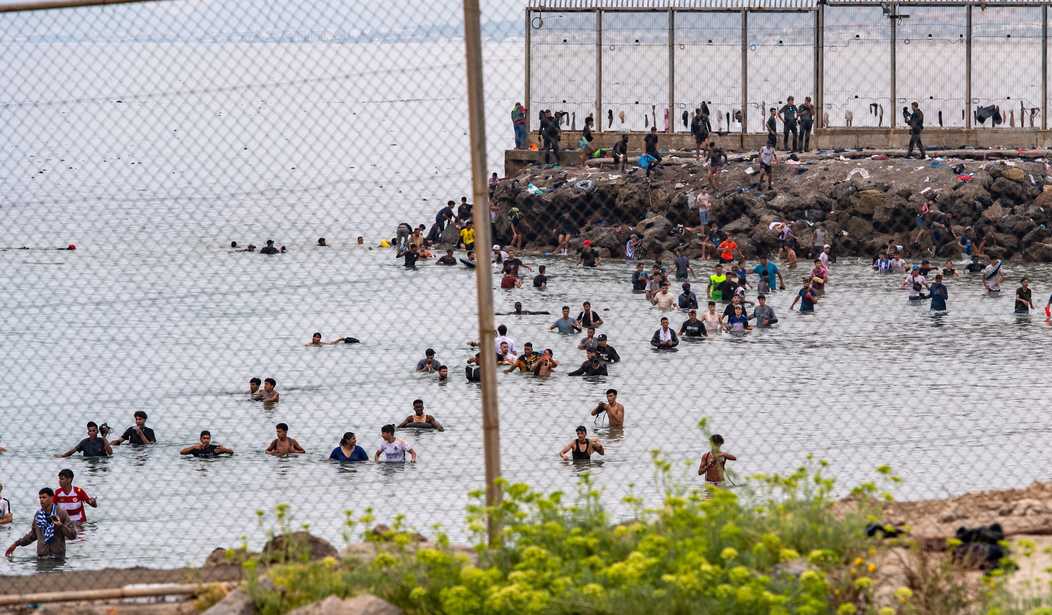

The Spanish city of Ceuta has captured international headlines due to a brewing migrant crisis that is one of the most stunning in recent history.
According to reports, at least 41 people have died as a flood of nearly 60,000 illegal migrants poured into the city within 24 hours.
While the socialist prime minister has denied responsibility, a number of international players have caused this manmade disaster.
First and foremost, Spain's Supreme Court appears to have opened the floodgates with a ruling in early July that the government could not use "hot returns" of migrants that come into those Spanish cities on the North African continent.
The hot returns they cannot be applied to migrants intercepted on the high seas who intend to swim into Ceuta and Melilla. This was established this Wednesday by the Supreme Court, which confirmed that the provision of the immigration law that regulates express rejection is not applicable to all foreigners who attempt to irregularly cross the border by land or sea, but only “for those who attempt to do so by overcoming established border containment elements, such as fences”.
The Contentious Chamber has established this new doctrine in a ruling in which it examines the case of an immigrant of Algerian nationality who appealed his surrender to the Moroccan authorities after being intercepted on the high seas on November 14, 2024 when, together With two other people, he intended to swim into Ceuta. In his appeal he alleged that this return was carried out directly without any procedure or resolution, nor allowing him the assistance of a lawyer or the law of international protection. The migrant requested compensation of 6,000 euros for the moral damages caused and to be recognized for adopting the necessary measures to achieve his return and readmission to Spain.
This may explain to a degree why Prime Minister Pedro Sánchez did not declare a "state of emergency," despite the petition of the president of Ceuta, Juan Jesús Vivas, and the local assembly by unanimity.
The Interior Ministry officially rejected activating the national emergency because the "migratory flows are not among the risks covered by that framework."
Now, the Supreme Court ruling's timing is interesting given that a meeting between Sánchez and Algerian President took place just one week before the Ceuta invasion.
I have asked my teams to start working with their Algerian counterparts as of today to ensure that this High-Level Meeting is a success that benefits both our societies.
I believe the High-Level Meeting will allow us to deepen our cooperation in many areas, such as security and the fight against irregular migration, as you mentioned. It will also provide fresh impetus to many other fields, such as cultural cooperation, which is of particular importance for fostering people-to-people exchanges.
It is also fascinating that the Foreign Ministry thought it sufficiently concerning to people to formally deny any connection between the meeting and the migration crisis.
#ÚLTIMAHORA | Exteriores desvincula la crisis migratoria en Ceuta del viaje de Sánchez a Argelia: "La relación con Marruecos es excelente y en nada se ve afectada por las buenas relaciones con Argelia" https://t.co/5sHIOjPjXE pic.twitter.com/MmOjEFT8gp
— Europa Press (@europapress) July 30, 2026
"The Ministry of Foreign Affairs has separated the migration crisis in Ceuta, after the entry of thousands of people in the last few hours from Morocco, from President Pedro Sánchez's trip to Algeria on July 20 and has defended that the relationship with Morocco is ' excellent'," Europa Press reported.
Relevant also is a high-level meeting between the head of Spain's Civil Guard Intelligence Directorate and Morocco’s Directorate of National Security and Territorial Surveillance in Rabat in March.
According to Morocco’s Directorate of National Security, this visit reflects the advanced level achieved by the strategic security partnership linking both Moroccan directorates-general with the various Spanish security and intelligence services. This partnership has become a model of cooperation in the fight against terrorism and various forms of cross-border crime.
This demonstrates the high level of coordination between the Spanish and Moroccan governments that makes it nearly inconceivable that Spain's government had no advanced warning of the coming migration crisis.
Indeed, the planning of the migrant invasion was out in the open, on Facebook, as demonstrated by a thread from researcher Data Republican.
The Ceuta invasion is being coordinated by Facebook groups. @finkd
— DataRepublican (small r) (@DataRepublican) July 30, 2026
The flagship group description: "Ceuta by every route #hraga_ceuta — Migration is an idea, and the idea does not die."
There are countless posts soliciting people to go with others. This is in clear violation… https://t.co/hfi7I6riQi
The flagship group description: "Ceuta by every route #hraga_ceuta — Migration is an idea, and the idea does not die."There are countless posts soliciting people to go with others. This is in clear violation of the Facebook ToS that prohibits content "offers to provide or facilitate human smuggling" or content that asks for "asks for human smuggling services."
They call it a "liberation" of Ceuta, a handover back to its owners. @mattvanswol is right on the money. It's an invasion.
Posters are exchanging phone numbers, maps, requesting "spots" to be guided, discussing how to purchase equipment such as fence grips. I haven't yet found any discussions on what they plan to do after landing in Ceuta.
Their destination appears to be Centro de Estancia Temporal de Inmigrantes (CETI) where they await a ferry to mainland Spain. They do not file asylum in Ceuta. They do it in the mainland.
Once they register in Spain, they are allowed to work the day that they register for asylum. And when their application is approved, they get their one-year residence permit, all deportation orders are suspended, and they have the right to receive social security.
IMO, the most likely resolution is that Spain will punt on confrontation altogether by simply sending more ferries and hauling them all up to mainland.
UPDATE: All 5 Ceuta border crossing coordination Facebook groups have been closed. These groups contained 230K+ members collectively.
As revealed in one of the cited screenshots, an article from The New Arab provides vital context.
The decree allows immigrants to work and prevents their deportation while their cases are being reviewed; once the application is accepted, the applicant receives a temporary residence permit for one year. For Khadija, Raed, Mohamed Abdi, and many others, the morning of January 26th was different. On that day, the Spanish government, headed by Pedro Sánchez, issued an exceptional decree to regularize the status of more than half a million undocumented migrants. According to the Minister of Integration and Migration, Elma Sáez, who announced the decree at a press conference, it allows migrants to work from the day they submit their asylum application and provides legal protection preventing their deportation while their cases are being processed. The ministry stated that applications will be accepted from April 2026 until…[June 30].
To be eligible for the application, applicants must have a clean criminal record. Once accepted, they receive a one-year temporary residence permit and a work permit, and any existing deportation orders are suspended. They are also granted the right to register with social security. Minors receive a five-year residence permit that includes educational, health, and social rights. According to estimates from the Spanish Ministry of Immigration, approximately half a million people could benefit from the regularization decree, but civil society organizations put this number at over 700,000 potential beneficiaries. They estimate the number of undocumented migrants in the country at around 840,000 by the end of 2025.
Due to Pedro Sánchez's decree, Spain has implemented "special" procedures to handle "undocumented migrants."
Undocumented migrants in Spain have until 30 June to apply for the country’s extraordinary regularisation programme. By mid-June, the migration ministry said it had received some 900,000 applications. The scheme offers eligible foreign nationals already in the country the opportunity to legalise their immigration status.
The programme comes as many European governments ramp up controls on immigration. Prime minister Pedro Sánchez described the move as “an act of normalisation” that recognises “the reality of almost half a million people who are already part of our daily lives”.
In a nation of 50 million people, half a million people granted "amnesty" is roughly one percent of the population. There are about ten million foreign-born persons in Spain, or about one in five in the population.
One of the ironies of the Ceuta migration crisis is that the European Union has unveiled a new set of migration policies that were implemented on June 12.
On 12 June, the Pact on Migration and Asylum entered into application, overhauling the EU's migration and asylum system. This comprehensive package of 10 legislative acts sets out common procedures for screening and registering irregular arrivals at EU borders, with swifter asylum and return procedures, clear rules on the responsibility for asylum applications and a solidarity mechanism to support EU countries facing migratory pressure. [...]
All irregular arrivals are subject to mandatory registration, identity checks, security, health and vulnerability assessments, strengthening the Schengen area by preventing those who pose security or public health risks from entering the bloc undetected.
The new screening procedures close a gap in the existing Schengen border regime by requiring all EU Member States to apply uniform rules for monitoring and registering irregular migrants and asylum seekers entering the EU.
The EU has nonetheless implemented a large set of costly measures to facilitate migration:
- Free legal counselling at all stages, including appeals;
- Guidance and assistance with applications, rights and obligations;
- Tailored support for vulnerable groups;
- EU-wide reception standards and contingency plans to ensure adequate capacity at all times.
One NGO reacted positively to Sanchez' decree: The nonprofit Spanish Commission for Refugee Aid (CEAR).
“The pandemic highlighted the precarious situation of undocumented people and how essential these individuals were to society,” Elena Muñoz, a lawyer with the group, said.
As the President of CEAR put it, citing the Barcelona Declaration and Euro-Mediterranean partnership:
Since its inception in 1997, two years after the adoption of the Barcelona Declaration, EuroMed Rights has become one of the most prominent and most active actors in the Euro-Mediterranean region on human rights protection and democracy promotion. In 25 years, its membership has grown and its structure has been consolidated.
Today, the network represents 68 organisations active in 30 countries, with offices in Copenhagen (headquarters), Brussels, Tunisia and presence in Morocco.
The organisation still stands by universal human rights principles and believes in the value of cooperation and dialogue across and within borders.
Another major international player is the International Organization for Migration (IOM). As their website states:
IOM enables resettlement, relocation and voluntary repatriation solutions for displaced persons who have fled conflict, violence and disaster. It works closely with governments, intergovernmental and regional bodies such as the European Union Agency for Asylum, United Nations agencies such as the Office of the High Commissioner for Refugees (UNHCR), non-governmental organizations, the private sector and other partners to provide essential support to Member States, stakeholders and people in need.
IOM supports refugee resettlement around the globe, relocation within Europe and other forms of humanitarian admission by processing cases and facilitating selection missions. It also provides pre-migration health activities, movement assistance in-country and across borders, and pre-departure and post-arrival integration support.
The European Union Agency for Fundamental Rights cites IOM while providing a broader picture of the migration crisis in the Mediterranean.
Although arrivals of migrants and refugees to the European Union (EU) by sea are decreasing, the Mediterranean remains one of the world's deadliest migration routes.
At least 1,430 people died or went missing while attempting to cross the Mediterranean during the first six months of 2026, according to the International Organization for Migration (IOM). The first six weeks of 2026 marked the deadliest start of the year in the Mediterranean since IOM began collecting data in 2014 (see FRA, Migration and fundamental rights bulletin – 1/2026).
The IOM recorded over 35,000 dead or missing migrants in the Mediterranean between 2014 and mid-2026. These figures are likely an underestimation, due to underreporting and limited official data. The data denote that search and rescue (SAR) capacity at sea is not sufficient to respond effectively to the great number of migrants and refugees trying to reach Europe on unseaworthy boats.
Thus, there is a highly complex and well-organized European Union-connected legal machine operating to ensure that the migrant "invasion" in Ceuta is one that can happen literally overnight but takes months or years to unwind.
While there are reports that 25,000 Moroccans have already voluntarily left Ceuta or Melilla, there are still tens of thousands of migrants whose legal status remains undetermined.
Amid this chaos, socialist prime minister Pedro Sánchez is making bold promises to fight the "human trafficking":
El Gobierno garantizará la seguridad de los vecinos y vecinas de Ceuta, intensificando la presencia de las Fuerzas y Cuerpos de Seguridad en las calles de la ciudad.
— Pedro Sánchez (@sanchezcastejon) July 31, 2026
Además, vamos a desplegar una barrera física de contención en el mar para facilitar la repatriación en frontera,… pic.twitter.com/Mj2LrcoBV9
"The Government will guarantee the safety of the residents of Ceuta, intensifying the presence of the Security Forces and Corps on the city's streets," he wrote in Spanish on X. "Additionally, we will deploy a physical containment barrier in the sea to facilitate repatriation at the border, in compliance with the Supreme Court ruling."
"We will expedite the repatriation files of the migrants who arrived irregularly," he added. "And we will maintain cooperation with the Moroccan authorities to continue fighting against the mafias that traffic in human beings."
The EU's President Ursula Van Der Leyen also used strong language to signal condemnation:
The images coming from Ceuta are unacceptable.
— Ursula von der Leyen (@vonderleyen) July 31, 2026
We cannot allow anyone to come to our Union without abiding by our rules.
Dangerous crossings must stop immediately. Smuggling networks must be dismantled. And returns must be swift, as our rules allow.
I tasked two Commissioners…
The images coming from Ceuta are unacceptable.
We cannot allow anyone to come to our Union without abiding by our rules.
Dangerous crossings must stop immediately. Smuggling networks must be dismantled. And returns must be swift, as our rules allow.
I tasked two Commissioners to support to control the situation.
@magnusbrunner is already working closely with Spain and is ready to travel to critical points.
He will work on additional operational support to Spain, including through Frontex.
@dubravkasuica is in contact with her Moroccan counterpart.
I am confident that our close partnership with Morocco will help deliver concrete results.
The EU's bluster about fixing the migrant crisis is mere window dressing, until proven otherwise.
The migrant crisis is a manmade disaster that provides a salient warning about the consequences of electing socialists to power.
President Trump's Deputy Chief of Staff Stephen Miller summed up the lesson to be gained from the Ceuta crisis.
The Democrats did this to America every single day for 4 years under Biden and will do it again instantaneously, but orders of magnitude greater, if they are given any form of national power. Democrats will see your home trampled and stolen by invaders and they will rejoice. https://t.co/HKRKAOOkmi
— Stephen Miller (@StephenM) July 30, 2026
"The Democrats did this to America every single day for 4 years under Biden and will do it again instantaneously, but orders of magnitude greater, if they are given any form of national power. Democrats will see your home trampled and stolen by invaders and they will rejoice."