






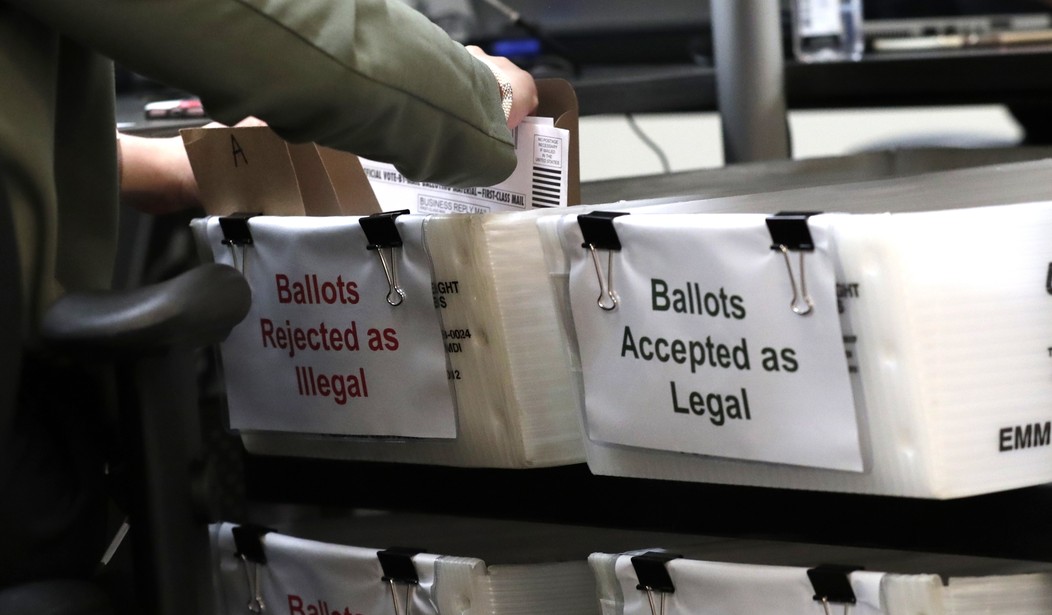
America got a pair of major election-integrity wins that could provide a model for the country moving forward. Until Congress passes something like the SAVE America Act, there are still major problems with the election system, but these rulings move things in the right direction.
The first came from the 5th Circuit Court of Appeals, which restored nine provisions of Texas's 2021 election law, including mail-ballot identification and voter-assistance rules. The court largely found that organizations challenging the provisions under federal disability laws lacked standing.
Judge Andrew Oldham, writing for a unanimous panel, concluded that the challengers lacked standing to attack Texas's mail-ballot ID requirements because they failed to demonstrate that their members faced a substantial risk of future harm. As SCOTUS Wire noted, the court also noted that ID-related ballot rejection rates had fallen substantially, from roughly 11 to 12 percent to 2.7 percent.
🚨 The Fifth Circuit restored nine provisions of Texas's 2021 election law, including mail-ballot ID and voter-assistance rules, largely finding that groups challenging them under federal disability laws lacked standing. pic.twitter.com/no2K6oLueQ
— SCOTUS Wire (@scotus_wire) August 12, 2026
One challenge did reach the merits, but that failed as well. The court held that local prosecutors enforce election crimes but do not themselves provide voting services, meaning they could not be held liable for disability discrimination under the Americans with Disabilities Act or Rehabilitation Act on that theory.
The broader significance is that federal disability law cannot simply be invoked as a catch-all mechanism for blocking election-integrity requirements like those adopted in Texas. Merely claiming that an identity safeguard is discriminatory does not automatically make it so.
That's a significant step in the right direction. The left has repeatedly attacked election safeguards by arguing that seemingly ordinary requirements impose discriminatory burdens. But the argument becomes particularly difficult to sustain when states provide remedies such as free identification.
READ MORE: DSA Takeover? 202 House Democrats Refuse to Sign Anti-Socialist Pledge
Americans routinely need identification or identifying information for ordinary activities, whether obtaining certain government benefits, traveling by air, or opening financial accounts. Yet voter ID continues to be portrayed as some extraordinary burden when it comes to exercising one of the most consequential rights of citizenship.
That brings us to the second major development, this time out of Minnesota, where the state Supreme Court upheld the state's ability to verify witness signatures connected to absentee ballots delivered by third parties.
BREAKING: In a loss for voters, the Minnesota Supreme Court upheld a state law requiring absentee ballots to include a witness signature.
— Democracy Docket (@DemocracyDocket) August 12, 2026
As a result, absentee voters must continue to:
✔️mark the ballot in the presence of a witness
✔️sign a certificate stating all voter… pic.twitter.com/liFYAk2VvV
In other words, if third parties are going to collect and deliver absentee ballots — what critics generally call ballot harvesting — election officials can still verify that the required witness information is legitimate.
That should be an obvious safeguard. If third-party ballot collection is going to exist, there needs to be some mechanism for checking whether the people involved actually complied with the law. Minnesota officials had rejected roughly 6,000 ballots at issue in the litigation, prompting objections from voting-rights groups.
But verifying signatures isn't some radical attack on democracy. It is a basic means of determining whether ballots meet the legal requirements established by the state.
This gets to the larger problem with the election debate. Election-integrity advocates aren't demanding some futuristic voting system filled with more electronics, more software, and more machinery. Quite the opposite.
The ideal system is remarkably simple: paper ballots, voter identification, voting on Election Day wherever practicable, and a transparent count that produces an accurate result and leaves behind a physical record that the public can audit.
The two favorable rulings also arrive against the backdrop of another election case moving in the opposite direction.
U.S. District Judge Indira Talwani in Boston has blocked important portions of the Trump administration's election executive order, including provisions involving the federal government's proposed role in mail voting and the Postal Service. That litigation could ultimately continue through the appellate courts.
The concern is particularly relevant heading toward the midterms because prolonged ballot counting has become an increasingly contentious feature of American elections. California provides an obvious example: Races can remain unresolved for days while mail ballots continue to be processed and added to the totals.
That became particularly noticeable in the recent Los Angeles mayoral contest, where DSA-aligned candidate Nithya Raman moved into second place as counting continued after Election Day. The election also produced videos and allegations involving outreach to homeless voters and questions about how aggressively political organizers were attempting to influence those voters.
This is where the election-integrity debate connects to the broader political fight. The American left has increasingly embraced policies ranging from opposition to ICE and expansive immigration policies to efforts to defund or radically restructure police departments. The Democratic Socialists of America go considerably further, advocating fundamental changes to American institutions.
Look at the DSA platform itself, and the pattern becomes difficult to ignore. Abolishing major law-enforcement institutions, radically restructuring the Senate and dismantling immigration enforcement aren't isolated proposals. They fit within a much broader ideological project aimed at remaking the existing American political system.
The same struggle is playing out over elections. If Americans are going to have bitter disagreements over immigration, policing, government spending, socialism and the future of the constitutional system, then the mechanism for settling those disagreements has to be beyond reasonable doubt.
That means elections should be free, fair, transparent, and easily auditable. Voters should know that the person casting a ballot is legally entitled to cast it, that absentee ballots satisfy the requirements established by law, and that the final count can be independently checked against a physical record.
Texas and Minnesota just received important judicial support for some of those basic safeguards. That's progress.
Editor's Note: The Democrat Party has never been less popular as voters reject its globalist agenda.
Help us continue exposing Democrats' plans to lead America down a dangerous path. Join RedState VIP and use promo code FIGHT to receive 60% off your membership.
Join the Conversation
VIP members get the ability to comment on articles.